

Exploring how socioeconomic factors and inherited predispositions shape mental well-being from childhood through adulthood.
In adolescence, it’s mostly environmental. By the time kids leave the home, it’s overwhelmingly genetic. Later on, same, but the correlation drops: parents matter less with time! The odd thing: the lowest quartile of income earners have the highest risk, but there is fadeout! The oddity is that the apparent protective effect of maternal income dissipates by age 40 for the top-three income quartiles and it’s modest for Dad’s. Check out this study if you want to see more: https://medrxiv.org/content/10.1101/2024.10.21.24315865v2.full.pdf
78+ Sources
- Key Insights into Mental Health Development
- The Protective Shield of Parental Wealth: Why Affluence Matters in Childhood
- The Dynamic Dance: Environmental and Genetic Influences Across the Lifespan
- The Critical Role of Parental Mental Health and Parenting Style
- Bridging the Gap: The Gene-Environment Interaction
- The Enduring Significance and Policy Implications
- The Nuance of Affluence: Beyond Simple “Rich vs. Poor”
- Frequently Asked Questions
- Conclusion
- Recommended Queries for Deeper Insight
- Referenced Search Results
Key Insights into Mental Health Development
- Early Advantage: Higher parental wealth significantly reduces a child’s risk of psychiatric disorders primarily by providing access to superior resources and mitigating environmental stressors during formative years.
- Evolving Influences: While environmental factors exert a dominant influence on mental health during childhood and adolescence, genetic predispositions become increasingly prominent as individuals transition into independent adulthood.
- Persistent Impact, Fading Correlation: The foundational experiences shaped by parental influence in childhood have lasting effects, but the direct parent-child mental health correlation tends to weaken over time as new independent environmental factors and personal choices gain significance.
The assertion that “the richer the parents, the lower kids’ risk of developing a psychiatric disorder” is largely supported by extensive research. This correlation stems from a multifaceted interplay of environmental advantages and reduced stressors that wealth provides during a child’s developmental stages. However, the influence of these factors, along with the role of genetics, shifts and evolves as an individual matures and gains independence.
The Protective Shield of Parental Wealth: Why Affluence Matters in Childhood
The primary reason children from wealthier families tend to have a lower risk of developing psychiatric disorders lies in the extensive protective factors and enhanced resources that higher socioeconomic status affords. These advantages create an environment conducive to healthy mental development and act as a significant buffer against adversity.
Access to Superior Resources and Stable Environments
Financial security translates directly into a child’s environment. Wealthier parents can provide:
- Stable and Safe Living Conditions: Freedom from financial insecurity, housing instability, and food insecurity significantly reduces chronic stress, which is a known contributor to mental health issues. A stable home environment fosters a sense of security and predictability, crucial for healthy development.
- Quality Education and Extracurricular Opportunities: Access to better schools, enriching educational programs, and diverse extracurricular activities (sports, arts, music) can enhance cognitive and emotional development, provide positive social outlets, and build resilience.
- Nutritious Food and Healthcare: Adequate nutrition is fundamental for brain development and overall well-being. Furthermore, wealthier families have better access to quality physical and mental healthcare services, enabling early diagnosis, intervention, and ongoing support for any emerging mental health concerns. This early access to professional help can be life-changing for children with mental health conditions.

The intricate dance between nature and nurture in shaping mental health outcomes.
Reduced Parental Stress and Enhanced Parenting Styles
Financial stability significantly reduces stress on parents, which directly benefits their children’s mental health. When parents are less burdened by financial worries:
- More Positive Parenting: They are better able to engage in nurturing, warm, consistent, and responsive parenting practices. This creates a secure attachment and a supportive home atmosphere, which are vital for a child’s emotional regulation and resilience. Conversely, poverty-induced stress can diminish a parent’s capacity for positive parenting, potentially leading to inconsistent or less supportive interactions.
- Lower Risk of Adversity: Children from wealthier backgrounds are less likely to experience trauma, neglect, or exposure to chronic conflict within the home, all of which are strong predictors of psychiatric disorders. Parental conflict, for instance, can significantly impact a child’s mental health.
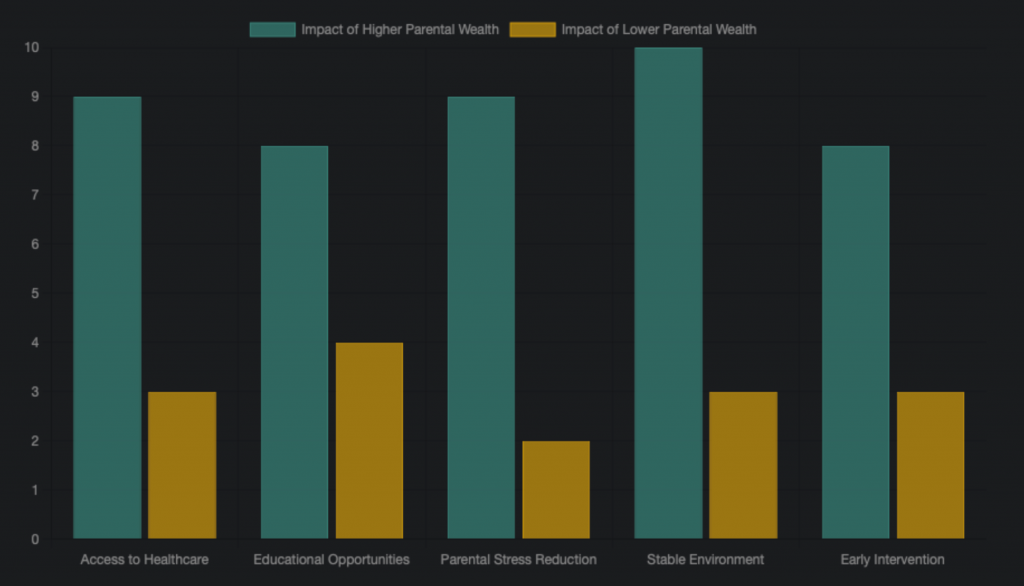
This bar chart illustrates the differential impact of parental wealth levels on key factors influencing a child’s mental health. Higher parental wealth is associated with significantly greater access to protective resources and reduced stressors, leading to improved mental well-being outcomes.
The Dynamic Dance: Environmental and Genetic Influences Across the Lifespan
The roles of environment and genetics are not static but evolve throughout an individual’s life. Understanding this dynamic interplay is crucial for comprehending the long-term mental health trajectory.
Childhood and Adolescence: The Environmental Crucible
During childhood and adolescence, environmental factors largely dominate the mental health landscape. This period is characterized by significant neurodevelopment and increased sensitivity to external stimuli. The home environment, parental behaviors, and socioeconomic conditions exert a profound influence:
- Dominance of Environmental Factors: Studies consistently show that modifiable social conditions—such as chronic stress, parenting styles, neighborhood safety, school quality, and material security—explain a substantial portion of the variance in children’s psychiatric symptoms, often more than genetic factors alone.
- Gene-Environment Interaction: While genetics lay a predisposition, environmental factors can either exacerbate or mitigate these risks. For instance, a child with a genetic vulnerability to anxiety might only develop the disorder if exposed to a highly stressful or unstable environment. Conversely, a supportive environment can buffer against genetic risks.
- Impact of Adverse Experiences: Exposure to parental conflicts, hostile parenting, or other traumatic experiences during formative years has a proven negative impact on mental health. Consistent, warm, and involved parenting, in contrast, acts as a protective factor, reducing the risk of conditions like depression in early adulthood.
Transitioning to Independence: The Growing Prominence of Genetics
As individuals mature and leave the parental home, the direct influence of the immediate family environment naturally wanes. This transition brings new dynamics:
- Diminished Shared Environment: Once young adults establish independent lives, the direct effects of parental income, household routines, and family-specific stressors lessen. Consequently, stable inherited liabilities (genetic predispositions) begin to account for a larger share of the individual differences observed in mental health outcomes. This doesn’t mean environment stops mattering, but rather that the parental environment becomes less central.
- Personal Agency and New Environments: Individuals begin to make their own choices regarding education, career, relationships, and lifestyle. These new independent environmental exposures (e.g., peer groups, work stress, financial decisions) introduce new risks or protective factors. The “gene-environment correlation” can shift, where individuals with certain genetic risks might gravitate towards or create more stressful environments for themselves, making genetic effects appear more pronounced.
- Delayed Onset: Some psychiatric disorders, such as schizophrenia and bipolar disorder, often manifest in late adolescence or early adulthood. In these cases, genetic factors, while present from birth, become more overtly expressed as individuals age and encounter specific life triggers.

A family tree visually representing the inheritance patterns of mental health traits across generations.
Later Adulthood: Attenuating Parental Correlation
In later adulthood, while the foundational impact of early experiences and genetic predispositions remains, the direct statistical correlation between parental wealth/influence and offspring mental health tends to drop further. This is due to several accumulating factors:
- Accumulation of Life Experiences: Over a lifetime, individuals accumulate a unique set of experiences, traumas, successes, and failures. These independent life events, along with personal financial status (e.g., debt), relationship quality, and career trajectory, increasingly become primary drivers of mental health outcomes.
- Broader Determinants: While parental socioeconomic status sets a initial trajectory, an individual’s own wealth accumulation, social support networks, and health behaviors become more significant determinants of well-being in adulthood.
- Persistent but Attenuated Footprints: Although the direct parent-child mental health correlation weakens, early adversity and parental mental illness can still leave measurable, albeit diminishing, long-term footprints on an individual’s mental health trajectory.
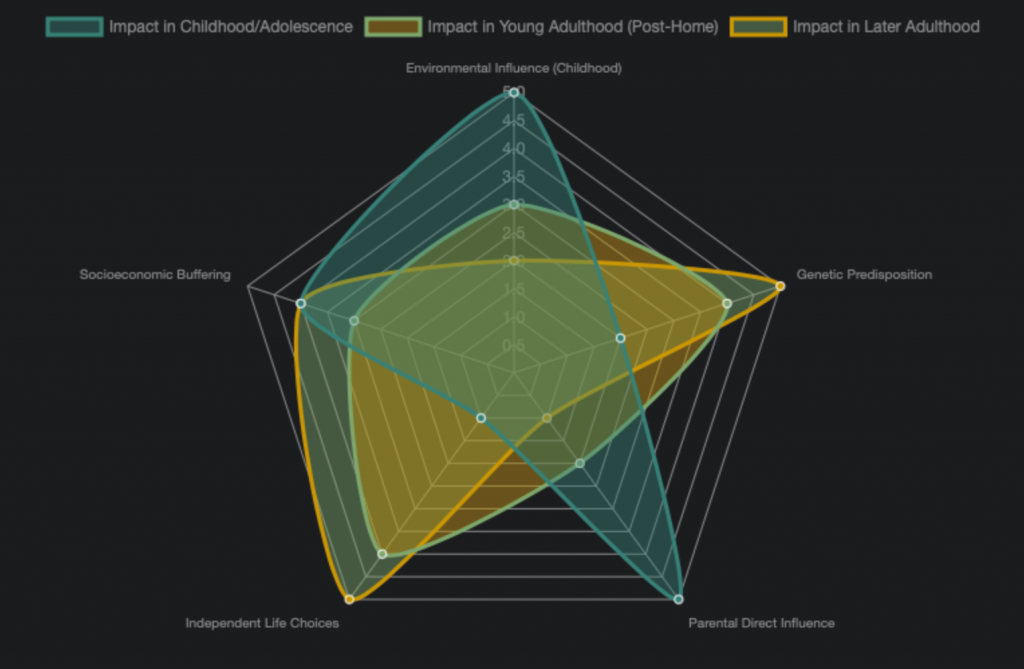
This radar chart illustrates the shifting prominence of environmental and genetic influences on mental health across different life stages. Environmental factors and direct parental influence are strongest in early life, while genetic predispositions and independent life choices become more significant in adulthood. Socioeconomic buffering consistently plays a role across all stages.
The Critical Role of Parental Mental Health and Parenting Style
Beyond direct financial resources, parental mental health and the family climate play a pivotal role in a child’s mental well-being, irrespective of income level. These factors often mediate the effects of wealth on child outcomes.
Parental Mental Health as a Transgenerational Factor
Parental mental health is a significant predictor of a child’s mental health. When parents experience mental health conditions, it can affect their capacity for consistent caregiving and create a challenging family environment. This can impact a child’s cognitive development, social skills, and behavior. Wealth, however, can mitigate some of these risks by enabling access to therapy and support for parents, helping them manage their conditions more effectively.
The Impact of Parenting Styles
Parenting styles have a profound and lasting impact:
- Protective Factors: Consistent, warm, and nurturing parenting provides predictability and emotional security, buffering children against potential mental health challenges. Higher parental involvement during childhood is linked to a lower risk of depression in early adulthood.
- Risk Factors: Conversely, hostile, overcontrolling parenting, or high levels of family conflict can significantly increase a child’s risk of developing mental health symptoms.
Bridging the Gap: The Gene-Environment Interaction
It is crucial to understand that genetics and environment are not isolated forces but constantly interact. This concept is central to comprehending mental health development.
- Epigenetics: Environmental factors can influence gene expression without altering the underlying DNA sequence. This means that even with a genetic predisposition, a supportive environment can “turn off” or reduce the expression of genes linked to psychiatric disorders.
- Sensitivity to Environment: Genetic predispositions can make an individual more sensitive to certain environmental factors. For example, some genetic variations might make a child more susceptible to stress in a chaotic environment, while another child with different genetics might be more resilient to the same conditions.
mindmap
root[“Mental Health Trajectories”]
Childhood[“Childhood & Adolescence”]
Environmental_Dominance[“Environmental Dominance”]
Resource_Access[“Access to Resources & Healthcare”]
Parental_Stress_Reduction[“Reduced Parental Stress”]
Stable_Home_Environment[“Stable Home Environment”]
Quality_Education[“Quality Education”]
Parenting_Styles[“Parenting Styles”]
Nurturing_Care[“Nurturing & Consistent Care”]
Reduced_Conflict[“Reduced Family Conflict”]
Adulthood[“Young & Later Adulthood”]
Genetic_Prominence[“Genetic Prominence”]
Inherited_Vulnerability[“Inherited Vulnerabilities”]
Gene_Environment_Correlation[“Gene-Environment Correlation”]
New_Environments[“New Independent Environments”]
Personal_Choices[“Personal Choices & Agency”]
Work_Life[“Work & Relationships”]
Financial_Stability[“Own Financial Stability”]
Interplay[“Complex Interplay”]
Gene_Environment_Interaction[“Gene-Environment Interaction”]
Epigenetics[“Epigenetic Modifications”]
Societal_Factors[“Societal & Policy Influences”]
Income_Supports[“Income Supports (e.g., Tax Credits)”]
Mental_Healthcare_Access[“Affordable Mental Healthcare Access”]
Community_Resources[“Community Resources”]
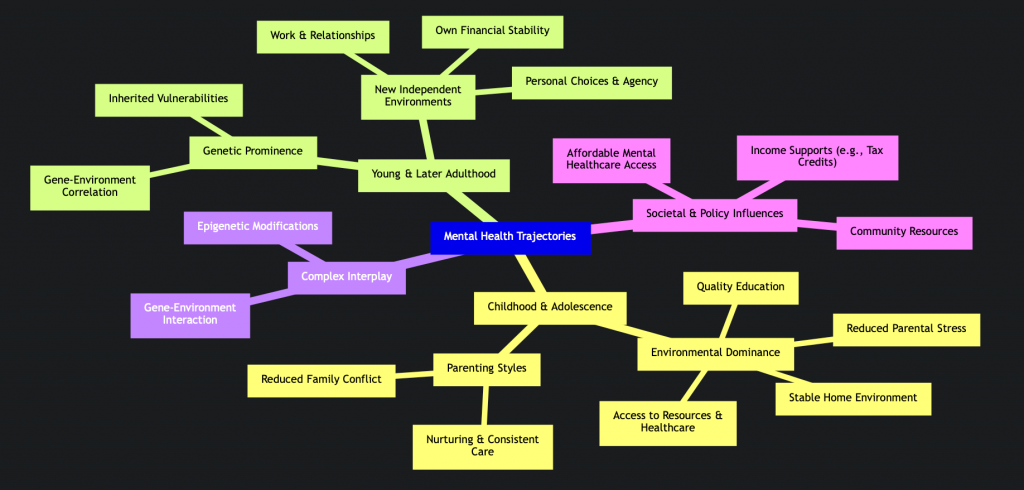
This mindmap illustrates the multifaceted factors influencing mental health trajectories across an individual’s lifespan, highlighting the shifting balance between environmental and genetic influences from childhood through adulthood, and the critical role of their complex interplay.
The Enduring Significance and Policy Implications
While the direct correlation between parental wealth and a child’s mental health may attenuate over time, the foundational advantages conferred in early life remain significant. These early experiences contribute to building resilience and shaping an individual’s capacity to navigate later life challenges.
The insights derived from this complex relationship have important policy implications. Investing in early childhood development, ensuring access to quality resources, and supporting parental mental health can have long-lasting positive effects on societal well-being. Policies such as income supports, affordable healthcare access, and quality educational opportunities are critical in mitigating mental health risks, particularly for children from lower-income backgrounds.
This video, “Money and Mental Illness: The Effect of Finances on Family Mental Health,” delves into the crucial relationship between financial stability and the mental well-being of families. It highlights how financial stress can cascade through a household, impacting parents and children alike, and underscores the importance of addressing monetary concerns as part of a holistic approach to mental health. Understanding this connection is vital for developing strategies that can intervene before financial pressures lead to mental health crises within families.
The Nuance of Affluence: Beyond Simple “Rich vs. Poor”
It’s important to recognize that the relationship isn’t always a simple binary of “rich versus poor.” While higher wealth generally buffers against mental distress, extreme affluence can present its own unique challenges, such as immense pressure, heightened expectations, and in some contexts, increased risk for certain behaviors like substance use. The full spectrum of socioeconomic status, encompassing wealth, income, education, and occupational status, provides a more complete picture of advantage and its complex relationship with mental health.
| Factor | Influence in Childhood/Adolescence | Influence in Young Adulthood | Influence in Later Adulthood |
|---|---|---|---|
| Environmental Buffers (Parental Wealth) | Dominant and highly protective. Provides direct access to resources, stable living, and reduced stressors. | Foundational but direct influence diminishes. Benefits accrue from early life advantages. | Indirect effects from cumulative early life benefits. Personal financial status gains importance. |
| Parental Stress & Parenting Style | Highly impactful. Reduced parental stress and nurturing parenting are key protective factors. | Indirect influence through established attachment styles and coping mechanisms. | Long-term emotional and behavioral patterns influenced by early parenting experiences. |
| Genetic Predispositions | Present but often mitigated or exacerbated by environmental factors. Gene-environment interactions are strong. | Increasingly prominent as independent environments allow genetic risks to manifest more overtly. | Overwhelmingly influential. Cumulative life events interact with stable genetic vulnerabilities. |
| Independent Environmental Factors | Limited (primarily school, peers). | Rapidly increasing importance (education, work, personal relationships, financial autonomy). | Primary drivers of mental health outcomes. Life events, personal wealth, and choices are key. |
| Parent-Child Mental Health Correlation | Strong correlation due to shared environment and direct parental influence. | Correlation begins to attenuate as independent factors become significant. | Further diminished as unique life experiences accumulate, though early adversity leaves subtle footprints. |
This table summarizes the evolving influence of key factors on mental health across different life stages, highlighting the shift from environmental dominance in early life to increasing genetic prominence and independent environmental factors in adulthood.
Frequently Asked Questions
Why is there a stronger link between parental wealth and mental health in childhood compared to adulthood?
In childhood, children are highly dependent on their parents for resources, a stable environment, and emotional support. Higher parental wealth directly provides these protective factors, shielding children from many stressors that can impact mental health. As individuals grow into adulthood, they gain independence, navigate their own environments, and make personal choices, causing the direct influence of parental wealth to lessen, although the foundational benefits of a privileged upbringing can endure.
Does this mean genetics don’t matter much in a child’s mental health?
No, genetics always play a role, providing a predisposition or vulnerability to certain conditions. However, in childhood and adolescence, environmental factors often act as strong mediators, either triggering genetic predispositions or buffering against them. The interaction between genes and environment is particularly significant during these formative years.
Can a child from a lower-income family still have good mental health?
Absolutely. While lower income can present more challenges, it does not predetermine poor mental health. Protective factors such as strong family bonds, supportive community networks, positive coping mechanisms, and access to some resources (even if limited) can significantly foster resilience and promote good mental well-being in children from all socioeconomic backgrounds.
If the correlation with parents’ influence drops over time, why is it still important to address childhood experiences?
Early childhood experiences, particularly those shaped by parental influence and environment, lay the groundwork for long-term development. While direct parental influence may diminish, the patterns of emotional regulation, resilience, and coping strategies learned in childhood have lasting impacts on an individual’s ability to navigate challenges in adulthood. Early interventions and supportive environments can build a strong foundation for lifelong mental health.
Conclusion
The relationship between parental wealth and a child’s risk of psychiatric disorders is a dynamic and intricate one. During childhood and adolescence, parental affluence acts as a powerful protective factor, primarily by providing access to critical resources, fostering stable environments, and reducing parental stress. This creates a nurturing foundation for mental well-being, where environmental influences hold significant sway. As individuals mature and transition into independent adulthood, the direct correlation with parental wealth may attenuate, and genetic predispositions become more prominent. However, the foundational advantages conferred in early life, coupled with the complex interplay of new environmental exposures and personal choices, continue to shape an individual’s mental health trajectory. Understanding this evolving dance between genetics and environment is crucial for developing comprehensive support systems that promote mental well-being across the lifespan.
Recommended Queries for Deeper Insight
- How do adverse childhood experiences impact adult mental health?
- What are the long-term effects of gene-environment interactions on psychiatric disorders?
- How do socioeconomic interventions improve child mental health outcomes?
- What role do parenting styles play in fostering resilience against mental illness?
Referenced Search Results
imprintnews.org
The Influence of Parental Mental Health on Children | The Imprint – The Imprint
abcnews.go.com
Parenting style can significantly influence a child’s mental health … – ABC News
fhi.no
Much greater risk of mental disorders in children of low-income parents – NIPH
sciencedirect.com
newportacademy.com
Genetic Factors in Teen Mental Health – Newport Academy
radio.kttz.org
pmc.ncbi.nlm.nih.gov
Family Income and Child Depression: The Chain Mediating …
jamanetwork.com
Relationship Between Household Income and Mental Disorders: Findings …
tandfonline.com
Parental Mental Illness as a Risk Factor for Adolescent …
drexel.edu
jahonline.org
The Indivisibility of Parental and Child Mental Health and …
sciencedirect.com
Childhood family wealth and mental health in a national …
pmc.ncbi.nlm.nih.gov
The Children of Mentally Ill Parents – PMC
bbk.ac.uk
Teenage mental health not just about genes
link.springer.com
Influence of at-risk family interactions on the course of psychiatric …
sciencedaily.com
moneyandmentalhealth.org
Money and mental health facts and statistics
ncbi.nlm.nih.gov
jamanetwork.com
Expansion of Child Tax Credits and Mental Health …
pmc.ncbi.nlm.nih.gov
bmjgroup.com
Least wealthy people more likely to have mental health disorder …
caldaclinic.com
The Psychology of Wealth and How It Affects Mental Health | The …
britannica.com
Universal Basic Income (UBI) | Pros, Cons, Debate, Arguments, & Income Equality | Britannica
pmc.ncbi.nlm.nih.gov
Childhood family wealth and mental health in a national cohort …
samhsa.gov
Mental Health Coping Resources for Parents | SAMHSA
mhanational.org
Parenting with a Mental Health Condition | Mental Health America
dcf.ks.gov
Child Care Assistance – Economic & Employment Services
ncbi.nlm.nih.gov
link.springer.com
Household income and children’s mental health outcomes
pmc.ncbi.nlm.nih.gov
bmcmedicine.biomedcentral.com
pmc.ncbi.nlm.nih.gov
Household Wealth and Individuals’ Mental Health: Evidence from …
19thnews.org
What we learned from the biggest study on guaranteed income programs
sciencedirect.com
The relationship between parental involvement in childhood and …
archpublichealth.biomedcentral.com
massgeneral.org
Research Spotlight: Environmental Influences Account for …
jhr.uwpress.org
Child Mental Health, Family Circumstance, and Long-Term …
pmc.ncbi.nlm.nih.gov
Environmental Connections: A Deeper Look into Mental …
hhs.gov
Parental Mental Health & Well-Being
pmc.ncbi.nlm.nih.gov
Gene–environment pathways to cognitive intelligence and psychotic-like experiences in children
discovery.ucl.ac.uk
Integrative analysis of genomic and exposomic influences on youth mental health
business.columbia.edu
Mental Health and the Economy — It’s Costing Us Billions
healio.com
Low parental income associated with later risk for mental health conditions
nature.com
integrishealth.org
How Parents Affect Their Child’s Mental Health | INTEGRIS Health
uab.edu
Study links debt with risk of psychiatric disorders, high …
publichealthpost.org
Kidfluencing: Profits Over Protection – Public Health Post
health.choc.org
Is mental health genetic? – CHOC – Children’s health hub
sciencedirect.com
Examining the relationship between genetic risk for …
nature.com
Parental characteristics and offspring mental health and related …
frontiersin.org
Unraveling the Genetic and Environmental Relationship …
elifesciences.org
Gene-Environment Pathways to Cognitive Intelligence and Psychotic-Like Experiences in Children
cdc.gov
Data and Statistics on Children’s Mental Health | Children’s Mental Health | CDC
nature.com
Gene-environment correlations and genetic confounding …
pmc.ncbi.nlm.nih.gov
Genetic Influences on the Developing Young Brain and Risk for Neuropsychiatric Disorders
nature.com
Environmental and neurodevelopmental contributors to …
caldwellmemorial.org
If Health is Wealth, Why Do So Many Ignore Mental Health?
pmc.ncbi.nlm.nih.gov
Is wealth associated with depressive symptoms in the United States?
sciencedirect.com
Psychological and physical wellbeing in adults who grew …
parentingmentalhealth.org
PMH | Support for parents facing childhood mental health issues
cdc.gov
About Children’s Mental Health | Children’s Mental Health | CDC
pmc.ncbi.nlm.nih.gov
The social determinants of mental health and disorder
crowncounseling.com
12 Single Parent Mental Health Statistics: Understanding the Challenges and Solutions
nature.com
jhr.uwpress.org
The Economics of Child Mental Health | Journal of Human Resources
mind.org.uk
The link between money and mental health
cdc.gov
Health Care, Family, and Community Factors Associated …
statnews.com
Precocious puberty in girls comes with mental health risks
pmc.ncbi.nlm.nih.gov
Parental income and mental disorders in children …
hechingerreport.org
How to help young kids: Give their parents cash
ascend.aspeninstitute.org
2Gen Approach – Ascend at the Aspen Institute
mdpi.com
Genome–Environment Interactions and Psychiatric Disorders
news.berkeley.edu
Wealth, power or lack thereof at heart of many mental disorders …
academic.oup.com
What can we conclude about the effect of parental income on …
ncbi.nlm.nih.gov
Parents’ Incomes and Children’s Outcomes: A Quasi-Experiment – PMC
pmc.ncbi.nlm.nih.gov
Gene-environment interactions in mental disorders – PMC
tikvahlake.com
Why being wealthy can make mental health problems worse – Tikvah …
online.regiscollege.edu
What Impact Does Parental Mental Health Have on Children?
Last updated September 5, 2025