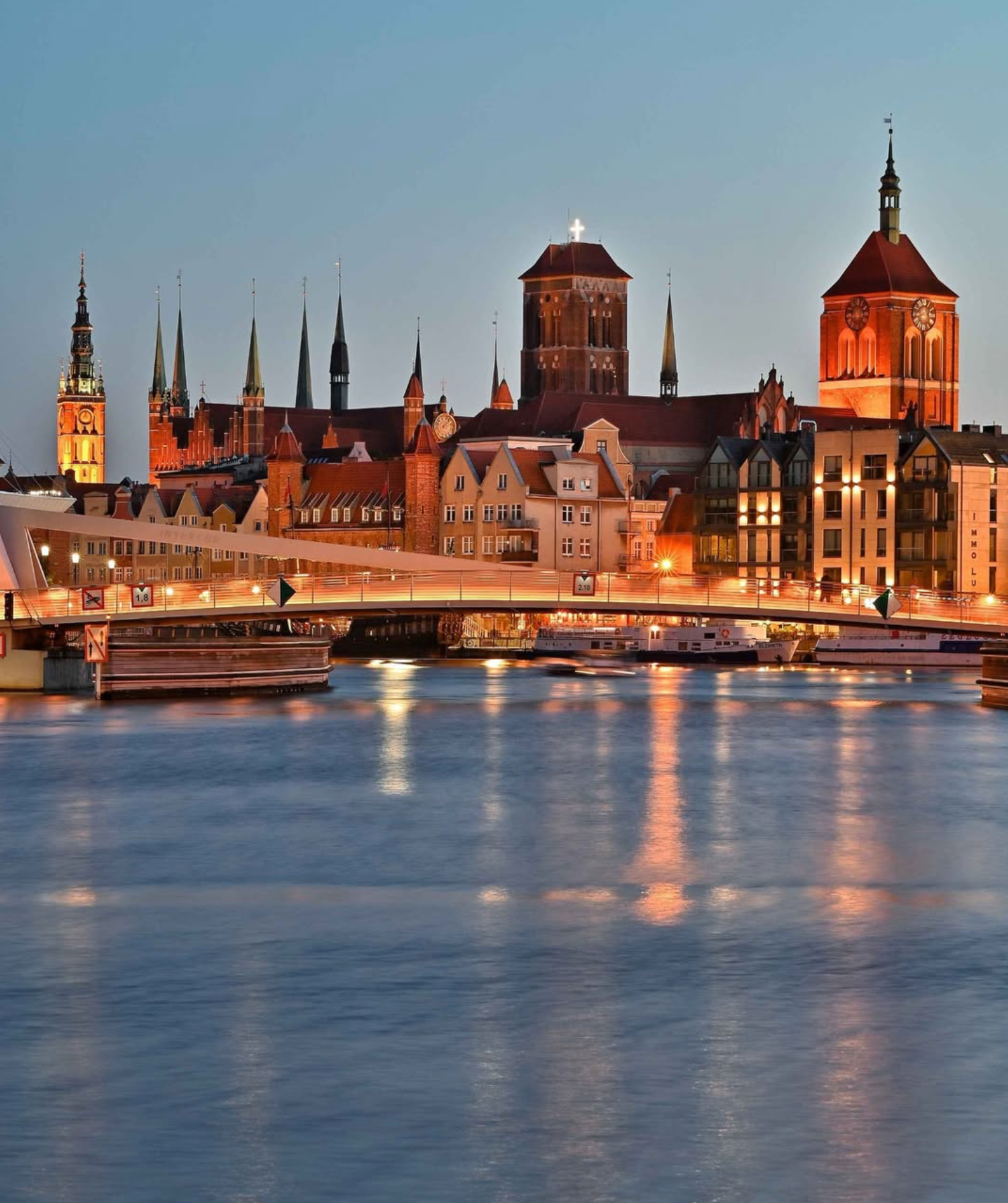

The economic trajectories of Poland and the UK, challenging simplistic narratives and revealing complex realities.
66+ Sources
- 1.Key Economic Insights: Poland’s Rise and UK’s Challenges
- 2.Poland’s Economic Momentum: A Closer Look
- 3.The UK’s Economic Headwinds and Stagnation
- 4.GDP Per Capita: The Convergence Story
- 5.Beyond Simplistic Ideologies: Mixed Economies in Action
- 6.Comparative Economic Performance in Detail
- 7.Visualizing Economic Trends
- 8.Video Insight: How Poland Became Europe’s Rising Power
- 9.Frequently Asked Questions
- 10.Conclusion
- 11.Recommended Further Exploration
- 12.Referenced Search Results
Recent economic projections highlight a significant shift in the European economic landscape, with Poland demonstrating remarkable growth that positions it to potentially surpass the United Kingdom in key economic metrics in the coming years. This trend, while generating considerable discussion, is far more nuanced than a simple ideological battle between “socialism” and “free-market capitalism.” Both nations operate under mixed economic systems, and their current situations are shaped by a confluence of historical context, policy decisions, and global economic forces.
Key Economic Insights: Poland’s Rise and UK’s Challenges
- Poland’s Dynamic Growth Trajectory: Poland’s economy is experiencing robust growth, driven by strategic EU integration, significant foreign investment, and strong domestic demand. GDP per capita (PPP) is projected to reach approximately $55,200 by 2030, a substantial leap from its current standing.
- UK’s Economic Stagnation: The United Kingdom’s economy has faced persistent stagnation, marked by minimal GDP growth, particularly in recent years. This slowdown is attributed to post-Brexit adjustments, inflationary pressures, high public debt, and a decline in manufacturing output.
- The Nuance of “Wealthier”: While Poland is rapidly closing the gap, a definitive overtake of the UK in GDP per capita (PPP) by 2030 is an ambitious but plausible scenario, rather than a universally agreed-upon baseline. The exact timing varies across different forecasts, with many predicting the crossover in the mid-2030s.
Poland’s Economic Momentum: A Closer Look
Poland’s economic story since its transition from communism has been one of consistent development and strategic integration. Its accession to the European Union in 2004 provided access to vast markets, structural funds, and a framework for liberal market reforms that have propelled its growth. Today, Poland stands as the sixth-largest economy in the EU, a testament to its successful economic transformation.
Drivers of Polish Prosperity
Strategic EU Integration and Investment
A significant factor in Poland’s economic success is its deep integration into the European Union. This has not only facilitated trade but also attracted substantial foreign direct investment and provided access to EU structural and cohesion funds, which have been instrumental in modernizing infrastructure and various sectors of the economy. These funds, coupled with strong private consumption and investment, are key drivers of Poland’s projected GDP growth of 3.3% in 2025 and 3.0% in 2026.

Warsaw’s skyline, symbolizing Poland’s rapid modernization and economic growth.
Robust Domestic Demand and Skilled Workforce
Poland benefits from a dynamic domestic market, fueled by rising real wages and government spending on family benefits. This, combined with easing inflation, supports strong private consumption. Furthermore, Poland possesses a skilled workforce, which has been a crucial asset in attracting manufacturing and service industries, contributing to its sustained economic development over the past 25 years.
Diversified Economic Structure
The Polish economy boasts a diversified structure, with services contributing 62.3%, industry 34.2%, and agriculture 3.5% to its GDP. This diversification provides resilience against economic shocks and supports broad-based growth. Sectors like investment, production, transport, and logistics have shown strong performance, underpinning the 3.2% year-on-year GDP increase observed in Q1 2025.
The “Catch-Up” Phenomenon
Poland’s growth can be largely understood as a “catching-up” phenomenon. As a formerly planned economy, it had a significant gap to close with Western European nations. Its journey reflects the typical trajectory of emerging economies that, through market reforms, integration, and investment, converge with more developed countries. This rapid pace of development is what makes comparisons with more mature economies like the UK particularly striking.
The UK’s Economic Headwinds and Stagnation
In stark contrast to Poland’s dynamism, the United Kingdom’s economy has been navigating a period of stagnation and structural challenges. While historically a powerhouse of free-market capitalism, recent years have seen a significant slowdown in growth, exacerbated by a combination of internal and external factors.
Post-Brexit Adjustments and Global Uncertainty
The UK’s departure from the European Union has introduced a period of significant economic adjustment. While the full long-term effects are still unfolding, Brexit has undoubtedly created new trade barriers and uncertainty, impacting investment and productivity. Coupled with broader global trade tensions and inflationary pressures, these factors have contributed to the UK’s subdued economic performance.
Weak Manufacturing and Service Sector Performance
Recent data underscores the UK’s economic difficulties. The economy registered zero GDP growth in July 2025, following a modest 0.4% in June. Manufacturing output declined by 1.3% in July, and while the services sector showed a slight increase, overall growth has averaged a mere 1.1% since 2009. This persistent weakness in key sectors indicates a deeper structural issue.
Rising Public Debt and Policy Uncertainty
The UK is also grappling with a rising public debt-to-GDP ratio, which surpassed 100% for the first time since 1961. This, alongside inflationary pressures and uncertainty surrounding government policies and tax increases, creates a challenging environment for businesses and consumers alike. These factors collectively dampen investment and consumer spending, further contributing to stagnation.
GDP Per Capita: The Convergence Story
The core of the discussion revolves around the convergence of GDP per capita (Purchasing Power Parity, PPP) between Poland and the UK. While the UK currently holds a higher GDP per capita, Poland’s rapid growth means this gap is shrinking quickly.
Current Standing and Projections
As of recent estimates, Poland’s GDP per capita (PPP) stands at approximately $49,464, compared to the UK’s $58,906. However, projections indicate a significant shift. The IMF forecasts Poland’s GDP per capita to reach $55,200 by 2030, a considerable increase. Some analyses even suggest Poland could surpass other developed nations like Japan, Spain, and Israel in this metric by that time.
The 2030 vs. Mid-2030s Debate
While some political figures and optimistic forecasts suggest Poland could overtake the UK in GDP per capita (PPP) as early as 2030, independent assessments often project this crossover to occur in the mid-2030s or even later, around 2035-2040. This variation underscores the uncertainty inherent in long-term economic forecasting. Nevertheless, the undeniable trend is one of significant convergence, driven by Poland’s sustained growth premium and the UK’s relatively subdued performance.
Mindmap: Key Factors Influencing Economic Trajectories
This mindmap illustrates the various interconnected factors driving the economic performance of Poland and the UK, highlighting both internal strengths and external pressures that contribute to their respective trajectories.
mindmap
root[“Economic Trajectories: Poland vs. UK”]
Poland[“Poland’s Growth”]
Economic_Transformation[“Economic Transformation”]
EU_Integration[“EU Integration”]
Liberal_Market_Reforms[“Liberal Market Reforms”]
Foreign_Investment[“Foreign Investment”]
Robust_GDP_Growth[“Robust GDP Growth”]
Private_Consumption[“Strong Private Consumption”]
Investment[“Increased Investment (EU-funded)”]
Export_Performance[“Strong Export Performance”]
Demographic_Dividend[“Skilled Workforce”]
Defense_Spending[“Increased Defense Spending”]
“Catch-Up_Dynamics”[“‘Catch-Up’ Dynamics”]
UK[“UK’s Challenges”]
Economic_Stagnation[“Economic Stagnation”]
Post_Brexit_Adjustments[“Post-Brexit Adjustments”]
Inflationary_Pressures[“Inflationary Pressures”]
High_Public_Debt[“High Public Debt”]
Weak_Productivity_Growth[“Weak Productivity Growth”]
Manufacturing_Decline[“Manufacturing Decline”]
Policy_Uncertainty[“Policy Uncertainty”]
Global_Headwinds[“Global Headwinds”]
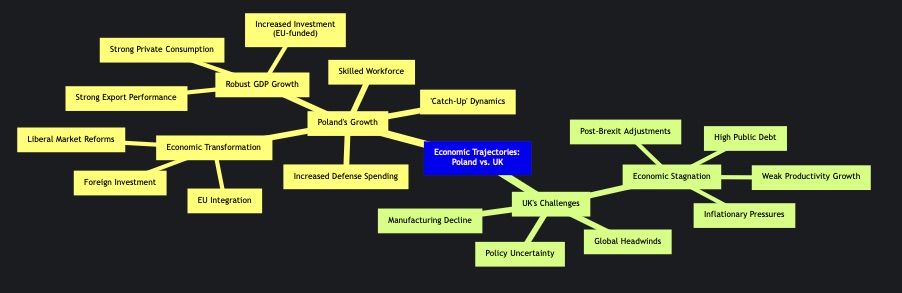
A comprehensive mindmap outlining the key factors influencing the economic paths of Poland and the UK.
Beyond Simplistic Ideologies: Mixed Economies in Action
The framing of this economic dynamic as a simple “socialism vs. free-market capitalism” debate is an oversimplification. Both Poland and the UK operate as mixed economies, blending market principles with social welfare provisions. Poland, while embracing market reforms, maintains a robust public welfare system and has increased public spending, including significant defense outlays. The UK, despite its market-oriented history, also provides extensive social safety nets and public services.
The Reality of Economic Systems
Poland’s success is not a triumph of pure capitalism but rather an outcome of strategic reforms, targeted investments (often with EU support), and a successful integration into the global economy. Its post-1989 shift towards market principles was coupled with the establishment of institutional frameworks necessary for sustained growth. Similarly, the UK’s economic performance is not solely a reflection of free-market principles but also the impact of policy choices, global events, and structural issues inherent in a mature economy.
Comparative Economic Performance in Detail
To further illustrate the divergent paths, let’s look at key economic indicators for both countries.
| Indicator | Poland (Current/Projected) | United Kingdom (Current/Recent) | Commentary |
|---|---|---|---|
| GDP Growth (2025 Projection) | 3.3% | ~1.25% (BoE guidance) | Poland’s growth is significantly higher, indicative of a catch-up economy. |
| GDP Per Capita (PPP) | $49,464 (current), $55,200 (2030 IMF proj.) | $58,906 (current) | The gap is narrowing rapidly. |
| GDP Growth Since 2019 | ~15% (increase) | ~1% (stagnation) | Highlighting Poland’s strong post-2019 recovery and UK’s struggles. |
| Public Debt-to-GDP Ratio | ~55% (current), ~65% (2026 proj.) | >100% (current, first time since 1961) | UK faces a higher debt burden. |
| Main Growth Drivers | Private consumption, investment, EU funds, exports | Services (modest), challenged by manufacturing decline | Poland’s drivers appear more robust and diversified. |
Comparison of key economic indicators between Poland and the United Kingdom.
Visualizing Economic Trends
To provide a clearer picture of the comparative economic strengths and challenges, we can analyze several key dimensions using a radar chart and a bar chart.
Radar Chart: Economic Performance Pillars
This radar chart illustrates the perceived performance of Poland and the UK across critical economic pillars. The scale ranges from 0 to 5, with higher values indicating stronger performance or positive outlook in that area.
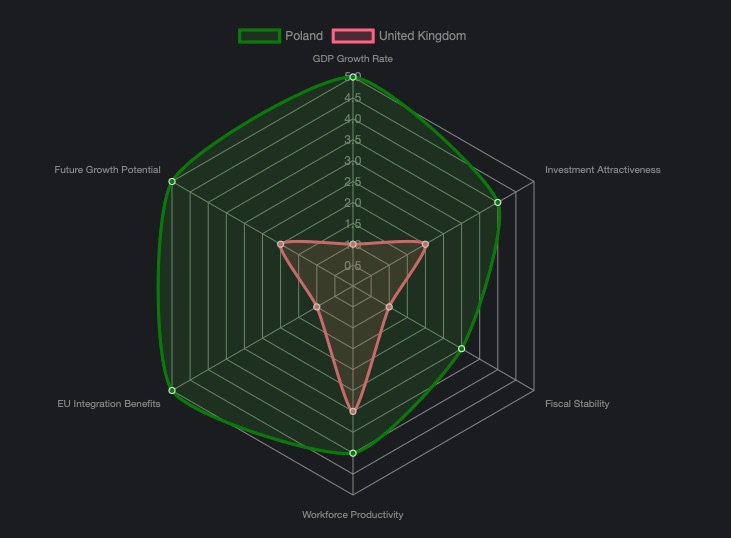
This radar chart compares Poland’s and the UK’s performance across several key economic pillars, highlighting Poland’s relative strengths in growth, investment, and EU integration benefits.
Bar Chart: GDP Per Capita Growth Factors
This bar chart illustrates the relative impact of various factors on GDP per capita growth for both countries, on a scale of 0 to 10. Higher values indicate a stronger positive impact or a significant challenge.
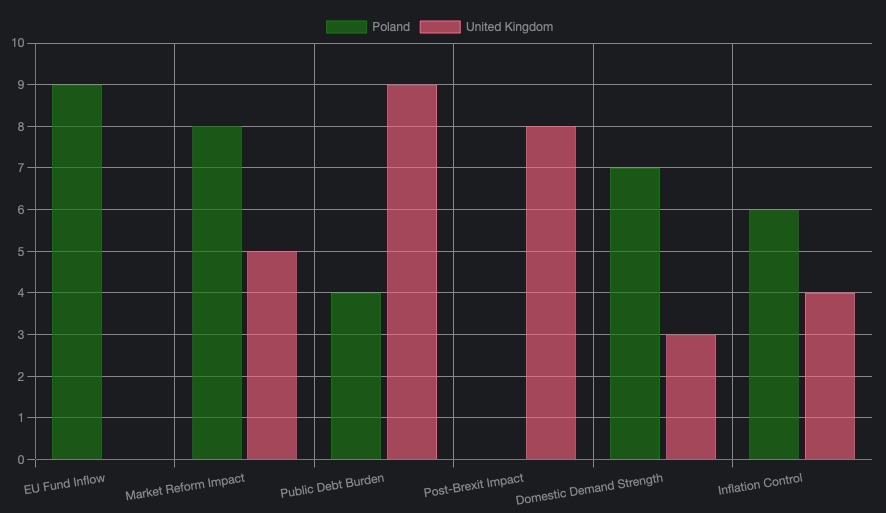
This bar chart compares the relative influence of various factors on GDP per capita growth, highlighting the advantages of EU funds and market reforms for Poland, versus the challenges of public debt and Brexit for the UK.
Video Insight: How Poland Became Europe’s Rising Power
To further understand Poland’s remarkable economic trajectory, this video provides an insightful overview of the factors contributing to its emergence as a significant economic force in Europe.
Exploring the strategic elements behind Poland’s impressive economic ascent and its growing influence within the European landscape.
The video delves into Poland’s strategic economic decisions, its effective utilization of EU membership, and the entrepreneurial spirit that has fueled its growth. It provides context to how a nation, once behind the Iron Curtain, has transformed into a dynamic economy, consistently outperforming many of its Western European counterparts. This narrative is crucial for understanding the depth of Poland’s economic transformation and the sustainability of its growth.
Frequently Asked Questions
Will Poland definitively be wealthier than the UK by 2030?
While Poland is experiencing rapid growth and is closing the gap significantly, the claim of definitively surpassing the UK in GDP per capita (PPP) by 2030 is an ambitious forecast, not a universal consensus. Many analyses suggest a crossover is more likely in the mid-2030s if current trends persist.
What are the primary reasons for Poland’s economic growth?
Poland’s economic growth is primarily driven by its successful integration into the EU, which has brought significant foreign investment and access to structural funds. Additionally, robust domestic demand, market-oriented reforms, a skilled workforce, and increasing private consumption have played crucial roles.
Why is the UK economy stagnating?
The UK economy’s stagnation is attributed to several factors, including ongoing adjustments post-Brexit, high public debt, inflationary pressures, weak manufacturing output, and broader global economic headwinds. Policy uncertainty and tax pressures also contribute to the slowdown.
Is this an example of “socialism vs. free-market capitalism”?
No, this framing is an oversimplification. Both Poland and the UK operate as mixed economies. Poland’s success stems from strategic market reforms and EU integration, combined with social welfare provisions, rather than pure socialism. The UK, while historically market-oriented, also maintains a significant welfare state.
What is GDP per capita (PPP) and why is it important for this comparison?
GDP per capita (Purchasing Power Parity) adjusts for differences in the cost of living between countries, providing a more accurate comparison of living standards and economic output per person. It’s a more relevant metric than nominal GDP per capita for understanding who is “wealthier” in terms of what money can buy.
Conclusion
The narrative surrounding Poland’s economic ascent and the UK’s current stagnation is a compelling illustration of divergent economic trajectories within Europe. Poland’s sustained growth, fueled by strategic EU integration, robust investment, and a dynamic domestic market, positions it as a rising economic power. Conversely, the UK faces significant structural challenges, including post-Brexit adjustments, high public debt, and persistent low growth, which have led to its recent economic difficulties. While the precise timing of Poland surpassing the UK in GDP per capita (PPP) remains subject to various forecasts, the trend of convergence is undeniable. It is crucial to view this complex economic interplay through a nuanced lens, acknowledging the multifaceted factors at play rather than resorting to simplistic ideological comparisons.
Recommended Further Exploration
- [What has been the long-term impact of EU structural funds on Eastern European economies?](/?query=Impact of EU structural funds on Eastern European economies)
- [How have the economic effects of Brexit influenced UK productivity and international trade?](/?query=Economic effects of Brexit on UK productivity and trade)
- [What are the future prospects for economic convergence among EU member states?](/?query=Future of economic convergence within the European Union)
- [How do different mixed economic models compare in their effectiveness for developed nations?](/?query=Comparing mixed economic models in developed nations)
Referenced Search Results
economy-finance.ec.europa.eu
Economic forecast for Poland – European Commission
poland-accounting.eu
Poland to overtake four countries in GDP per capita
theglobalist.com
Comparing Poland to the UK and Japan – The Globalist
academic.oup.com
Postscript: What’s Next for Poland? – Oxford University Press
poland-accounting.eu
Poland’s economic growth gathers momentum – Q1 2025 analysis
paih.gov.pl
Economic stability and a strong economy – Why Poland – PAIH
bloomberg.com
UK economy stagnated in July as Headwinds Grow Before Budget – Bloomberg
devdiscourse.com
Britain’s Economic Stagnation: Factors and Future Prospects – Devdiscourse
markets.financialcontent.com
Pound Plunges: Sterling Faces Toughest Week Since January …
ibisworld.com
Banks in the UK – Market Research Report (2015-2030)
telegraph.co.uk
Britain’s use of economic data is dire – The Telegraph
aleasoft.com
Energy demand forecasting – AleaSoft Energy Forecasting
notesfrompoland.com
bmmagazine.co.uk
UK economy stalls in July as manufacturing slowdown drags on growth
statista.com
Gross domestic product (GDP) 2030 – Poland – Statista
survivingtomorrow.org
Why the United Kingdom Will Be Poorer Than Poland In 5 Years
telegraph.co.uk
Brexit means Poles will be richer than Britons in five years, says Donald Tusk
polskieradio.pl
Poland on track to become wealthier than Britain by 2030: report …
europesolutions.co.uk
Poland Will Outgrow The UK Unless Businesses Can Recruit Easily From Europe – Europe Solutions
imf.org
cebr.com
Claims that Poland will be richer than the UK this decade are overambitious but only just – CEBR
ourworldindata.org
Average years of schooling vs. GDP per capita
en.wikipedia.org
think.ing.com
Poland’s economic growth outshines CEE peers in second quarter
media.pekao.com.pl

Poland’s new chapter of development – Pekao’s report outlines an …
oecd.org
Real GDP long-term forecast | OECD
economicshelp.org
Is the Polish Economy set to Overtake UK Economy? – Economics Help
worldbank.org
Poland Overview: Development news, research, data – World Bank
telegraph.co.uk
Poland will be wealthier than Britain by 2030 – it’s time we took notice
independent.co.uk
theguardian.com
UK business growth hits five-month low amid budget uncertainty and …
news.sky.com
cert-ease.com
worldeconomics.com
Poland’s Wealth Rating | 2025 | Economic Data | World Economics
bransontrilakesnews.com
UK economy stalls in July in fresh government setback
reddit.com
Poland is almost as wealthy as Britain and it’s on track to surpass it …
credenceresearch.com
Recruitment Process Outsourcing Market Size, and Forecast 2030
reddit.com
r/europe on Reddit: Poland will be wealthier than Britain by 2030 …
thenewworld.co.uk
When Poland overtakes the UK – The New World
imf.org
World Economic Outlook (April 2025) – GDP per capita …
thetimes.com
Poland is nearly as rich as the UK. How has it caught up so fast?
euractiv.com
Tusk promises Poles will soon be richer than Brits – Euractiv
euractiv.com
Tusk promises Poles will soon be richer than Brits – Euractiv
reuters.com
UK economy makes weak start to second half of 2025
oecd.org
Poland: OECD Economic Outlook, Volume 2025 Issue 1
inventiva.co.in
theguardian.com
UK economy flatlines in July in grim news for Rachel Reeves
statista.com
Poland – Gross domestic product (GDP) 2030| Statista
dailysabah.com
Britain’s growth stagnates to add to government headaches
marketingresearchbureau.com
Global Immunoglobulin (IG) Usage in 2023 & Forecast to 2030 – Marketing Research Bureau
bbc.com
How fast is the UK’s economy growing and what is GDP? – BBC
worldeconomics.com
GDP | 2025 | 2026-2030 | World Economics
hlb-poland.global
Poland to overtake four countries in GDP per capita
kaloramainformation.com
diis.dk
Power moves east: Poland’s rise as a strategic European player | DIIS
statista.com
Gross domestic product (GDP) per capita Poland| Statista
rttnews.com
mckinsey.com
ft.com
UK economy failed to grow in July – Financial Times
businesstimes.com.sg
ersj.eu
The Determinants of Economic Growth in Poland in 2018- …
standard.co.uk
Britain’s ‘stuck’ economy flatlined in July with zero growth
uk.finance.yahoo.com
Reeves under pressure as UK growth grinds to halt – Yahoo Finance
notesfrompoland.com
metaculus.com
Polish GDP per capita > UK before 2031?
researchandmarkets.com
Human Liver Model Market Size, Share & Forecast to 2030
Last updated October 12, 2025