

Exploring the nuanced impact of AI on employment, from job transformation to the emergence of entirely new professions.
88+ Sources
- 1.The Evolving Definition of “Real Work”: A Historical Lens
- 2.AI’s Dual Impact: Disruption and Augmentation
- 3.The Near-Term Challenges and Critiques
- 4.Anticipated Shifts and New Opportunities
- 5.The Path Forward: Designing for an AI-Augmented Future
- 6.Visualizing the Future of Work: Insights from Experts
- 7.Frequently Asked Questions (FAQ)
- 8.Conclusion
- 9.Recommended Further Reading
- 10.Referenced Search Results
- AI is Redefining “Work”: Sam Altman’s perspective suggests that our understanding of “real work” is fluid, continuously evolving with technological advancements, similar to how agricultural labor gave way to knowledge work.
- Beyond Displacement—Transformation: While AI will undoubtedly automate tasks and eliminate some jobs, the consensus indicates a broader transformation of existing roles and the creation of entirely new ones, rather than a catastrophic job wipeout.
- The Critical Role of Adaptability: Both individuals and organizations must prioritize upskilling, re-skilling, and developing human-centric skills like creativity, judgment, and interpersonal interaction to thrive in an AI-augmented economy.
The Evolving Definition of “Real Work”: A Historical Lens
Sam Altman’s provocative comments at OpenAI’s DevDay conference invite us to reconsider the very definition of “real work” in an age increasingly shaped by artificial intelligence. His core argument, that what constitutes meaningful labor is a societal construct that changes over time, resonates deeply with historical economic shifts. Altman posits that just as a farmer from 50 years ago might struggle to comprehend the value of today’s knowledge-based professions, future generations will likely view our current jobs through an entirely different lens, perhaps seeing them as mere “games to fill your time.” This philosophical framework emphasizes human adaptability and the continuous emergence of new forms of occupation.
This perspective, while thought-provoking, also highlights a fundamental tension: the long-term historical narrative of job evolution versus the immediate, tangible challenges of job displacement. The historical record indeed shows that technological revolutions have consistently led to the creation of new industries and roles, often unforeseen at their inception. However, the transition periods have rarely been seamless, often marked by significant societal upheaval and the need for widespread adaptation.
From Fields to Offices: A Paradigm Shift
Consider the agricultural revolution. Centuries ago, the vast majority of the population was engaged in farming. This was undeniably “real work”—producing sustenance essential for survival. With industrialization and subsequent technological advancements, agricultural labor became increasingly automated, leading to a dramatic reduction in farm employment. New jobs emerged in factories, then in offices, and now in digital realms. Each shift redefined what was considered productive and valuable work.
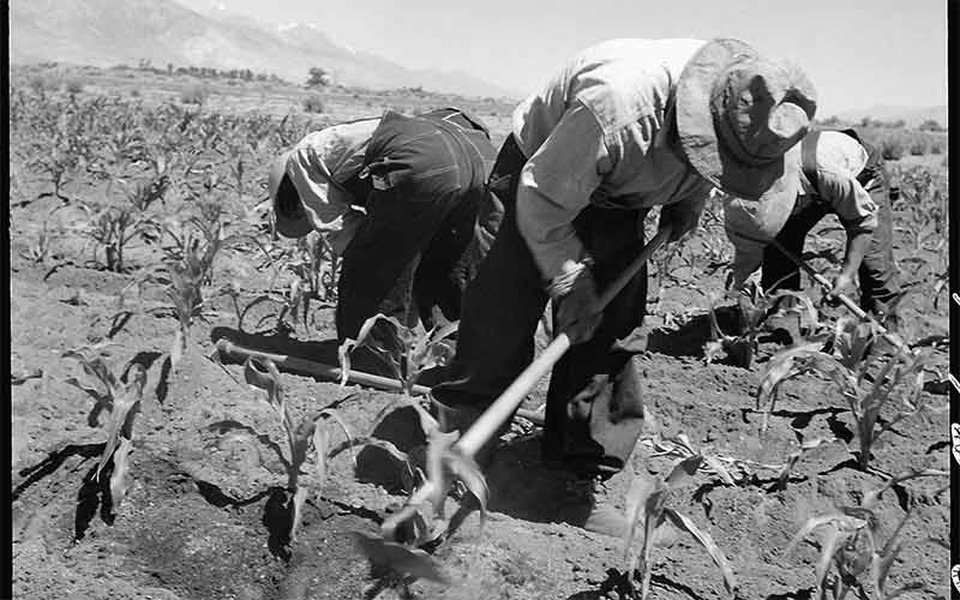
Agricultural laborers from a previous era, symbolizing what was once considered quintessential “real work.”

A modern office environment, illustrating the shift to knowledge-based professions.
Altman’s analogy suggests that the current transition, driven by AI, is simply another chapter in this ongoing story. While he acknowledges the disruption, his underlying optimism stems from a belief in human ingenuity to continually “find plenty of things to do” as technology handles more routine and even complex tasks.
AI’s Dual Impact: Disruption and Augmentation
The impact of AI on the workforce is multifaceted, encompassing both significant disruption and unprecedented opportunities for augmentation and job creation. Rather than a wholesale replacement of jobs, the evidence points to a transformation of tasks within existing roles, requiring a dynamic recalibration of skills and processes.
Task Transformation vs. Job Elimination
Research consistently indicates that AI is more likely to automate tasks within jobs than to eliminate entire occupations. For instance, McKinsey’s analysis suggests that only about 5% of occupations are fully automatable, while activities accounting for up to 30% of hours worked in the US economy could be automated by 2030. This means many workers will experience a shift in their daily responsibilities, requiring them to engage with AI tools and focus on higher-value, human-centric activities.
OECD surveys, covering manufacturing and finance across seven countries, generally report positive experiences from both employers and workers regarding AI implementation. Improved performance and working conditions are cited, although concerns about trust and implementation gaps remain. This indicates that successful AI integration often depends on thoughtful deployment and worker involvement.
Specific Job Impacts: Vulnerabilities and Resilience
While some roles, particularly those heavy in routine, language-based, or information processing tasks, are highly susceptible to automation, others exhibit high “complementarity” with AI. For example:
- Highly Susceptible: Customer support, administrative roles, and certain data entry positions are often cited as areas where AI can efficiently handle routine inquiries and processes.
- Enhanced or Augmented: Software developers and programmers may see their productivity significantly boosted by AI tools, though the long-term evolution of these roles is still unfolding.
- Resilient (Human-Centric): Professions requiring strong human connection, empathy, critical judgment, and complex interpersonal interaction, such as nursing, teaching, and certain medical specialties, are less likely to be displaced. These roles often leverage AI as a powerful augmentation tool rather than a replacement.
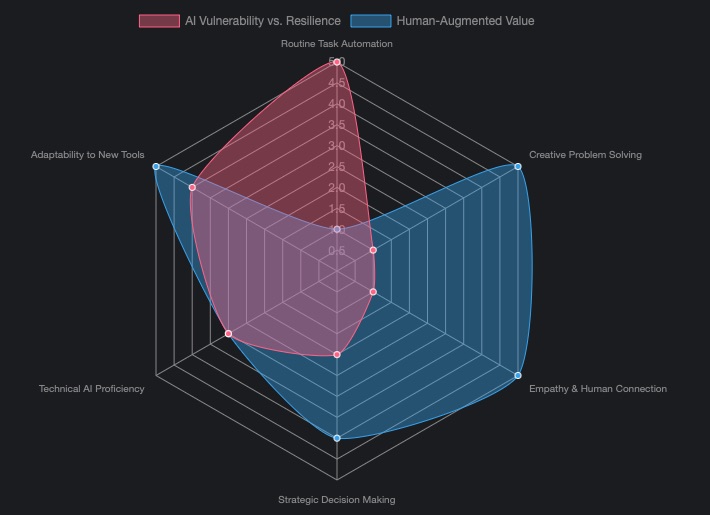
The radar chart above illustrates the relative vulnerability of job components to AI automation versus the value derived from human augmentation. It highlights that while AI excels at routine tasks, human skills in creativity, empathy, and strategic thinking remain paramount and are often enhanced by AI tools.
The Near-Term Challenges and Critiques
While Altman’s long-term vision offers a hopeful perspective on human adaptability, critics rightly point out that his analogy often sidesteps the immediate and pressing economic realities. The “timing and transition costs” associated with AI integration are substantial, leading to potential job displacement, wage pressures, and significant skill mismatches in the short to medium term.
The Urgency of Transition Support
Goldman Sachs estimates that AI could displace 6-7% of the US workforce if widely adopted, potentially affecting 300 million full-time jobs globally. These figures, while not predicting mass unemployment, underscore the need for robust support mechanisms for workers whose roles are significantly altered or eliminated. Concerns about “distributional risk” also arise, as many fear increased inequality and obsolescence.
The gap between worker expectations and technological capabilities is another critical area. While workers generally desire AI assistance, the current implementation often falls short, leading to “implementation risk” where rushed automation can result in poor outcomes or even harm entry-level career pathways. It’s crucial for organizations to view AI as task re-engineering, carefully mapping roles and applying a “Human Agency Scale” to ensure that automation aligns with human needs and preferences.
The Need for Proactive Strategies
Addressing these near-term challenges requires a multi-pronged approach involving individuals, companies, and policymakers:
- For Workers: Focus on developing “complementarity skills” such as exception handling, client interaction, domain judgment, and effective communication with AI systems (e.g., prompt design). Building “mobility options” through cross-training into roles with high augmentation potential (e.g., healthcare support, operations, project management) is also crucial.
- For Companies: Prioritize ethical and strategic AI adoption. This includes protecting entry-level pathways by redesigning apprenticeships with AI tools, establishing clear governance for quality assurance and bias, and investing in scalable upskilling programs tailored to specific roles.
- For Policymakers: Accelerate “bridge” solutions rather than solely focusing on the “destination.” This means funding rapid re-employment programs, establishing regional reskilling hubs, updating social safety nets, and reinforcing worker voice in AI implementation decisions.
Anticipated Shifts and New Opportunities
Despite the challenges, a consensus emerges that AI will ultimately create new categories of work and demand for specialized skills. The World Economic Forum forecasts a net gain of 78 million jobs by 2030 due to AI, contingent on effective reskilling efforts. This points to a future where human capabilities are augmented, allowing individuals to focus on more complex, creative, and interpersonal aspects of their work.
Emerging Roles and In-Demand Skills
The AI-driven economy will necessitate skills that leverage human creativity, judgment, and interaction. New roles are expected in areas such as:
- AI Programming and Machine Learning: Developing, deploying, and maintaining AI systems.
- Data Analysis and Interpretation: Extracting insights from vast datasets generated by AI.
- Prompt Engineering and AI Interaction: Designing effective queries and workflows for AI tools.
- Ethical AI Development and Governance: Ensuring AI systems are fair, transparent, and align with societal values.
- Human-AI Collaboration Specialists: Facilitating seamless interaction between human workers and AI tools.
The emphasis will shift towards lifelong learning and continuous adaptation. Those who embrace AI as a tool to enhance their capabilities, rather than fearing it as a replacement, will be best positioned to thrive. Sam Altman has even referred to younger generations as the “luckiest” due to the transformative potential of AI, implying that they will be at the forefront of defining these new forms of work.
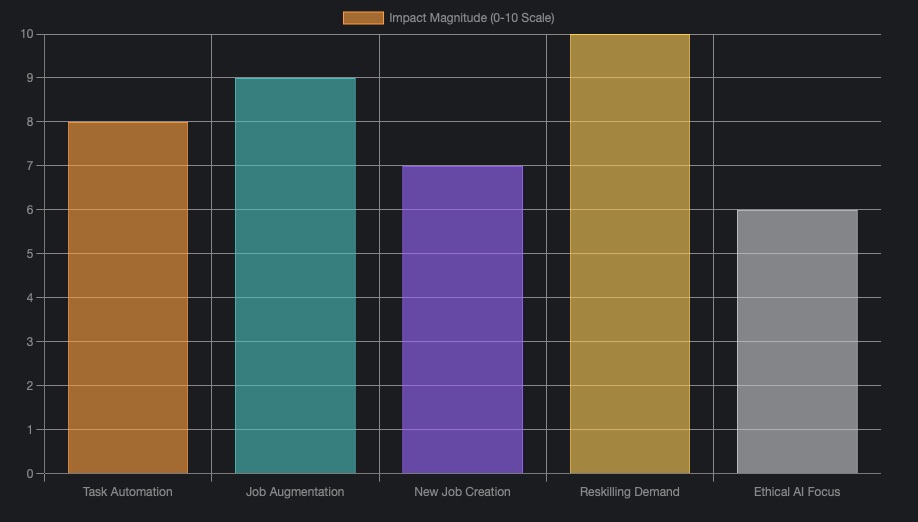
This bar chart illustrates the perceived magnitude of various AI impacts on the workforce. “Reskilling Demand” ranks highest, emphasizing the critical need for continuous learning, followed closely by “Job Augmentation” and “Task Automation,” which represent the primary ways AI will reshape roles.
The Path Forward: Designing for an AI-Augmented Future
The conversation surrounding AI and the future of work is not merely about predicting outcomes but actively shaping them. Sam Altman’s provocative stance, while sparking debate, underscores the profound transformation underway. The key is to move beyond a simple “jobs lost vs. jobs gained” dichotomy and instead focus on intelligently designing a future where AI augments human potential and creates new value.
Strategic Integration and Human-Centric Design
Successful integration of AI will require organizations to treat it as a tool for “task reengineering.” This involves a granular analysis of roles, identifying tasks that can be automated, and those where human expertise, judgment, and creativity are irreplaceable or even enhanced by AI. Protecting entry-level pathways and redesigning them to incorporate AI tools is essential to ensure future talent pipelines.
The following table summarizes key strategies for different stakeholders:
| Stakeholder | Key Strategies for Navigating AI’s Impact | Anticipated Benefits |
|---|---|---|
| Workers | Develop complementarity skills (e.g., critical thinking, problem-solving, communication with AI, emotional intelligence). Actively pursue continuous learning and cross-training into augmented roles. | Increased adaptability, enhanced career mobility, reduced risk of displacement, higher value contribution. |
| Companies | Implement AI as task re-engineering, not just headcount reduction. Establish clear governance for ethical AI use, data security, and quality assurance. Invest in role-specific AI training and change management. | Improved productivity, innovation, employee retention, responsible AI adoption, long-term competitive advantage. |
| Policymakers & Educators | Fund rapid re-employment programs and regional reskilling hubs. Update social safety nets and labor policies. Invest in compute/energy infrastructure. Promote AI literacy across educational systems. | Smoother economic transitions, reduced inequality, stronger workforce resilience, equitable access to AI benefits. |
This collaborative approach will ensure that the benefits of AI are widely distributed, mitigating risks and maximizing opportunities for a more productive and fulfilling future of work.
Visualizing the Interconnected Future of Work
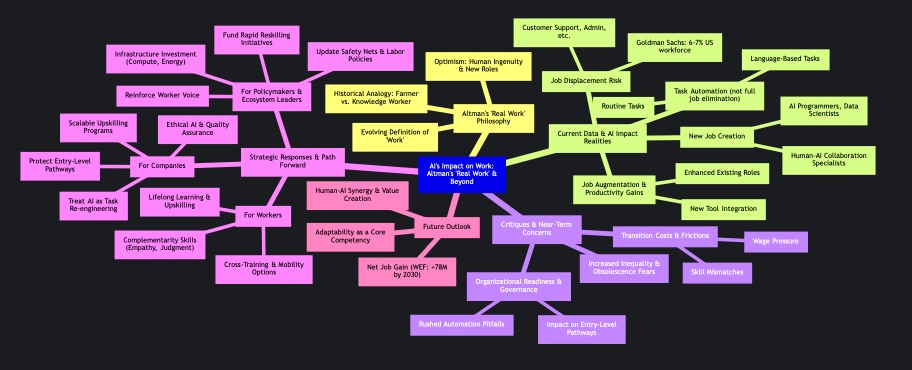
The mindmap below illustrates the key interconnected concepts discussed, showing how Sam Altman’s philosophical stance on “real work” connects to the practical implications and strategic responses required from various stakeholders to navigate the AI revolution successfully.
mindmap
root[“AI’s Impact on Work: Altman’s ‘Real Work’ & Beyond”]
Altman_Philosophy[“Altman’s ‘Real Work’ Philosophy”]
Historical_Analogy[“Historical Analogy: Farmer vs. Knowledge Worker”]
Evolving_Definition[“Evolving Definition of ‘Work'”]
Human_Ingenuity[“Optimism: Human Ingenuity & New Roles”]
AI_Impact_Realities[“Current Data & AI Impact Realities”]
Task_Automation[“Task Automation (not full job elimination)”]
Routine_Tasks[“Routine Tasks”]
Language_Based_Tasks[“Language-Based Tasks”]
Job_Augmentation[“Job Augmentation & Productivity Gains”]
Enhanced_Roles[“Enhanced Existing Roles”]
New_Tools_Integration[“New Tool Integration”]
Job_Displacement_Risk[“Job Displacement Risk”]
Specific_Sectors[“Customer Support, Admin, etc.”]
Quantified_Estimates[“Goldman Sachs: 6-7% US workforce”]
New_Job_Creation[“New Job Creation”]
AI_Specialists[“AI Programmers, Data Scientists”]
Human_AI_Collaborators[“Human-AI Collaboration Specialists”]
Critiques_Concerns[“Critiques & Near-Term Concerns”]
Transition_Costs[“Transition Costs & Frictions”]
Wage_Pressure[“Wage Pressure”]
Skill_Mismatches[“Skill Mismatches”]
Distributional_Risk[“Increased Inequality & Obsolescence Fears”]
Implementation_Challenges[“Organizational Readiness & Governance”]
Rushed_Automation[“Rushed Automation Pitfalls”]
Entry_Level_Impact[“Impact on Entry-Level Pathways”]
Strategic_Responses[“Strategic Responses & Path Forward”]
For_Workers[“For Workers”]
Complementarity_Skills[“Complementarity Skills (Empathy, Judgment)”]
Lifelong_Learning[“Lifelong Learning & Upskilling”]
Mobility_Options[“Cross-Training & Mobility Options”]
For_Companies[“For Companies”]
Task_Reengineering[“Treat AI as Task Re-engineering”]
Protect_Pathways[“Protect Entry-Level Pathways”]
Ethical_AI_Governance[“Ethical AI & Quality Assurance”]
Upskilling_Programs[“Scalable Upskilling Programs”]
For_Policymakers[“For Policymakers & Ecosystem Leaders”]
Rapid_Reskilling[“Fund Rapid Reskilling Initiatives”]
Update_Safety_Nets[“Update Safety Nets & Labor Policies”]
Infrastructure_Investment[“Infrastructure Investment (Compute, Energy)”]
Worker_Voice[“Reinforce Worker Voice”]
Future_Outlook[“Future Outlook”]
Net_Job_Gain_Potential[“Net Job Gain (WEF: +78M by 2030)”]
Human_AI_Synergy[“Human-AI Synergy & Value Creation”]
Adaptability_Key[“Adaptability as a Core Competency”]
Visualizing the Future of Work: Insights from Experts
To further contextualize the discussions around AI’s impact on employment, it’s beneficial to hear directly from experts. The following video offers additional perspectives on how automation and artificial intelligence are shaping the future of work, aligning with many of the points raised by Sam Altman and industry analyses.
“The Future of Work: AI, Automation, and Human Skills” delves into how AI is transforming the workplace, redefining roles, and underscoring the importance of human skills in an increasingly automated world.
This video provides a broader overview of how AI and automation are changing the landscape of jobs, reinforcing the idea that adaptability and the development of unique human skills will be paramount. It complements Altman’s philosophical musings by offering practical insights into navigating this evolving professional terrain.
Frequently Asked Questions (FAQ)
What does Sam Altman mean by “real work”?
Sam Altman suggests that the definition of “real work” is not static but evolves with technological progress. He uses the analogy of a farmer 50 years ago viewing modern knowledge work as “not real” to illustrate that future generations may similarly perceive our current jobs as less tangible or essential, as AI takes over more tasks.
Will AI eliminate all jobs?
The consensus among experts is that AI is unlikely to eliminate all jobs. Instead, it will primarily automate specific tasks within jobs and transform existing roles. While some jobs may be displaced, new ones will also be created, requiring different skill sets.
Which jobs are most vulnerable to AI displacement?
Jobs that involve highly routine, repetitive, or data-intensive tasks are generally considered most vulnerable to AI automation. This includes areas like customer support, data entry, and certain administrative functions.
Which jobs are most resilient to AI?
Jobs requiring strong human connection, empathy, creativity, critical judgment, complex problem-solving, and interpersonal skills are considered most resilient. Examples include nurses, teachers, artists, and strategic leaders, where human interaction and nuanced understanding are crucial.
What should individuals do to prepare for an AI-driven job market?
Individuals should focus on continuous learning, developing “complementarity skills” that enhance AI tools (e.g., prompt engineering, ethical AI use), and honing uniquely human abilities like creativity, emotional intelligence, and critical thinking. Cross-training and building adaptability are also key.
Conclusion
Sam Altman’s “real work” analogy, while philosophical, serves as a powerful catalyst for contemplating the future of employment in an AI-dominated world. It underscores a fundamental truth: the nature of work is dynamic, continuously reshaped by technological innovation. While AI promises unparalleled efficiency and the creation of entirely new categories of jobs, it also presents significant near-term challenges related to job displacement, skill mismatches, and the urgent need for transition support.
The path forward requires a balanced approach. It demands that individuals embrace lifelong learning and cultivate uniquely human skills that complement AI. It calls for companies to strategically integrate AI, focusing on task re-engineering and ethical governance, while protecting career pathways. And it necessitates that policymakers establish robust support systems for reskilling and equitable access to the benefits of this technological revolution. By proactively designing for an AI-augmented future, we can ensure that the evolution of “real work” leads to widespread prosperity and human flourishing.
Recommended Further Reading
- [Explore the nuanced impact of AI on the global workforce across different industries.](/?query=the impact of AI on the global workforce by industry)
- [Discover effective strategies for individuals and organizations to upskill and reskill for an AI-driven economy.](/?query=strategies for upskilling and reskilling in the age of AI)
- [Delve into the critical ethical considerations and governance frameworks for responsible AI implementation.](/?query=ethical considerations and governance in AI implementation)
- [Understand how human creativity, empathy, and critical thinking will define the jobs of the future.](/?query=the role of human creativity and empathy in future jobs)
Referenced Search Results
futurism.com
Sam Altman Says If Jobs Gets Wiped Out, Maybe They Weren’t Even ‘Real Work’ to Start With – Futurism
theguardian.com
Sam Altman: AI will take human jobs but create new ones | Technology – The Guardian
oecd.org
goldmansachs.com
How will AI affect the global workforce – Goldman Sachs
finalroundai.com
OpenAI CEO Sam Altman says these Jobs will Entirely Disappear due to AI – Final Round AI
timesofindia.indiatimes.com
Sam Altman: I’m confident that these people will lose their jobs to AI – The Economic Times
fortune.com
nexford.edu
How will Artificial Intelligence Affect Jobs 2025-2030 – Nexford University
weforum.org
Future of Jobs Report 2025: The jobs of the future – and the skills … – World Economic Forum
mckinsey.com
AI, automation, and the future of work: Ten things to solve for
techbytes.app
Sam Altman on OpenAI DevDay & AI Buildout – Tech Bytes
futurism.com
Sam Altman Says OpenAI Is Poised to Wipe Out Entire Categories of Human Jobs
finalroundai.com
Sam Altman Reveals One Skill AI Can’t Replace as 40% of Work Could Soon Be Automated
peopleinsight.co.uk
10 Pros and Cons of AI in the Workplace
m.economictimes.com
Sam Altman reveals the one job ChatGPT can’t touch. For software …
innopharmaeducation.com
The Impact of AI on Job Roles, Workforce, and Employment
shrm.org
How AI and Automation Will Transform the Future of Work
cnbc.com
OpenAI DevDay: Jony Ive says pace of change in AI is ‘extraordinary’
mckinsey.com
AI in the workplace: A report for 2025
futurism.com
Sam Altman Says Sorry, AI Is Definitely Destroying Jobs
fortune.com
economictimes.indiatimes.com
artificialintelligence-news.com
Sam Altman: AI will cause job losses and national security threats
en.wikipedia.org
mckinsey.com
Generative AI and the future of work in America – McKinsey
wired.com
OpenAI Wants ChatGPT to Be Your Future Operating System | WIRED
reddit.com
Is AI Really Going to Take Over Jobs? Or Is This Just Another Tech …
businessinsider.com
ChatGPT Creator Sam Altman Says ‘Jobs Are Definitely Going to Go Away’ – Business Insider
stratechery.com
An Interview with OpenAI CEO Sam Altman About DevDay and the AI …
weforum.org
Jobs of Tomorrow: Will AI automate or augment future work?
x.com
Stratechery on X: “10-8-2025 An Interview with OpenAI CEO Sam Altman …
hai.stanford.edu
Assessing the Real Impact of Automation on Jobs | Stanford HAI
aiconsequences.com
Why Is AI Bad? Open AI CEO Sam Altman On The Dangers of AI
habscheid.com
Sam Altman Drops AI Truth Bombs at Harvard Fireside Chat —Here’s What
www150.statcan.gc.ca
Exposure to artificial intelligence in Canadian jobs
aspen.edu
The Future of Work: How AI and Automation Are Changing Business
timesofindia.indiatimes.com
Sam Altman: I’m confident that these people will lose their jobs to AI – The Times of India
yahoo.com
Sam Altman predicts AI will cause major job losses in these fields – will you be safe?
markelitics.com
Sam Altman: AI Could Replace 40% of Jobs
vcpost.com
Sam Altman news & latest pictures from vcpost.com
versobooks.com
Automation and the Future of Work
forklog.com
isi.edu
A Real-Time Look at How AI Is Reshaping Work
economictimes.indiatimes.com
learningbank.io
Future Work Life: How Automation Changes Our Jobs and Tasks
sumsub.com
OpenAI’s Sam Altman Sounds Alarm on Looming Financial “AI Fraud Crisis”
unmissableai.com
An interview with Sam Altman about DevDay and the AI Buildout
uc.edu
The future of work: How will AI and automation affect work?
joshbersin.com
Why AI Harm To Jobs and Humanity are Vastly Over-Hyped
reddit.com
r/singularity on Reddit: Sam Altman tells the OpenAI’s London DevDay …
futureofwork.saltlab.stanford.edu
brookings.edu
The future of work: Robots, AI, and automation
metr.org
Measuring the Impact of Early-2025 AI on Experienced …
forbes.com
These Jobs Will Fall First As AI Takes Over The Workplace – Forbes
futureofwork.saltlab.stanford.edu
hbr.org
AI-Generated “Workslop” Is Destroying Productivity
pewresearch.org
5. The future of work in the automated workplace
microsoft.com
AI at Work Is Here. Now Comes the Hard Part
pymnts.com
Senator Grills Altman on if AI Could Eliminate Up to 70% of Jobs
edition.cnn.com
OpenAI CEO Sam Altman warns of an AI ‘fraud crisis’ | CNN Business
evit.com.au
An Interview with OpenAI CEO Sam Altman About DevDay and the AI …
oecd.org
abacusdata.ca
Are We Ready? Canadians Voice Real Fears About AI and …
insightglobal.com
The Impact of Automation on the Future of Work
news.ycombinator.com
An Interview with OpenAI CEO Sam Altman About DevDay and the AI …
hbr.org
The Perils of Using AI to Replace Entry-Level Jobs
timesofindia.indiatimes.com
Sam Altman’s AI warning: Millions of jobs are at risk—here’s why | – The Times of India
nationalfund.org
AI and the Future of Work | National Fund for Workforce Solutions
aei.org
What Research Reveals About AI’s Real Impact on Jobs and Society
ndtv.com
As AI Kills Jobs, Sam Altman Says Gen Z Are The ‘Luckiest’ Kids In …
dni.gov
Deeper Looks: The Future of Work
linkedin.com
An Interview with OpenAI CEO Sam Altman About DevDay and the …
tomsguide.com
OpenAI CEO Sam Altman warns AI will wipe entire job categories off the map
insight.ieeeusa.org
Navigating the Shift: Preparing for the Future of Work in the Age of AI and …
reddit.com
r/ArtificialInteligence on Reddit: AI Set to Replace 40% of Jobs by 2030—Sam Altman Warns
bcg.com
AI at Work 2025: Momentum Builds, but Gaps Remain
stratechery.com
2025.41: It’s OpenAI’s World, We’re Just Living in It
commerce.nc.gov
Insights on Generative AI and the Future of Work | NC Commerce
brookings.edu
Generative AI, the American worker, and the future of work
ibm.com
AI and the Future of Work | IBM
futurism.com
Sam Altman Says Human-Tier AI Is Coming Soon
arxiv.org
Future of Work with AI Agents: Auditing Automation and …
ssir.org
Choosing AI’s Impact on the Future of Work …
finance.yahoo.com
imf.org
AI Will Transform the Global Economy. Let’s Make Sure It …
therundown.ai
Exclusive interview: Sam Altman on Dev Day and AI’s future
weforum.org
Why AI is replacing some jobs faster than others
fr.wikipedia.org
patentlyapple.com
Last updated October 14, 2025