How ancient traditions offer a radical alternative to contemporary economic paradigms.
65+ Sources
- 1.Key Insights into Monasticism’s Challenge to Capitalism
- 2.The Essence of “Fuga Mundi”: A Deliberate Act of Dissent
- 3.Monasticism as an Anti-Capitalist Utopia
- 4.Navigating the Complex Intersections: Monasticism, Weber, and Capitalism
- 5.The Political Grace of the Monastery: A Utopia for Our Time
- 6.Timothée de Rauglaudre’s Contributions
- 7.Frequently Asked Questions
- 8.Conclusion: Monasticism as a Living Beacon
- 9.Recommended Further Exploration
- 10.Referenced Search Results
Key Insights into Monasticism’s Challenge to Capitalism
- Monasticism as a Conscious Critique: Timothée de Rauglaudre argues that the monastic “flight from the world” is not an escape, but a deliberate and active critique of capitalist modernity, providing a living counter-model to its core tenets.
- Alternative Economic and Social Models: Monasteries embody principles of communal ownership, sustainability, and production focused on values rather than profit, directly contrasting the individualistic, growth-driven nature of capitalism.
- Relevance for Modern Crises: The monastic way of life offers practical insights into addressing contemporary issues such as burnout, environmental degradation, and social inequality by emphasizing alternative approaches to time, labor, and community.
Timothée de Rauglaudre, a distinguished French journalist and essayist, presents a compelling reinterpretation of monastic life, suggesting it is far more than a mere withdrawal from society. His seminal statement, “Das monastische Leben versteht die Flucht aus der Welt als Kritik an der kapitalistischen Moderne” (“Monastic life understands fleeing the world as a critique of capitalist modernity”), serves as the cornerstone for understanding his profound analysis. This perspective elevates monasticism from a secluded spiritual practice to a vibrant, living critique of the pervasive economic and social structures of our contemporary capitalist world. Rauglaudre’s work, particularly in books like “La grâce politique du monastère: Une utopie pour notre temps,” delves into how monastic communities, through their unique organizational principles and daily practices, offer a radical alternative to the dominant capitalist ethos.
The Essence of “Fuga Mundi”: A Deliberate Act of Dissent
Beyond mere retreat, the strategic withdrawal of monastic life.
Historically, the concept of “fuga mundi” (flight from the world) has been central to monastic traditions. It describes the intentional disengagement from worldly distractions to pursue spiritual and ascetic disciplines, fostering an environment conducive to devotion. However, de Rauglaudre reframes this withdrawal not as an act of passive escapism, but as a proactive, performative objection to the prevailing societal norms. He asserts that by consciously detaching themselves from the relentless pressures of consumption, competition, and acceleration, monastics expose the limitations and detriments of a system that prioritizes material accumulation and individual gain above all else.
This “flight” is a profound social commentary, demonstrating that a different, more fulfilling way of life is not only possible but actively practiced. Monasteries, in their very existence, challenge the logic of unbounded growth and profit maximization by embodying principles of sufficiency, shared resources, and a holistic understanding of value that extends beyond mere monetary worth.
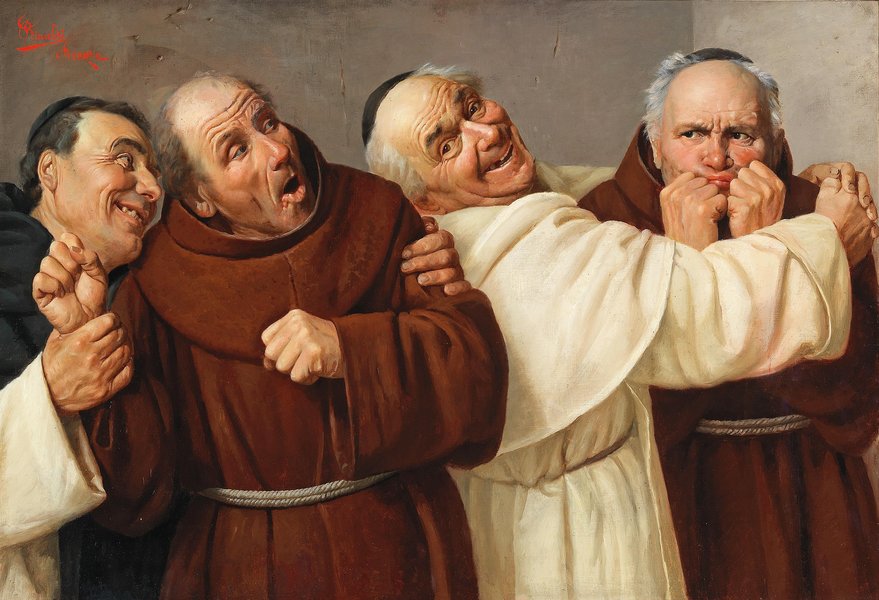
A look into the daily life of medieval monks, showcasing their communal and self-sustaining practices.
Monasticism as an Anti-Capitalist Utopia
Examining the practical blueprint for an alternative society.
De Rauglaudre posits that monastic communities function as living laboratories for alternative social and economic models, effectively operating as “anti-capitalist utopias.” These communities foreground collective well-being, shared ownership, and a distinct approach to labor and time that stands in stark contrast to the capitalist paradigm. This perspective resonates with ideas of “monastic communism,” where the abolition of private property and an emphasis on communal living form the bedrock of their existence. This challenges the capitalist propensity for individualism and often unchecked greed.
Reimagining Time and Work
One of the most striking elements of the monastic critique lies in its unique temporal and labor organization. The monastic day is structured around the Divine Office and liturgical rhythms, where spiritual duties take precedence over all else. This intentional ordering of time (“Nichts sei der Gottesdienstordnung vorzuziehen” – Nothing should be preferred to the work of God) inherently limits the pursuit of endless work and productivity, counteracting the modern obsession with efficiency and output. This contrasts sharply with the capitalist demand for constant engagement and performance, offering a model of “monastic detachment” that could alleviate the pervasive issues of burnout and overwork in contemporary society.
Shared Ownership and Community
Monastic poverty is personal, yet communal. While individuals may renounce personal possessions, goods are held in common, fostering a strong sense of solidarity and mutual support. This communal ownership model directly opposes the individualistic accumulation of wealth central to capitalism, promoting a system of collective security and shared responsibility. It highlights a fundamental rejection of material possession as the ultimate measure of success or security.
Sustainable Economy and Subsistence
Many monasteries engage in small-scale, qualitatively focused economic activities, often with an ecological orientation. Their purpose is primarily the sustenance of the community and the practice of hospitality, not profit maximization. This approach to economics prioritizes sustainability and sufficiency over relentless growth, embodying an economic model that is value-driven rather than purely market-driven. When monasteries do interact with broader markets, they often set clear boundaries to protect their core values of prayer, contemplation, and community life, sometimes even forsaking lucrative ventures if they threaten to undermine their spiritual essence.
Navigating the Complex Intersections: Monasticism, Weber, and Capitalism
A nuanced historical perspective on influence and opposition.
The relationship between monasticism and capitalism is complex and has been a subject of extensive scholarly debate. Max Weber, in his seminal work “The Protestant Ethic and the Spirit of Capitalism,” argued that the ascetic rationality cultivated within monasteries laid groundwork for modern work discipline. He suggested that the Reformation then “carried this asceticism out of the cells into the world,” thereby fostering the “spirit of capitalism.”
However, de Rauglaudre and other scholars offer a crucial counter-narrative, emphasizing the distinct monastic economy. While monasteries indeed engaged in economic activities (such as wool, wine, and beer production), these were typically geared towards self-sufficiency and communal well-being rather than speculative profit. Monastic communities, even when economically productive, consistently set spiritual and ethical boundaries to prevent “monastic capitalism” from eclipsing their core spiritual mission. This highlights a continuous tension, where the introduction of “Mammon” or excessive wealth could corrupt the ideals of “monastic communism.”
The “demonization of capitalism” as a system that can undermine any attempt to build something truly life-sustaining and durable is a critical theme. The inherent tension between monastic values and the “demon of capitalism” becomes apparent when monastic ideals are compromised or co-opted by capitalist forces. This ongoing dialectic underscores the monastery’s role as a site of both engagement with and resistance to economic ideologies.
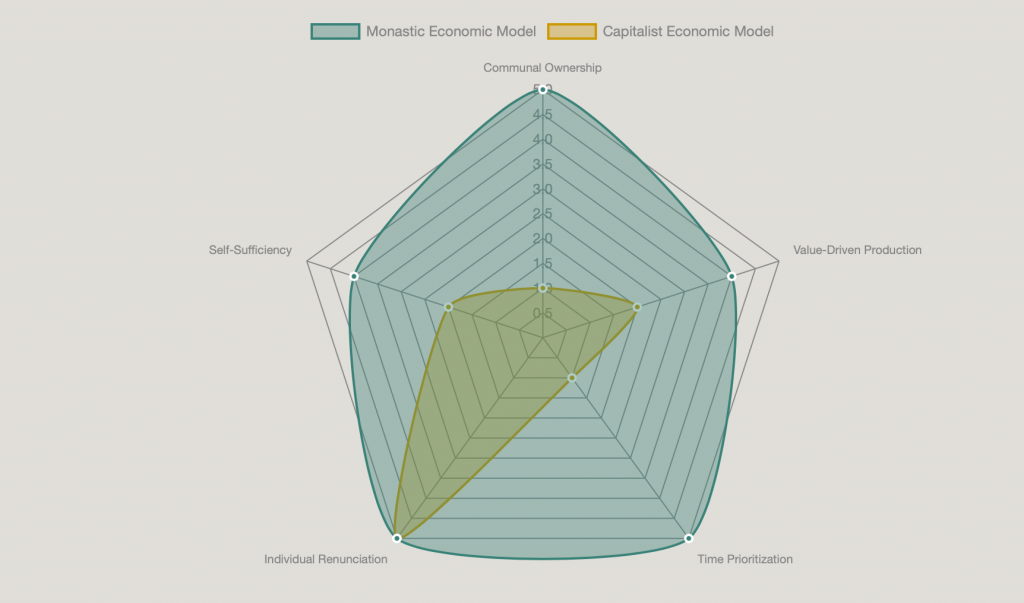
This radar chart illustrates the contrasting characteristics of the monastic and capitalist economic models, based on an opinionated analysis of Rauglaudre’s arguments. The monastic model, with its high scores in communal ownership, value-driven production, and time prioritization, starkly differs from the capitalist model, which tends to score lower in these areas while emphasizing individual renunciation (in capitalism, individuals accumulate privately) and self-sufficiency (though often through market mechanisms rather than communal labor).
mindmap
root[“Monasticism’s Critique of Capitalism”]
Critique_Nature[“Nature of Critique”]
Deliberate_Distancing[“Deliberate Distancing from Market Logic”]
Performative_Objection[“Performative Objection to Societal Norms”]
Counter_Model[“Living Counter-Model”]
Key_Principles[“Key Monastic Principles”]
Time_Ordering[“Time Ordering (Liturgy vs. Productivity)”]
Communal_Ownership[“Communal Ownership (vs. Private Accumulation)”]
Sustainability[“Sustainability & Subsistence”]
Hospitality[“Hospitality & Service”]
Values_Driven_Production[“Values-Driven Production”]
Contrast_Capitalism[“Contrast with Capitalism”]
Individualism_Greed[“Individualism & Greed”]
Profit_Maximization[“Profit Maximization & Endless Growth”]
Consumerism[“Consumerism & Acceleration”]
Burnout_Crisis[“Burnout & Meaning Crisis”]
Historical_Context[“Historical & Sociological Context”]
Fuga_Mundi[“Fuga Mundi (Flight from World)”]
Weber_Thesis[“Weber’s Protestant Ethic”]
Monastic_Economy[“Distinct Monastic Economy”]
Avoiding_Corruption[“Avoiding ‘Monastic Capitalism'”]
Modern_Relevance[“Modern Relevance”]
Alternative_Labor[“Alternative Approaches to Labor”]
Environmental_Concern[“Addressing Environmental Degradation”]
Social_Inequality[“Mitigating Social Inequality”]
Meaning_Crisis[“Coping with Meaning Crisis”]
Inspiration_Not_Blueprint[“Inspiration, Not Universal Blueprint”]
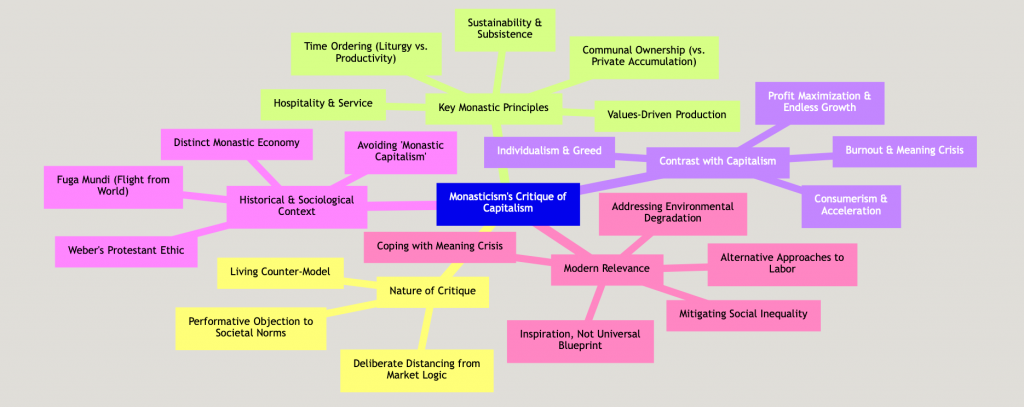
This mindmap visually structures the multifaceted arguments presented by Timothée de Rauglaudre regarding monasticism’s role as a critique of modern capitalism. It outlines the nature of the critique, the core monastic principles that form its basis, how these principles contrast with capitalist tenets, the relevant historical context, and the profound contemporary relevance of these monastic models.
The Political Grace of the Monastery: A Utopia for Our Time
Why monastic ideals offer solutions to modern challenges.
De Rauglaudre argues that monastic models are particularly relevant in an era plagued by crises such as environmental degradation, social inequality, and a widespread sense of meaninglessness amidst hyper-capitalism. Monasteries, with their focus on simplicity, solidarity, and the common good, provide a blueprint for a more equitable and sustainable way of life. They serve as “laboratories for alternatives,” offering insights into different time cultures, shared ownership, frugal production, and caring institutions.
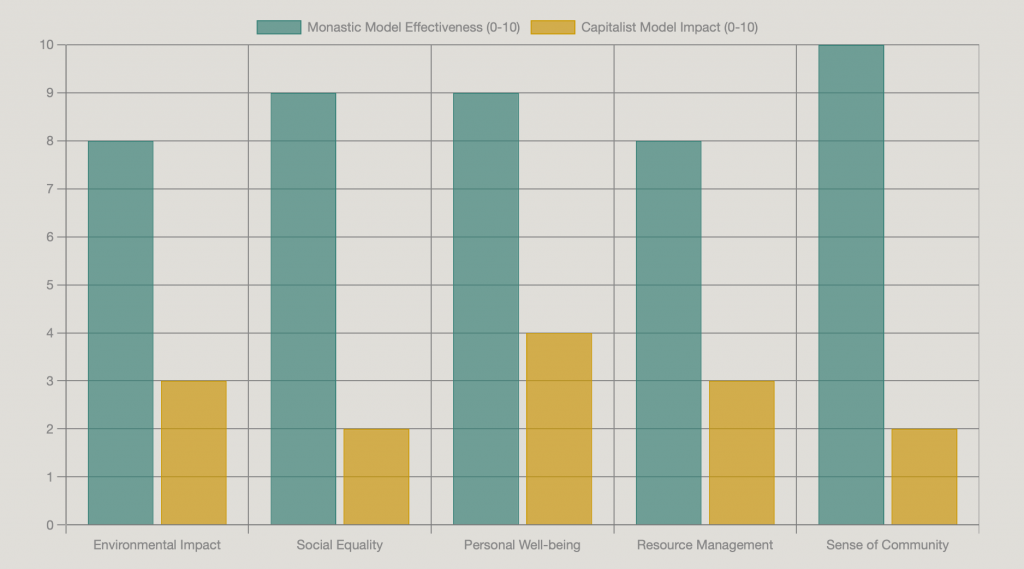
This bar chart compares the effectiveness of monastic and capitalist models in addressing key societal aspects. It reflects the idea that monastic communities, by their very nature, demonstrate higher effectiveness in areas like environmental impact, social equality, and fostering personal and communal well-being, while the capitalist model often falls short in these areas due to its inherent drivers.
A Transformative Presence
The “flight” is not a shunning of responsibility but a strategic withdrawal that enables critique and service to the world through different means, such as prayer, education, hospitality, and local value creation. Monasticism, in this view, does not call for the world to transform into one giant monastery but offers impulses and standards for living differently. It provides visible, lived alternatives, challenging the prevailing narratives of endless growth and consumption by limiting their influence within their own sphere and demonstrating that a life beyond market logic is not only possible but enriching.
Timothée de Rauglaudre’s Contributions
The intellectual framework and its impact.
Timothée de Rauglaudre’s work critically examines contemporary monasteries, their community structures, and their political significance. Through interviews, articles, and television appearances, he systematically develops his thesis: that the monastic way of life constitutes a modern utopia and a practical critique of capitalist modernity. His analysis, rooted in extensive reportage and philosophical reflection, portrays monastic communities as vibrant, living critiques of the present.
This video features Timothée de Rauglaudre discussing how monasteries embody an anti-capitalist utopia, directly aligning with his core arguments presented in his work.
This video provides direct insight into Timothée de Rauglaudre’s perspective, featuring him discussing his concept of monasteries as anti-capitalist utopias. It reinforces the central theme that monastic life, rather than being a mere retreat, actively challenges the fundamental tenets of capitalism by demonstrating alternative ways of organizing society, economy, and spiritual life. His insights into communal living, resource sharing, and prioritizing human and religious values over profit offer a compelling vision for those seeking alternatives to dominant economic systems.
Key Aspects of Rauglaudre’s Thought:
| Aspect of Critique | Monastic Approach | Capitalist Contrast |
|---|---|---|
| Economic Model | Sustainability, self-sufficiency, value-driven production, communal resources | Profit-driven, growth-oriented, accumulation, individualism |
| Relationship to Time | Rhythmic, contemplation-focused, liturgical structure, mindful pace | Accelerated, productivity-obsessed, constant engagement, “time is money” |
| Social Structure | Solidarity, shared responsibility, communal living, mutual support | Competition, individualistic pursuit of wealth, social stratification |
| Purpose of Work | Means of subsistence, spiritual fulfillment, service, community building | Means to accumulate capital, performance-driven, self-identification with profession |
| Materialism | Simplicity, detachment from possessions, rejection of excess | Consumerism, desire for more, material acquisition as status |
This table summarizes the core distinctions between the monastic approach and the capitalist paradigm, as articulated in de Rauglaudre’s critique. It highlights how each system fundamentally differs in its economic model, relationship to time, social structure, purpose of work, and approach to materialism.
Frequently Asked Questions
What does Timothée de Rauglaudre mean by “flight from the world”?
De Rauglaudre redefines “fuga mundi” not as an escape, but as a deliberate and active detachment from the prevalent social and economic logics of modern capitalism, such as consumerism, competition, and acceleration. It’s a conscious act of resistance that enables a critique of these systems.
How does monastic life criticize capitalist modernity?
Monastic life critiques capitalism by offering a tangible, lived alternative through its communal ownership, focus on sustainable subsistence, different relationship with time and labor, and emphasis on shared values over profit. It demonstrates that a meaningful life is possible outside the capitalist imperative.
Are monasteries advocating for everyone to become monks?
No, de Rauglaudre clarifies that monastic life provides impulses and standards for living, not a universal blueprint for all. It serves as a visible, practical example of alternative ways of organizing society and economy, offering insights that can be adapted and applied more broadly.
Did monasticism contribute to the rise of capitalism?
While some scholars like Max Weber argued that monastic asceticism laid groundwork for modern work discipline, de Rauglaudre and others emphasize that monastic economies were primarily geared towards self-sufficiency and communal well-being, often setting boundaries against unchecked profit accumulation. The relationship is complex, involving both historical influence and critical distance.
Why is this critique relevant today?
The monastic critique is highly relevant in addressing contemporary crises such as burnout, environmental degradation, social inequality, and a loss of meaning. It offers proven models for sustainable living, community building, and valuing human and spiritual well-being over material gain.
Conclusion: Monasticism as a Living Beacon
Timothée de Rauglaudre’s incisive analysis recasts monastic life as a profound and active critique of capitalist modernity. Far from being an outdated relic, monasteries stand as dynamic, living testaments to alternative ways of organizing human society and economy. Their deliberate “flight from the world” is not an act of disengagement but a powerful, performative statement—a utopian vision enacted daily through communal ownership, a nuanced relationship with time, and an economy rooted in values rather than solely in profit. In an age grappling with the profound social and ecological costs of unchecked capitalism, the monastic model offers invaluable insights, serving as a beacon for those seeking sustainable, equitable, and spiritually enriching alternatives.
Recommended Further Exploration
- Explore Timothée de Rauglaudre’s full works on monasticism and anti-capitalist thought.
- Investigate modern movements inspired by communal living and alternative economic models.
- Delve into the critical analyses of Max Weber’s theories on Protestantism and capitalism.
- Understand how various spiritual traditions offer critiques of consumerism and materialism.
Referenced Search Results
lemediatv.fr
Monastères : ces utopies anticapitalistes | Timothée de Rauglaudre – Le Média TV
philomag.com
danheck.medium.com
Monastic Ethics and the Demon of Capitalism | by Daniel Heck – Medium
stpaisiusmonastery.org
Monasticism in 21st Century – St. Paisius Monastery
lightoftruth.in
Monastic Capitalism Drains the Credibility of Monastic Communism – Light of Truth
acton.org
How Christianity Created Capitalism | Acton Institute
crisismagazine.com
The Catholic Origins of Capitalism: Max Weber Clarified – Crisis Magazine
wordonfire.org
“Libres”: A Big-Screen Glimpse into the Hidden World of Monasticism – Word on Fire
youtube.com
La vie monastique, un manifeste politique? – YouTube
worldhistory.org
The Daily Life of Medieval Monks – World History Encyclopedia
litcharts.com
Asceticism Analysis in The Protestant Ethic and the Spirit of Capitalism | LitCharts
cambridge.org
spiritualityshoppe.org
The Place of Withdrawal in Fourth Century Monasticism …
docs.un.org
[PDF] Human rights and international solidarity – General Assembly
medium.com
Leaving it All Behind to Become a Monastic? | by Sincerae Smith …
rfi.fr
Gay conversion therapy victims push France towards banning … – RFI
blogs.dickinson.edu
Review: Capitalism—its Nature and its Replacement – Dickinson Blogs
hospitam.hypotheses.org
The Monastic Paradox: negotiating monastic seclusion and pilgrim …
numberanalytics.com
en.wikipedia.org
The Protestant Ethic and the Spirit of Capitalism – Wikipedia
thenew.institute
Beyond Liberalism: Commons, Constitutionalism and the Common …
parembasis.gr
July 10, 2009. Capitalism’s Ideology
gotquestions.org
What is New Monasticism? | GotQuestions.org
cambridge.org
commonwealmagazine.org
routledge.com
Contemporary Monastic Economy: A Sociological Perspective Across Continents
tifwe.org
How Caring for the Poor Led to the Beginnings of Capitalism
reddit.com
One cannot both be a capitalist and a buddhist : r/Buddhism – Reddit
medievalists.net
The Economics of Monasticism – Medievalists.net
lecho.be
“Nous avons besoin de repenser nos rituels collectifs” | L’Echo
en.wikipedia.org
triumphias.com
postmodernperennialist.substack.com
Capitalism versus the Contemplative Life – Postmodern Perennialist
decolonialisme.fr
How “conversion therapies” became an LGBT+ political weapon …
jsri.loyno.edu
Catholicism and Capitalism | Jesuit Social Research Institute
abbey.suscopts.org
What is Monasticism? – St. Mary & St. Moses Abbey
quora.com
What is the value of monasticism in the modern world?
philpapers.org
academia.edu
Markets and Monasticism: A Survey & Appraisal of Eastern Christian Monastic Enterprise
buddhistdoor.net
churchlifejournal.nd.edu
Catholic Social Doctrine Isn’t a Surrogate for Capitalism
reddit.com
r/Buddhism on Reddit: Is Monastic Life an ‘Escape?’
chooser.crossref.org
democracyjournal.org
joanchittister.org
Flight from the World | Joan Chittister
scienceshumaines.com
La vie monacale est une contre-culture – Sciences Humaines
mondediplo.com
Pope Francis won’t be ‘the West’s chaplain’
orthodoxtimes.com
Metropolitan of Kyiv: Monasticism is not an escape from the world …
growrag.wordpress.com

What Hath Benedictine Monks to do with the Mammon of Capitalism? – Athanasian Reformed
thefreelibrary.com
amazon.com

Timothée De Rauglaudre: Books – Amazon.com
marxists.org
Max Weber, The Protestant Ethic and the Spirit of Capitalism
oblatespring.blogspot.com

Fuga mundi, Free at Last. A Benedictine oblate blog
uregina.ca
Sociology 250 – Notes on Max Weber
firstthings.com
journal.obcon.org
Monastic Life – Journal of the Order of Buddhist Contemplatives
academia.edu
(PDF) Contemporary Monastic Economy. A Sociological Perspective Across Continents
st-marymagdalene.org
Lessons from Monasticism – St. Mary Magdalene Orthodox Church
quotemaster.org
Quotes about Monastic Life (21 quotes)
quora.com
Do monks choose being a monk as a way to escape real/mundane/worldly …
phatmass.com
The Scandal Of The Monastic Life – Catholic Vocation Station – Phatmass
thearticle.com
Benedictine economics: the Catholic work ethic and the spirit of capitalism | TheArticle
en.wikipedia.org
Christian monasticism – Wikipedia
joeledmundanderson.com
The Ways of the Worldviews (Part 26): Monks and Capitalism…Open For Business!
via.library.depaul.edu
[PDF] A Postmodernist Theologian’s Critique of Capitalism
goodreads.com
Books by Timothée de Rauglaudre (Author of Le Nouveau péril …
ewtn.com
Last updated August 21, 2025