

Unpacking the Efficacy and Side Effect Profiles of Semaglutide, Tirzepatide, and the Promising Retatrutide
65+ Sources
- Key Insights into Modern Weight Management Medications
- A Deep Dive into the Mechanisms of Action
- Comparative Efficacy: A Closer Look at Weight Loss Results
- Navigating Side Effects: Are They “Much Worse”?
- The “Outdated” Question: Semaglutide’s Enduring Relevance
- The Future Horizon: What’s Next in Weight Management?
- Key Considerations for Personalized Treatment
- The Broader Context of Weight Management
- Frequently Asked Questions
- Conclusion
- Recommended Further Exploration
- Referenced Search Results
Key Insights into Modern Weight Management Medications
- Tirzepatide’s Superior Efficacy: Clinical trials consistently show that tirzepatide (Zepbound, Mounjaro) leads to greater average weight loss compared to semaglutide (Wegovy, Ozempic), often achieving over 20% body weight reduction in studies.
- Retatrutide: The Triple Threat: While still investigational, retatrutide, a triple-agonist, exhibits even higher weight loss potential in early trials, positioning it as a future leader in metabolic care, though its long-term safety profile is still being established.
- Semaglutide’s Enduring Role: Despite newer alternatives, semaglutide remains a highly effective and FDA-approved option with robust long-term data and established cardiovascular benefits, making it far from “outdated” for many patients.
The field of weight management and metabolic health is experiencing a rapid transformation, driven by the introduction of novel pharmaceutical agents that offer increasingly potent effects on weight loss and glycemic control. Your assertion that semaglutide (found in Ozempic and Wegovy) is “outdated” and possesses “much worse side effects” compared to newer drugs like tirzepatide (Zepbound, Mounjaro) and the investigational retatrutide reflects a common sentiment in an era of accelerating medical innovation. While it is true that newer compounds demonstrate superior weight loss efficacy in head-to-head trials, a nuanced understanding reveals that semaglutide still holds a significant and valuable place in therapy, and its side effect profile is generally comparable, not “much worse,” than its successors.
A Deep Dive into the Mechanisms of Action
Understanding how these medications work is key to appreciating their differences in efficacy. All three drugs fall under the class of incretin mimetics, which mimic the action of natural gut hormones involved in appetite regulation, insulin secretion, and gastric emptying.
Semaglutide: The GLP-1 Powerhouse
Semaglutide is a glucagon-like peptide-1 (GLP-1) receptor agonist. It works by activating GLP-1 receptors in the brain, pancreas, and gut. This leads to:
- Reduced appetite and increased satiety, helping individuals consume fewer calories.
- Stimulation of insulin release from the pancreas in a glucose-dependent manner, which helps lower blood sugar.
- Suppression of glucagon secretion, preventing the liver from releasing too much sugar.
- Delayed gastric emptying, contributing to a feeling of fullness and helping to manage post-meal blood sugar spikes.

Understanding the mechanism of GLP-1 agonists like semaglutide.
Tirzepatide: The Dual-Action Innovator
Tirzepatide is a novel dual glucose-dependent insulinotropic polypeptide (GIP) and GLP-1 receptor agonist. Its unique mechanism of action targeting two different incretin pathways is believed to be the reason for its enhanced efficacy.
- It leverages the benefits of GLP-1 agonism, similar to semaglutide.
- Additionally, it activates GIP receptors. GIP is another incretin hormone that further enhances insulin secretion and may have direct effects on fat metabolism and energy expenditure, contributing to greater weight loss.
Retatrutide: The Triple-Target Trailblazer
Retatrutide, currently in investigational stages, is a triple-hormone receptor agonist, targeting GLP-1, GIP, and glucagon receptors. This multi-pronged approach aims to maximize metabolic benefits:
- It combines the actions of GLP-1 and GIP agonism.
- The addition of glucagon receptor agonism may further enhance energy expenditure and lipolysis (fat breakdown), potentially leading to even more substantial weight loss.

Retatrutide’s triple-agonist mechanism is designed for superior metabolic outcomes.
Comparative Efficacy: A Closer Look at Weight Loss Results
When evaluating the “superiority” of these medications, weight loss efficacy is often the primary metric. Clinical trials provide direct comparisons that illuminate their respective strengths.
Semaglutide’s Established Performance
Semaglutide, particularly at its highest approved dose for weight loss (Wegovy 2.4 mg), has demonstrated significant and sustained weight reduction. In clinical trials, participants typically achieve an average weight loss of approximately 14.9% to 15% of their body weight over 68 weeks. This is a substantial achievement for many individuals struggling with obesity and is a key reason semaglutide remains a first-line treatment option.
Tirzepatide’s Edge
Head-to-head trials have consistently shown tirzepatide to outperform semaglutide in terms of average weight loss. For instance, a notable study reported an average weight loss of 20.2% with tirzepatide over 72 weeks, compared to 13.7% with semaglutide. This represents a statistically significant and clinically meaningful difference, indicating that tirzepatide can lead to greater weight reduction for many patients. This superior efficacy has positioned tirzepatide as a strong contender for individuals seeking maximal weight loss.
Retatrutide’s Remarkable Promise
Early phase clinical trials for retatrutide have yielded impressive results, with some participants achieving an average weight loss of up to 24% of their body weight. If these results are replicated in larger Phase 3 trials and maintained long-term, retatrutide could set a new benchmark for pharmacological weight management. However, it is crucial to remember that retatrutide is still investigational and not yet FDA-approved. Its full long-term safety and efficacy profile are still under rigorous evaluation.
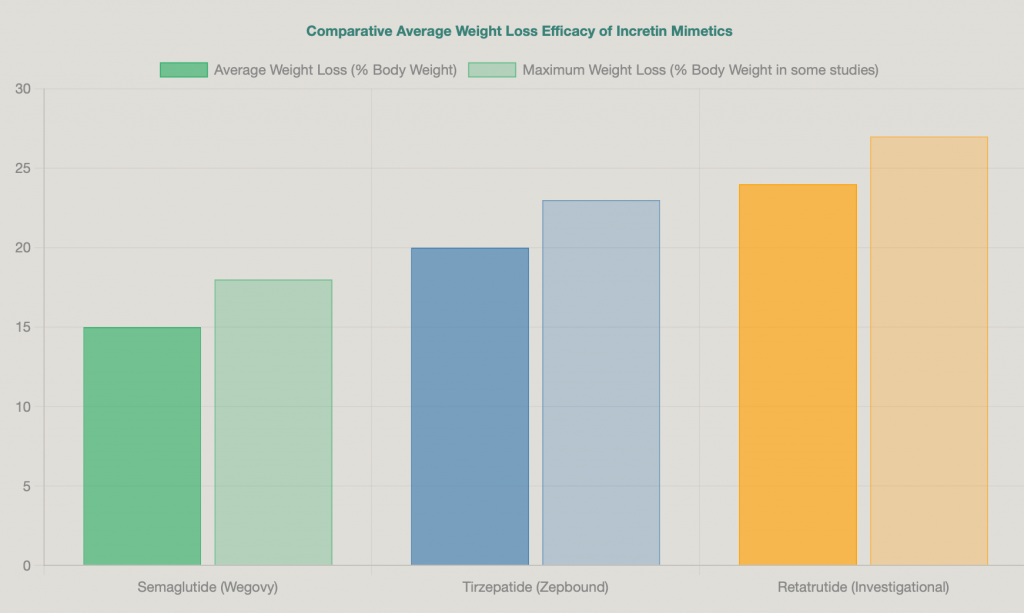
This bar chart visually represents the general trend in average weight loss efficacy among semaglutide, tirzepatide, and investigational retatrutide. It highlights how newer generations of these medications are demonstrating increased potency in achieving significant body weight reductions. The data points are illustrative and based on general findings from clinical trials.
Navigating Side Effects: Are They “Much Worse”?
The claim that semaglutide has “much worse side effects” than tirzepatide or retatrutide is generally not supported by current evidence. While all incretin mimetics share a similar side effect profile, predominantly gastrointestinal, differences in severity and frequency are often marginal or dependent on individual patient factors and dosing strategies.
Common Gastrointestinal Side Effects
The most commonly reported side effects for semaglutide, tirzepatide, and retatrutide are gastrointestinal in nature. These include:
- Nausea
- Vomiting
- Diarrhea
- Constipation
- Abdominal pain
These symptoms are typically mild to moderate and often decrease over time as the body adjusts to the medication, especially with careful dose escalation. Healthcare providers commonly advise patients on dietary adjustments and strategies to manage these side effects effectively.
Comparing Side Effect Profiles
- Semaglutide: While GI side effects are common, large comparative studies do not indicate that semaglutide’s overall side effect profile is “much worse.” Discontinuation rates due to adverse events are comparable across these drug classes.
- Tirzepatide: Some analyses suggest that tirzepatide, particularly at certain doses, may have a similar or even slightly more favorable GI side effect profile compared to semaglutide. However, this varies, and some patients may experience more intense GI symptoms with tirzepatide, especially at higher doses.
- Retatrutide: As an investigational drug, its long-term safety profile is still being fully elucidated. While it shares the common GI side effects, a unique aspect noted in early trials is a dose-dependent increase in heart rate. This requires careful monitoring in ongoing and future studies. Claims of unequivocal superiority or safety over semaglutide are premature given its developmental stage.
It is crucial to note that individual tolerance varies widely. What might be tolerable for one person could be challenging for another. The perception of side effects can also be influenced by factors like patient expectation, concomitant medications, and underlying health conditions. Furthermore, real-world data suggest that side effects for both semaglutide and tirzepatide might be less severe than those observed in highly controlled clinical trials.
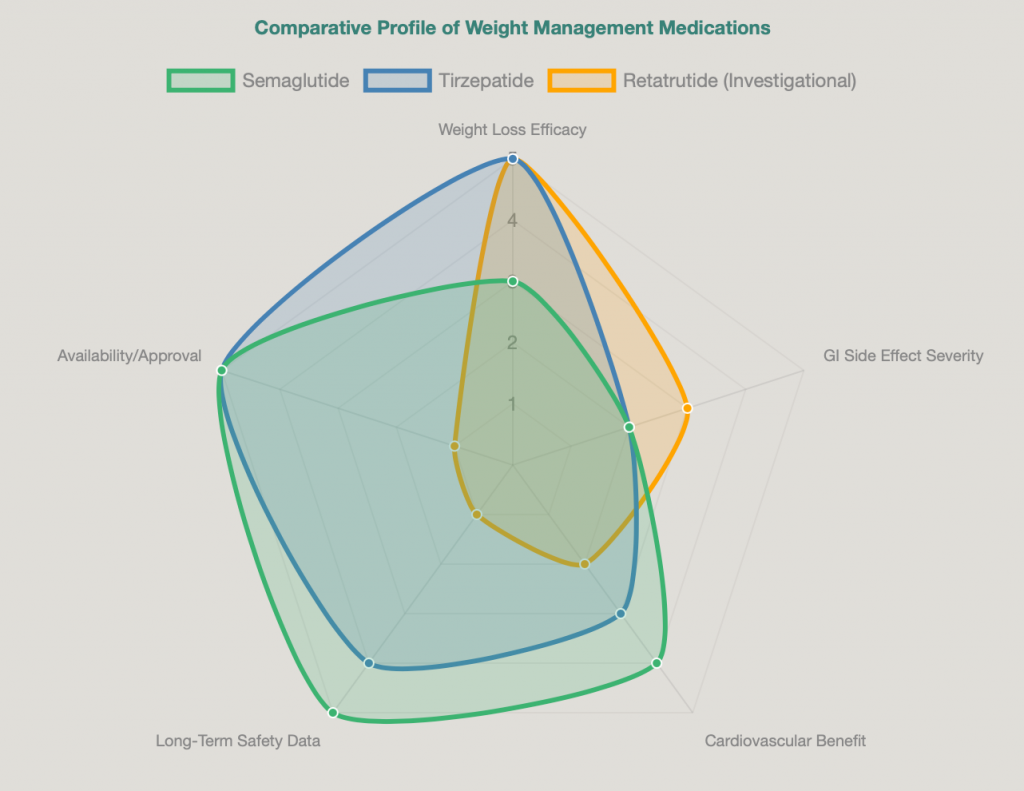
This radar chart illustrates a comparative profile of semaglutide, tirzepatide, and the investigational retatrutide across several key dimensions, using an opinionated scale from 1 to 5 (higher is better for positive attributes, lower is better for negative ones like side effect severity). It highlights the strengths of each drug, such as semaglutide’s strong long-term safety data and tirzepatide’s superior weight loss efficacy, while also noting areas where more data is needed, particularly for retatrutide.
The “Outdated” Question: Semaglutide’s Enduring Relevance
To label Ozempic (semaglutide for type 2 diabetes) or Wegovy (semaglutide for weight loss) as “outdated” is an oversimplification. While newer, more potent options are emerging, semaglutide remains a cornerstone of treatment for several reasons:
- Established Efficacy and Safety: Semaglutide has robust long-term efficacy and safety data, accumulated over years of clinical use and extensive trials. This provides a high degree of confidence for both prescribers and patients.
- FDA-Approved Indications: Semaglutide holds multiple FDA approvals, not only for type 2 diabetes and weight loss but also for reducing the risk of major adverse cardiovascular events in individuals with type 2 diabetes and established cardiovascular disease. This is a significant advantage that newer drugs are still working to achieve.
- Accessibility and Formulations: Semaglutide is widely available and comes in various formulations, including once-weekly injectable pens and an oral tablet (Rybelsus) for type 2 diabetes, offering flexibility and patient preference options.
- Guideline Support: Semaglutide is strongly supported by clinical guidelines as a first-line or early-add-on therapy for type 2 diabetes and obesity.
Therefore, while tirzepatide often offers greater average weight loss, semaglutide is far from obsolete. It continues to be a highly effective and well-tolerated option for many individuals, particularly those who may prioritize established safety profiles, specific cardiovascular benefits, or prefer its established dosing and availability.
The Future Horizon: What’s Next in Weight Management?
The field is dynamic, with several promising agents in the pipeline that could further revolutionize obesity and diabetes treatment:
Emerging Therapies and Combinations
- MariTide: A monthly obesity injection developed by Amgen, showing significant weight loss in trials and offering the convenience of monthly dosing, which could greatly improve adherence.
- Amycretin: A novel drug activating GLP-1, amylin, and calcitonin receptors, demonstrating over 20% average weight loss in early trials through a multi-pathway approach.
- CagriSema: A combination of cagrilintide and semaglutide in Phase 3 trials, showing superior weight loss compared to its individual components.
- Orforglipron: An oral GLP-1 receptor agonist in development, which could offer a convenient non-injectable option for many patients.
- Ecnoglutide: A new GLP-1 drug emerging from China, with promising weight loss results and a weekly administration schedule.
Key Considerations for Personalized Treatment
The choice of medication for weight management or type 2 diabetes is a highly individualized decision that should be made in close consultation with a healthcare provider. Several factors influence this choice:
| Factor | Description |
|---|---|
| Primary Treatment Goal | Is the main objective maximal weight loss, glycemic control, or cardiovascular risk reduction? |
| Comorbidities | Presence of conditions like type 2 diabetes, cardiovascular disease, chronic kidney disease, or obstructive sleep apnea may influence drug selection due to specific approved benefits. |
| Side Effect Tolerance | Individual response to and tolerance of gastrointestinal side effects can vary significantly. |
| Administration Preference | Daily, weekly, or monthly injections versus oral tablets. |
| Insurance Coverage & Cost | Access to these medications often depends heavily on insurance coverage, which can vary by drug and indication. |
| Long-term Data & Safety | The availability of extensive long-term safety and efficacy data for approved drugs provides reassurance. |
This table summarizes critical considerations when selecting a weight management medication. The decision is complex and requires a comprehensive assessment of the patient’s health profile and preferences.
The Broader Context of Weight Management
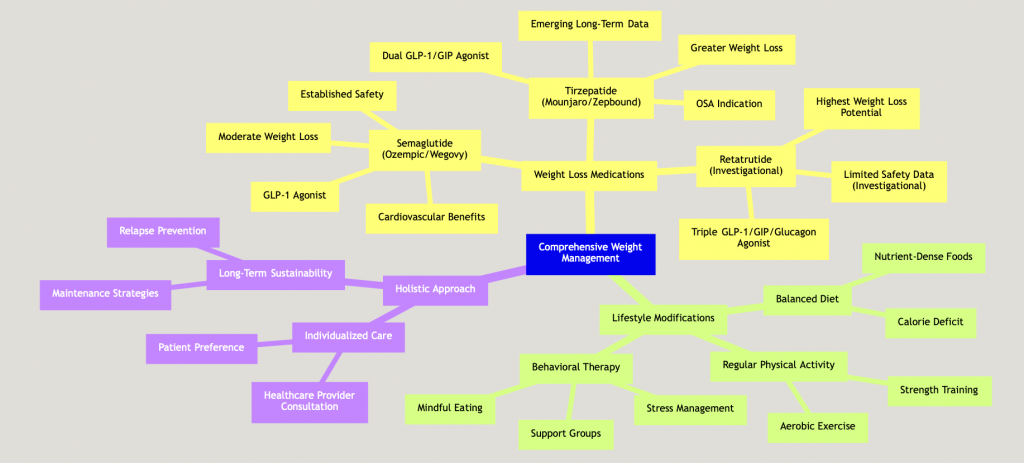
While pharmacological interventions are powerful tools, it’s essential to remember that they are most effective when integrated into a holistic weight management plan that includes lifestyle modifications.
This mindmap illustrates the comprehensive nature of effective weight management, emphasizing that while medications play a crucial role, they are optimally integrated within a broader strategy that includes sustained lifestyle modifications and individualized care. The interconnections highlight the multifaceted approach required for long-term success.
Furthermore, concerns regarding compounded versions of these medications have arisen. The FDA has issued warnings about unapproved and potentially unsafe compounded GLP-1 and GIP drugs, stressing the importance of using only FDA-approved products to ensure efficacy, safety, and quality standards.
This video highlights the risks associated with compounded semaglutide and tirzepatide, emphasizing the importance of adhering to FDA-approved versions for safety and efficacy. Understanding these warnings is crucial for patients considering these treatments.
Frequently Asked Questions
Is Ozempic truly outdated for weight loss?
No, Ozempic (semaglutide) is not outdated. While newer medications like tirzepatide show greater average weight loss, semaglutide remains a highly effective, FDA-approved treatment with robust long-term safety data and established cardiovascular benefits. Its role depends on individual patient needs and treatment goals.
Do tirzepatide and retatrutide have significantly fewer side effects than semaglutide?
All three medications share similar gastrointestinal side effects (nausea, vomiting, diarrhea, constipation). While some studies suggest slight differences in side effect profiles or severity at certain doses, there’s no strong evidence to support that semaglutide has “much worse” side effects overall. Individual tolerance varies. Retatrutide is still investigational, and its long-term side effect profile is being studied.
What makes tirzepatide more effective for weight loss than semaglutide?
Tirzepatide is a dual agonist, meaning it activates both GLP-1 and GIP receptors. Semaglutide is primarily a GLP-1 agonist. The additional activation of the GIP pathway by tirzepatide is believed to contribute to its enhanced effects on appetite regulation, fat metabolism, and overall greater weight loss.
When will retatrutide be available for weight loss?
Retatrutide is currently in Phase 3 clinical trials and is not yet FDA-approved. While early trial data show significant weight loss potential, it will likely be several years before it could be available to the public, pending successful completion of trials and regulatory approval.
Can I switch from semaglutide to tirzepatide?
Switching medications should only be done under the strict guidance of a healthcare provider. They will assess your individual health status, current medication response, and potential benefits and risks of switching, helping you make an informed decision tailored to your needs.
Conclusion
The landscape of weight management medications is indeed evolving rapidly, offering increasingly effective options for individuals seeking to manage their weight and metabolic health. While newer agents like tirzepatide demonstrate superior weight loss efficacy compared to semaglutide, and investigational retatrutide promises even greater results, it is an overstatement to consider semaglutide “outdated” or to claim it has “much worse side effects.” Semaglutide remains a highly effective, well-established, and FDA-approved treatment with significant long-term safety data and crucial cardiovascular benefits. The choice between these powerful medications is a personalized one, requiring careful consideration of individual health goals, comorbidities, side effect tolerance, and access in consultation with a qualified healthcare professional. The future holds even more promise with a pipeline of innovative therapies, but for now, each of these medications offers a valuable and distinct contribution to modern metabolic care.
Recommended Further Exploration
- Comparative efficacy of GLP-1 and GIP agonists for weight loss
- Long-term safety profile of tirzepatide vs semaglutide
- Investigational weight loss drugs 2025
- Role of GLP-1 agonists in cardiovascular risk reduction
Referenced Search Results
jamanetwork.com
Tirzepatide vs. Semaglutide for Weight Loss in Adults – JAMA Network
newsroom.clevelandclinic.org
easo.org
New research to be presented at ECO 2025 in Málaga – EASO
gardwellnesssolutions.com
Retatrutide vs Semaglutide | Gard Wellness Solutions
yuniquemedical.com
Retatrutide vs. Semaglutide: Which is Right for You? | Yunique Medical
drugs.com
Monthly Obesity Shot, MariTide, Shows Big Weight Loss in Trial – Drugs.com MedNews
news-medical.net
Amycretin delivers unprecedented weight loss in early trial for obesity treatment – News-Medical.Net
nature.com
The weight-loss drugs being tested in 2025: will they beat Ozempic? – Nature
nejm.org
nejm.org
compassindy.com
Have Scientists discover a natural Ozempic (GLP-1) ?
thennt.com
Efficacy of Tirzepatide, Retatrutide, and Semaglutide for Weight Loss …
skintightmedicalspa.com
Retatrutide vs Semaglutide | Which is Better for Weight Loss? | …
reddit.com
r/Mounjaro on Reddit: Comparing the Big 3, Semaglutide, Tirzepatide …
pmc.ncbi.nlm.nih.gov
Semaglutide vs Tirzepatide for Weight Loss in Adults With Overweight or Obesity – PMC
pubmed.ncbi.nlm.nih.gov
Semaglutide vs Tirzepatide for Weight Loss in Adults With Overweight or Obesity – PubMed
drugs.com
CagriSema (cagrilintide and semaglutide): What is it and is it FDA approved? – Drugs.com
drugs.com
Monthly Obesity Shot, MariTide, Shows Big Weight Loss in Trial – Drugs.com MedNews
secretmedspa.com
Understanding the Difference Between Semaglutide and Tirzepatide | It’s a Secret Med Spa
thehcginstitute.com
Semaglutide vs Retatrutide | Weight Loss – The HCG Institute
goodrx.com
Comparing Ozempic, Wegovy and Other GLP-1 Drugs – GoodRx
goodrx.com
Can’t Get Ozempic? Here’s 6 Ozempic Alternatives to Consider
tryeden.com
Retatrutide vs. Semaglutide: What to Know | Eden
acc.org
Semaglutide vs. Tirzepatide for Weight Loss in Adults – American College of Cardiology
nulevelwellnessmedspa.com
Retatrutide vs Semaglutide | Nulevel Wellness Medspa
powershealth.org
Rival GLP-1 Weight-Loss Drug Emerges From China
sandiegobodysculptingca.com
Semaglutide vs. Retatrutide: A Comparison – San Diego Body Sculpting
vancouverdirectprimarycare.com
Best Weight Loss Medications (2025) | Compare Options at VDPC
clinicaltrials.gov
A Study of Tirzepatide (LY3298176) in Participants With Type 2 …
pubmed.ncbi.nlm.nih.gov
Tirzepatide as Compared with Semaglutide for the Treatment of Obesity – PubMed
jamanetwork.com
Continued Treatment With Tirzepatide for Maintenance of Weight …
sciencedirect.com
healthline.com
Semaglutide for Weight Loss: Effectiveness, Benefits, Side Effects
nuvancehealth.org
Tirzepatide or semaglutide, weight loss drugs explained | Nuvance Health
forbes.com
4 FDA-Approved Weight Loss Medications, According To Experts
clinicaltrials.gov
A Study of Tirzepatide (LY3298176) in Participants With Obesity or …
dietitianlive.com
9 Best Ozempic Alternatives: Other GLP-1s and Semaglutides to Try
amazing-meds.com
Retatrutide vs Tirzepatide vs Semaglutide: Key Differences
trials.lilly.com
A Study of Tirzepatide (LY3298176) Compared With Placebo in …
drugs.com
Tirzepatide vs semaglutide: How do they compare?
investor.lilly.com
healthline.com
Tirzepatide vs. Semaglutide: How Do These Two Medications Compare?
jmcp.org
saxonmd.com
Tirzepatide Vs Semaglutide: Which One Should You Choose?
sciencedirect.com
Comparative efficacy and safety of semaglutide 2.4 mg and …
webmd.com
Ozempic (semaglutide): Uses, Side Effects, Interactions, Pictures, Warnings & Dosing – WebMD
fda.gov
FDA’s Concerns with Unapproved GLP-1 Drugs Used for Weight Loss
sesamecare.com
9 Ozempic Alternatives and Different Price Points – Sesame
canadianinsulin.com
Retatrutide vs Semaglutide: Which One Delivers Better Results? …
drugs.com
Rival GLP-1 Weight-Loss Drug, Ecnoglutide, Emerges From China – Drugs.com MedNews
pbrc.edu
Tirzepatide Reduces Food Intake and Appetite, and Affects Brain …
med.stanford.edu
Naturally occurring molecule rivals Ozempic in weight loss …
thenp2go.com
A Comparison of Tirzepatide vs. Semaglutide From a Weight Loss Expert – NP2GO
canadianinsulin.com
Retatrutide vs Semaglutide: Which One Delivers Better Results …
ourfamilyhealthcenter.com
Understanding the Differences Between Semaglutide and Tirzepatide
drugs.com
Rival GLP-1 Weight-Loss Drug, Ecnoglutide, Emerges From China – Drugs.com MedNews
pmc.ncbi.nlm.nih.gov
Efficacy of tirzepatide 5, 10 and 15 mg versus semaglutide …
pubmed.ncbi.nlm.nih.gov
firstchoicemedical.us
Retatrutide vs Semaglutide | First Choice Medical
diabetesjournals.org
sciencedirect.com
Tirzepatide did not impact metabolic adaptation in people with …
news-medical.net
Tirzepatide rewires appetite and slashes calorie intake in new …
sciencealert.com
Ozempic Alternative Ditches The Needle And One Major Side Effect
pubmed.ncbi.nlm.nih.gov
doralhw.org
New Weight Loss Drugs In 2025: Will They Outperform Ozempic And …
Last updated August 27, 2025