
Unlocking: The Power of AI in Personalized Health Coaching
Revolutionizing your sleep and fitness journey with cutting-edge AI insights.
48+ Sources
- 1.Key Insights into PH-LLMs for Health Coaching
- 2.Decoding the Personal Health Large Language Model (PH-LLM)
- 3.Performance and Real-World Applications
- 4.The Impact on Sleep Coaching
- 5.Optimizing Fitness with AI Coaching
- 6.The Future of Personal Health: Ethical Considerations and Potential
- 7.Frequently Asked Questions
- 8.Conclusion
- 9.Recommended Further Exploration
- 10.Referenced Search Results
Key Insights into PH-LLMs for Health Coaching
- Personalized Guidance: Personal Health Large Language Models (PH-LLMs) leverage diverse data inputs, including wearable device metrics and subjective user logs, to deliver highly individualized recommendations for improving sleep and fitness.
- Expert-Level Performance: Advanced PH-LLMs, such as Google’s Gemini-based model, have demonstrated performance in health-related assessments that can match or even surpass human experts, providing credible and actionable advice.
- Multimodal Data Integration: These AI systems excel at processing complex, multimodal health data—from detailed polysomnograms to training load and mood — transforming raw information into actionable insights for holistic wellness management.
A Personal Health Large Language Model (PH-LLM) for sleep and fitness coaching represents a significant leap forward in personalized health management. These sophisticated AI systems are meticulously designed to analyze and interpret a vast array of personal health data, offering bespoke recommendations that adapt to an individual’s unique physiological and behavioral patterns. Unlike generic fitness apps or one-size-fits-all advice, PH-LLMs leverage the power of advanced language understanding combined with multimodal data analysis to provide truly tailored coaching interventions.
Decoding the Personal Health Large Language Model (PH-LLM)
At its core, a PH-LLM is a specialized artificial intelligence model, often fine-tuned from powerful general-purpose LLMs like Google’s Gemini. Its primary purpose is to synthesize complex health data and deliver actionable insights for improving sleep quality and optimizing fitness regimes. This involves much more than simply tracking steps or sleep cycles; it encompasses a deep understanding of individual health metrics, lifestyle choices, and even psychological frameworks that influence behavior change.
The Foundation of Personalized Health Intelligence
The development of PH-LLMs is rooted in the ability of large language models to process and reason over both natural language and numerical data. This dual capability is crucial for interpreting not only user-provided logs and queries but also the intricate time-series data generated by wearable devices. Imagine an AI that understands the nuances of your sleep stages from a polysomnogram, the precise training load from your last workout, and how these factors collectively impact your daily energy levels and recovery needs.
Multimodal Data Integration: The Key to Comprehensive Understanding
PH-LLMs distinguish themselves through their ability to integrate and analyze multimodal inputs. This includes a rich tapestry of data points such as:
- Sleep Metrics: Detailed data on brain activity, heart rate variability, breathing patterns, and sleep stages (REM, deep, light sleep) captured throughout the night.
- Fitness Data: Training load, intensity, recovery status, heart rate zones, calorie expenditure, and activity levels.
- Health Data: Broader physiological signals, biomarkers (if available), and historical health records.
- Subjective Inputs: User-logged exercise routines, mood journals, dietary intake, perceived exertion, and even qualitative descriptions of daily well-being.
By combining these diverse data streams, a PH-LLM can create a holistic profile of an individual’s health, allowing for more precise and effective coaching.

A person interacting with a fitness tracking application on a smartphone.
The AI’s Coaching Prowess: Beyond Data Analysis
The true power of a PH-LLM lies not just in its analytical capabilities but in its ability to translate complex data into actionable, personalized coaching prompts. These models are fine-tuned on extensive datasets, including real-world coaching case studies and professional examination questions related to sleep and fitness. This rigorous training enables them to approach expert-level performance in recommending behavioral changes and predicting health outcomes.
For instance, a PH-LLM can analyze your sleep data, detect patterns of disturbed sleep, and then recommend specific sleep hygiene practices, personalized wind-down routines, or even suggest when to adjust your training schedule to optimize recovery. Similarly, it can review your fitness data, identify areas for improvement or potential overtraining, and propose tailored workout adjustments or recovery strategies.
Autonomy, Proactivity, and Personalization in Coaching
Embedding principles from behavioral science and psychology into these LLMs allows them to provide autonomous, proactive, and truly personalized text-based coaching. This proactive approach distinguishes them from static health apps, offering dynamic guidance that evolves with the user’s progress and changing needs. Research has shown that such AI-driven interventions can even be preferred over human-curated messages for sustained long-term behavior change in health and fitness contexts.
Performance and Real-World Applications
Recent advancements, particularly by Google, highlight the impressive capabilities of PH-LLMs. Their models have undergone rigorous evaluation, demonstrating significant proficiency in understanding and responding to complex health-related queries.
Benchmarking Against Human Expertise
Google’s PH-LLM, built on Gemini, has shown remarkable performance in assessments designed to test knowledge in sleep medicine and fitness. In evaluations:
- It achieved 79% accuracy on a set of 629 multiple-choice sleep medicine questions.
- It scored an impressive 88% accuracy on 99 fitness certification-style questions.
These scores frequently surpassed the average performance of human experts in similar test regimes, underscoring the model’s reliability and depth of knowledge. This robust performance is critical, as it builds user trust and validates the credibility of the AI’s recommendations.
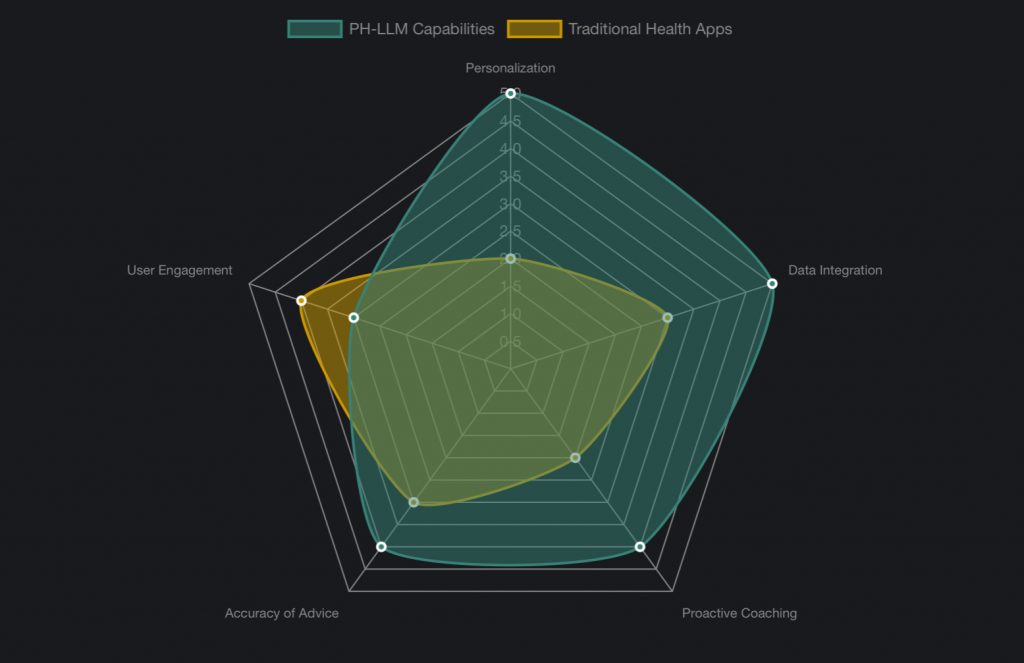
This radar chart illustrates the comparative strengths of PH-LLMs versus traditional health apps across key aspects of personalized health coaching. PH-LLMs demonstrate superior capabilities in personalization, data integration, proactive coaching, and accuracy of advice, while traditional apps might excel in broader user engagement due to wider adoption.
Practical Implementation and Existing Tools
The integration of PH-LLMs with wearable devices is transforming how individuals manage their health. By seamlessly processing data from smartwatches, fitness trackers, and other sensors, these models translate raw biometric information into clear, actionable advice.
Several AI health coaching tools are already leveraging similar principles:
- WHOOP Coach: Utilizes advanced AI to provide individualized, conversational responses to health and fitness questions.
- Oura Advisor: Analyzes data from Oura rings to offer actionable sleep and activity tips.
- ONVY: An AI-powered health coach that converts wearable data into hyper-personalized insights for fitness, nutrition, recovery, and sleep.
- Humanity App: Employs generative AI trained on real-world health data to help users extend their healthspan and longevity.

An Apple Watch displaying sleep tracking data, highlighting the integration of wearables in PH-LLMs.
The Impact on Sleep Coaching
PH-LLMs offer unprecedented potential for revolutionizing sleep health. By moving beyond simple sleep duration tracking, these models delve into the intricate architecture of sleep, providing deep insights and personalized strategies for improvement.
Detailed Sleep Analysis
Unlike earlier AI models that analyzed only short segments of sleep data, PH-LLMs, combined with advanced sensor technology, can analyze full nights of polysomnogram data. This comprehensive analysis captures detailed physiological signals, leading to more accurate interpretations of sleep quality and the detection of underlying issues like sleep apnea.
The AI can identify subtle patterns in your sleep that might indicate stress, inadequate recovery, or even early signs of health issues. For example, it might notice recurring awakenings during REM sleep or consistent low levels of deep sleep, then cross-reference this with your daily activities and provide tailored advice.
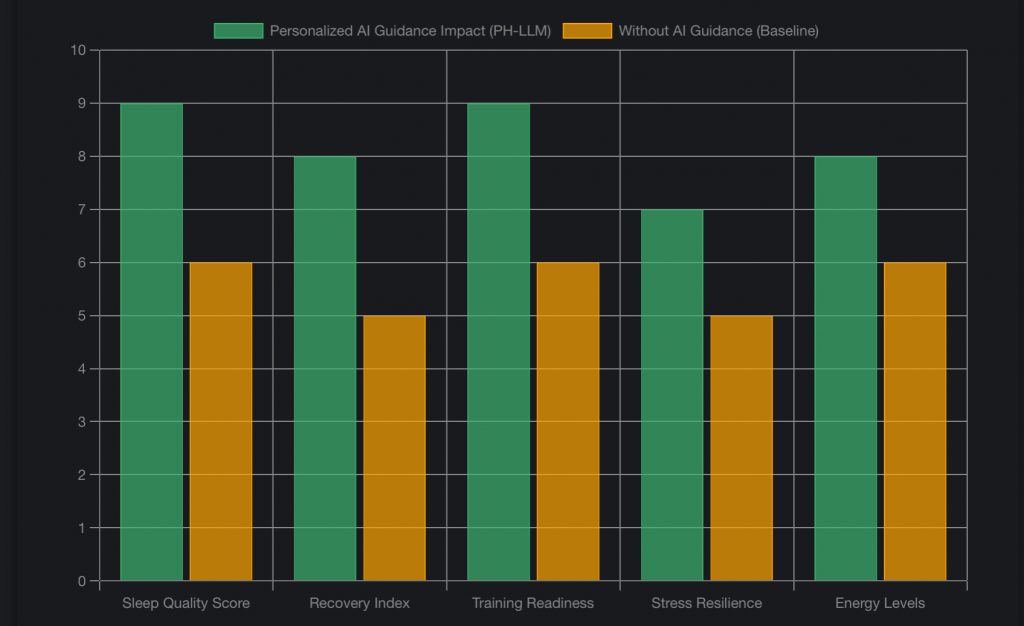
This bar chart illustrates the potential impact of personalized AI guidance (PH-LLM) on various health metrics compared to a baseline without such guidance. The data suggests that AI-driven insights can significantly enhance sleep quality, recovery, training readiness, stress resilience, and overall energy levels.
Actionable Recommendations for Better Rest
Based on continuous analysis, a PH-LLM provides hyper-personalized recommendations each morning. These can include:
- Adjustments to your bedtime routine based on your sleep latency and wake-up times.
- Suggestions for optimizing your sleep environment (e.g., temperature, light exposure).
- Guidance on managing pre-sleep activities, such as caffeine intake or screen time.
- Alerts regarding potential sleep disturbances and advice on seeking professional help if necessary.
Optimizing Fitness with AI Coaching
Beyond sleep, PH-LLMs provide robust support for fitness coaching, enabling individuals to achieve their exercise goals more efficiently and safely. By integrating real-time data with long-term trends, the AI acts as a dynamic training partner.
Dynamic Workout Planning and Adaptation
PH-LLMs can create personalized workout plans that are not static but adapt in real-time to your body’s responses. This means if you’re experiencing fatigue or have had a poor night’s sleep, the AI can suggest modifications to your training intensity or volume to prevent overtraining and promote optimal recovery.
They can also analyze your performance data to identify plateaus or areas where you could push harder, providing targeted feedback and new challenges to keep your progress consistent. This level of dynamic adaptation far surpasses what traditional, static workout plans can offer.

A close-up of a person’s hand adjusting a fitness wristband.
Holistic Fitness Management
The coaching extends to various aspects of fitness, including:
- Recovery Optimization: Based on training load and sleep quality, the AI recommends optimal recovery strategies.
- Nutrition Tips: While not a substitute for a registered dietitian, some models can offer general nutrition guidance to complement fitness goals.
- Motivation and Accountability: Through personalized messaging and progress tracking, PH-LLMs can help users stay motivated and consistent with their health routines.
The Future of Personal Health: Ethical Considerations and Potential
As PH-LLMs become more sophisticated and integrated into daily life, it’s essential to consider their broader implications, including privacy and the ongoing evolution of AI in healthcare. While these tools offer immense potential, they are designed to enhance human expertise, not replace it.
mindmap
root[“Personal Health LLM”]
PHLLM_Core[“Core Functionality”]
Data_Analysis[“Analyze Multimodal Data”]
Wearable_Metrics[“Wearable Metrics”]
Heart_Rate[“Heart Rate”]
Sleep_Patterns[“Sleep Patterns”]
Activity_Levels[“Activity Levels”]
User_Inputs[“User Inputs”]
Exercise_Logs[“Exercise Logs”]
Mood_Journals[“Mood Journals”]
Personalized_Recommendations[“Generate Personalized Recommendations”]
Sleep_Improvement[“Sleep Improvement”]
Hygiene_Tips[“Hygiene Tips”]
Schedule_Adjustments[“Schedule Adjustments”]
Fitness_Optimization[“Fitness Optimization”]
Workout_Plans[“Workout Plans”]
Recovery_Strategies[“Recovery Strategies”]
PHLLM_Benefits[“Key Benefits”]
Hyper_Personalization[“Hyper-Personalization”]
Tailored_Advice[“Tailored Advice”]
Proactive_Coaching[“Proactive Coaching”]
Dynamic_Adaptation[“Dynamic Adaptation”]
Expert_Level[“Expert-Level Performance”]
Benchmarked_Accuracy[“Benchmarked Accuracy”]
Efficiency[“Efficiency & Accessibility”]
Scalable_Guidance[“Scalable Guidance”]
PHLLM_Challenges[“Challenges & Considerations”]
Data_Privacy[“Data Privacy & Security”]
Confidentiality[“Confidentiality”]
Ethical_AI[“Ethical AI Development”]
Bias_Mitigation[“Bias Mitigation”]
Complementary_Role[“Complementary Role to Human Experts”]
Tool_Not_Replacement[“Tool, Not Replacement”]
PHLLM_Applications[“Applications & Examples”]
Wearable_Integration[“Integration with Wearables”]
Smartwatches[“Smartwatches”]
Smart_Rings[“Smart Rings”]
AI_Coaching_Tools[“Existing AI Coaching Tools”]
WHOOP_Coach[“WHOOP Coach”]
Oura_Advisor[“Oura Advisor”]
ONVY[“ONVY”]
PHLLM_Training[“Training & Development”]
Fine_Tuning[“Fine-Tuning on Health Data”]
Medical_Exams[“Medical Exams”]
Case_Studies[“Coaching Case Studies”]
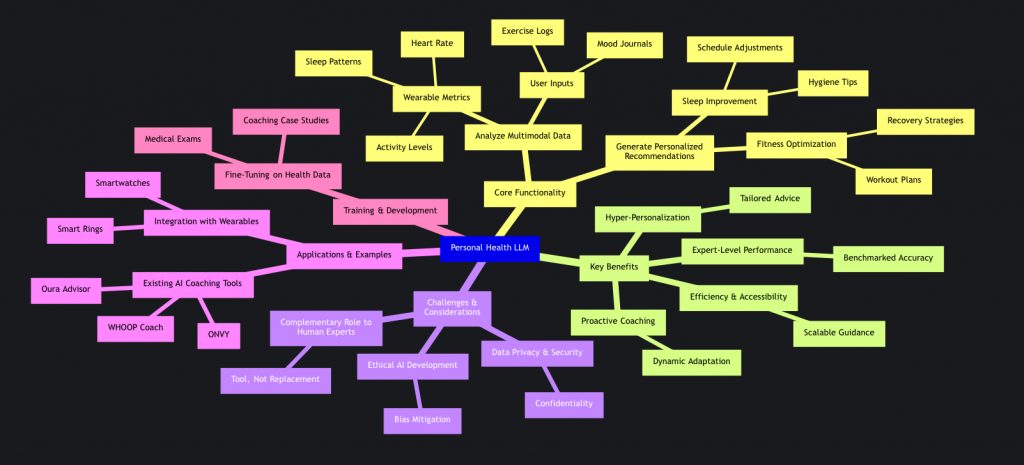
This mindmap illustrates the comprehensive ecosystem of a Personal Health Large Language Model (PH-LLM), outlining its core functionalities, key benefits, associated challenges, real-world applications, and the foundational training methods that enable its advanced capabilities.
The Human-AI Partnership
It is crucial to recognize that PH-LLMs are powerful tools designed to augment personal health management, not to replace the nuanced judgment of human medical professionals. While they can offer highly accurate and personalized insights, complex health conditions or sudden critical symptoms still necessitate consultation with doctors or specialists. The AI acts as an intelligent assistant, empowering individuals with more information and guidance for proactive wellness.
Data Privacy and Security
The extensive collection and analysis of personal health data raise important questions about privacy and data security. Developers of PH-LLMs must prioritize robust encryption, anonymization techniques, and transparent data governance policies to ensure user information is protected. Users, in turn, must be aware of the data practices of the platforms they choose and make informed decisions about sharing their sensitive health information.
Key Distinctions: PH-LLM vs. Traditional AI/Apps
| Feature | Personal Health LLM (PH-LLM) | Traditional Health AI / Apps |
|---|---|---|
| Data Input Range | Multimodal: Wearable biometrics (polysomnogram, HR, training load), subjective logs, clinical data. | Limited: Often focuses on step counts, basic sleep tracking, manual input. |
| Intelligence & Reasoning | Advanced natural language understanding and reasoning over numerical data, trained on expert knowledge. | Rule-based algorithms, pattern recognition; less contextual understanding. |
| Personalization Level | Hyper-personalized, dynamic, adapts in real-time based on individual physiological responses and behavior. | Generic or template-based advice; less adaptive. |
| Coaching Style | Proactive, conversational, integrates behavioral science for long-term change. | Reactive, data summarization, reminders. |
| Knowledge Depth | Near expert-level performance on complex health assessments (e.g., sleep medicine exams). | Basic health facts and generalized advice. |
This table highlights the significant advantages PH-LLMs hold over traditional health AI and applications, particularly in their ability to process diverse data, reason intelligently, and deliver highly personalized and proactive coaching.
This video, titled “AI Research Radar | Towards a Personal Health Large Language Model”, offers an insightful overview of the fundamental concepts behind PH-LLMs. It discusses how these advanced AI systems are being developed to understand and process complex personal health data, specifically focusing on their application in areas like sleep and fitness coaching. The video helps to contextualize the technical underpinnings and the potential impact of these models on individual well-being.
Frequently Asked Questions
What exactly is a Personal Health Large Language Model (PH-LLM)?
A PH-LLM is an AI system, often fine-tuned from powerful general LLMs, specifically designed to process and interpret personal health data from sources like wearable devices and user-reported information. It provides personalized coaching and recommendations for improving sleep and fitness.
How does a PH-LLM differ from a regular fitness tracker app?
Unlike basic fitness tracker apps that primarily collect and display data, a PH-LLM analyzes complex, multimodal data (e.g., detailed sleep stages, training load, mood logs) and uses advanced reasoning to provide truly personalized, proactive, and dynamic coaching advice. It goes beyond simple data summarization.
Can a PH-LLM replace my doctor or personal trainer?
No, a PH-LLM is designed to be a powerful tool to enhance your personal health management, not to replace medical professionals or certified trainers. It provides personalized insights and guidance, but for complex health conditions, diagnoses, or injuries, consultation with human experts is always necessary.
What kind of data does a PH-LLM use?
PH-LLMs utilize multimodal data, including physiological metrics from wearable devices (heart rate, sleep patterns, activity levels), subjective inputs like exercise logs and mood journals, and potentially even professional health assessment questions.
How accurate are the recommendations from a PH-LLM?
Leading PH-LLMs, such as those developed by Google, have demonstrated high accuracy in health-related assessments, often matching or exceeding the performance of human experts in specific knowledge domains like sleep medicine and fitness. The accuracy is driven by extensive training on vast datasets and expert-curated information.
Conclusion
The emergence of Personal Health Large Language Models for sleep and fitness coaching marks a transformative era in personalized wellness. By intelligently synthesizing vast quantities of multimodal health data, these advanced AI systems offer unprecedented levels of tailored guidance and proactive coaching. They move beyond mere data tracking to provide actionable insights that adapt dynamically to individual needs, demonstrating expert-level understanding in complex health domains. While serving as powerful tools to empower individuals in their pursuit of optimal sleep and fitness, PH-LLMs also highlight the importance of ethical AI development and a collaborative approach with human expertise. This innovation promises a future where personalized health management is more intelligent, accessible, and effective than ever before.
Recommended Further Exploration
- How AI wearables are transforming preventative healthcare
- The role of behavioral science in AI health coaching
- Ethical considerations for AI in personal health data
- Future trends in AI-powered personalized nutrition coaching
Referenced Search Results
firstwordhealthtech.com
Google’s personal health LLM matches experts on sleep, fitness – firstwordhealthtech.com
research.google
Advancing personal health and wellness insights with AI – Google Research
arxiv.org
Towards a Personal Health Large Language Model – arXiv
deepgram.com
ONVY: Your Personal AI Health Coach and Wellness Assistant | Deepgram
honehealth.com
AI Health Coaches Are Here—Can You Trust Them? – honehealth.com
nature.com
A personal health large language model for sleep and fitness coaching – Nature Medicine
nature.com
Leveraging LLMs and wearables to provide personalized health insights – Nature Scientific Reports
saatva.com
Best Sleep Tracker Apps & How They Work | Saatva
health.harvard.edu
Smarter, safer workouts with a wearable fitness tracker – Harvard Health Publishing
flickr.com
Jawbone Fitness Tracker (closeup) | Mike Silverman | Flickr
theconversation.com
Why an ‘AI health coach’ won’t solve the world’s chronic disease problems
unite.ai
AI Health Coaches: Transforming Personal Wellness Through AI-Driven Recommendations – Unite.AI
eightsleep.com
Eight Sleep | Autopilot: AI for Better Sleep
rm.edu
Harnessing AI for Fitness and Health
january.ai
AI health coach: What it is and why you need it
forbes.com
Open AI And Thrive’s AI Health Coach Is A Bold Step Toward Hyper-personalized Healthcare
topai.tools
AI Health Coach – Top AI tools
va.gov
reddit.com
I Asked AI For A Fitness Plan, Thoughts? : r/PetiteFitness
wellmeright.com
eightsleep.com
Introducing: Our AI-Powered Sleep Coach
apps.apple.com
Hapday: ADHD AI Coach on the App Store
news.ycombinator.com
A personal health large language model for sleep and fitness coaching …
forbes.com
How To Make AI Your Secret Weapon For Achieving …
openai.com
Saving lives with AI health coaching | OpenAI
nestedhealthcoach.com
play.google.com
ONVY – Health Coaching with AI – Apps on Google Play
ringconn.com
RingConn App: Your AI Guide to Total Wellness
prnewswire.com
Eight Launches AI-Powered Personal Sleep Coach
medium.com
Creating Personalized Health Insights with LLM Agents – Medium
truecoach.co
Top 9 AI Tools For Personal Trainers – TrueCoach
apps.apple.com
Athlytic: AI Fitness Coach on the App Store
neurohive.io
Google PH-LLM: A Language Model for Health Monitoring
sleepi.ai
AI-Driven Sleep Coach App for Peak Daily Performance
reddit.com
linkedin.com
Google’s research on a Personal Health Large Language Model …
apps.apple.com
HUMANITY – AI Health Coach on the App Store
lennylarry.com
How to Use AI to Plan Your Next Workout
fitnessai.com
FitnessAI — Get Stronger, Faster with Artificial Intelligence
arxiv.org
[2406.06474] Towards a Personal Health Large Language Model
onvy.health
sleeptracker.com
The Clinically Validated Platform for Sleep Medicine and Clinical …
reddit.com
Asked AI for a fitness plan. Thoughts? : r/WorkoutRoutines
entrepreneur.com
All About The New AI Health Coach | Entrepreneur
openai.com
whoop – Delivering LLM-powered health solutions – OpenAI
rocky.ai
AI Coaching Platform Tailored to Your Company | Rocky – App for Personal Development
apps.apple.com
Remy AI: Sleep & Health coach on the App Store
time.com
AI Health Coaches Are Coming Soon to a Device Near You | TIME
microsoft.com
Workout Smarter with AI Fitness Coaching | Microsoft Copilot
signos.com
Using AI for Workout Plans: How Smart Technology Can …
amazon.com

Essentials of Fitness & Health: The First Practical Guide to …
Last updated August 15, 2025