
Unpacking the “Mind Virus” Metaphor: A Deep Dive into the Socialism Debate
Exploring the controversial claim that socialist ideologies operate as an intellectual contagion and its profound implications.
68+ Sources
- 1.Key Insights into the “Mind Virus” Allegation
- 2.The Genesis of the “Mind Virus” Metaphor
- 3.Substantive Critiques of Socialism Beyond the Metaphor
- 4.Counterarguments and the Spectrum of Socialism
- 5.Why the “Mind Virus” Frame is Problematic
- 6.The Intersection of Ideology and Mental Well-being
- 7.Understanding Criticisms and Counter-Criticisms
- 8.The Broad Landscape of Ideological Critique
- 9.The Social and Psychological Dimensions of Economic Systems
- 10.Frequently Asked Questions (FAQ)
- 11.Conclusion: Beyond the Rhetoric of a “Mind Virus”
- 12.Recommended Further Exploration
- 13.Referenced Search Results
Key Insights into the “Mind Virus” Allegation
- Metaphorical Framing: The “mind virus” label is a powerful metaphor used by critics to depict socialist ideas as harmful thought patterns that spread like an infection, potentially undermining rational thought.
- Critiques of the Metaphor: Many argue that applying the “mind virus” label to socialism oversimplifies complex ideologies, dehumanizes opponents, and stifles constructive debate, leading to increased polarization rather than understanding.
- Core Criticisms of Socialism: Substantive arguments against socialism often center on the economic calculation problem, concerns about incentives, innovation, and historical inefficiencies of centrally planned economies, rather than psychological diagnoses.
The assertion that “socialism is a mind virus” is a provocative statement frequently encountered in contemporary political discourse. This metaphor extends beyond a simple critique of an economic or political system; it characterizes socialism as an intellectual contagion, a belief system that “parasitizes one’s ability to think properly and accurately,” leading to a perceived loss of reason and logic. This framing is largely deployed by critics who contend that socialist ideas exploit human insecurities and emotions to gain influence and control, suggesting that such ideas are inherently irrational or detrimental and spread akin to an infection, subverting critical thinking.
The Genesis of the “Mind Virus” Metaphor
The “mind virus” or “idea pathogen” framing gained prominence through thinkers like Gad Saad, who use it to describe belief systems deemed unfalsifiable or detached from reality. This perspective suggests that certain ideologies, including socialism in this context, can take hold of individuals’ minds by appealing to emotions rather than rigorous reason. The implication is that these ideas, once embedded, can lead to a rejection of fundamental biological and economic realities. Critics employing this metaphor often point to a perceived appeal to sentiments of fairness and equality, which they argue can mask underlying flaws that lead to economic inefficiency, diminished individual freedom, and hindered innovation.

The concept of “brainwashing” or “mind control” has been used in various political contexts to describe the alleged manipulation of public thought.
The Psychological Underpinnings of the Claim
From a psychological standpoint, proponents of the “mind virus” theory suggest that socialism leverages human psychological needs for meaning and community. They argue that this appeal can be so potent that it creates intellectual defense mechanisms, making the ideology resistant to critical examination. Some critiques even extend to “woke” ideologies, viewing them as operating on similar psychological principles. This often leads to accusations that socialist ideas foster dependency and resentment rather than promoting individual agency and flourishing.
Mental Health and Economic Systems: A Contested Terrain
The relationship between economic systems and mental health is a complex and often debated topic. Proponents of socialism argue that it addresses issues like income inequality, which has been correlated with higher rates of mental illness in developed countries according to some surveys, including those from the World Health Organization. They suggest that socialist structures, by prioritizing collective well-being and reducing exploitation, could foster a greater sense of psychological security and belonging, thereby mitigating mental health challenges. This perspective posits that capitalism, with its emphasis on competition and individual accumulation, can lead to alienation and psychological distress.
Conversely, critics of socialism argue that it can be detrimental to mental health. They contend that the removal of worker autonomy, market incentives, and private property can lead to a “psychological absurdity” where individuals feel disempowered and unmotivated. Some even link extreme leftist forms of socialism to promoting victimhood, poor impulse control, and paranoia. The “mind virus” analogy, in this light, suggests that socialism can encourage resentment over personal reflection and action, leading to a toxic environment for individual mental well-being.
Substantive Critiques of Socialism Beyond the Metaphor
While the “mind virus” label is emotionally charged, it’s crucial to differentiate it from more substantive, evidence-based criticisms of socialism. These critiques primarily focus on the practical feasibility and efficiency of socialist systems, especially those involving centralized planning or extensive state control.
The Economic Calculation Problem and Resource Allocation
A cornerstone of anti-socialist arguments, particularly from the Austrian School of economics, is the “economic calculation problem.” This theory, famously articulated by Ludwig von Mises and expanded upon by Friedrich Hayek, posits that without private property rights, competitive markets, and the resulting price signals, rational economic calculation becomes impossible. In a centrally planned economy, where the state controls the means of production, there are no market prices to convey information about the relative scarcity and value of goods and services. This lack of information makes it exceedingly difficult, if not impossible, for planners to efficiently allocate resources, value capital goods, and determine consumer preferences. The consequence, according to this view, is systemic inefficiency, misallocation of labor, and a general inability to adapt to changing economic conditions or innovate effectively.
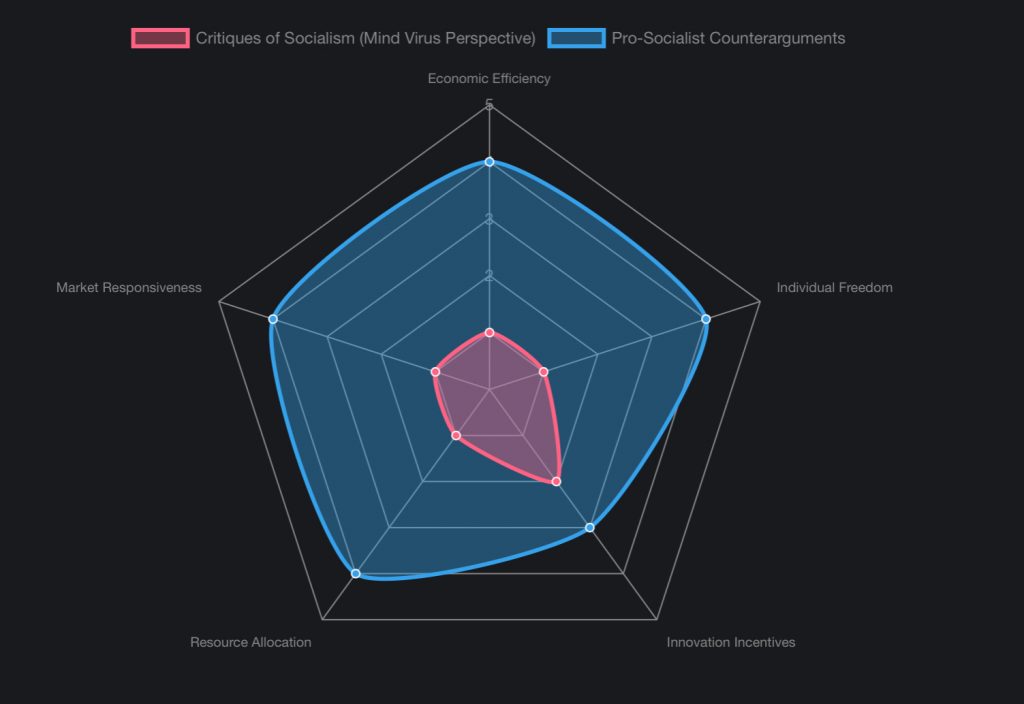
This radar chart illustrates perceived strengths and weaknesses of socialism from two opposing viewpoints. The “Mind Virus Perspective” highlights concerns about its impact on economic efficiency, individual freedom, innovation, resource allocation, and market responsiveness. Conversely, “Pro-Socialist Counterarguments” suggest that socialism, particularly in its mixed or democratic forms, can address these areas more effectively than pure capitalism. The scale is from 0 (very low) to 5 (very high).
Incentives, Innovation, and Human Nature
Another significant criticism revolves around incentives. Critics argue that socialist systems, by reducing or eliminating private ownership and market-based rewards, diminish the motivation for individuals to innovate, work hard, and take risks. The concept of “soft budget constraints,” where state-owned enterprises are not subject to the same pressures of bankruptcy as private firms, is also cited as leading to inefficiency and a lack of cost discipline. This perspective often posits that socialism ignores fundamental aspects of human nature, such as self-interest and the desire for personal gain, which are seen as crucial drivers of economic progress under capitalism.
Historical Performance and Real-World Outcomes
Many critics point to the historical failures of centrally planned socialist states, such as the Soviet Union, Maoist China, and more recently, Venezuela, as empirical evidence of socialism’s inherent unworkability. These examples are often cited to demonstrate that socialist systems tend to lead to economic stagnation, shortages, and, in some cases, political oppression and loss of individual liberties. The argument is that these historical outcomes are not mere accidents but rather inherent consequences of the socialist economic model.
Counterarguments and the Spectrum of Socialism
The “mind virus” metaphor, and many of the sweeping criticisms of socialism, often fail to acknowledge the broad spectrum of ideas and practices encompassed by the term “socialism.”
Defining the Target: Socialism’s Diverse Forms
“Socialism” is not a monolithic ideology. It ranges from social democracy and cooperative ownership models to centrally planned economies. To apply a single label like “mind virus” to all these variations is seen by many as oversimplifying and caricaturing complex systems. For instance, critiques of Soviet-style command economies do not automatically apply to Scandinavian social democracies, which integrate robust welfare states with market economies and private ownership.
The Aims of Socialism: Beyond Economics
Philosophical defenses of socialism often highlight its moral and political aims, focusing on reducing exploitation, domination, and alienation. Proponents argue that socialism seeks to achieve greater equality, social justice, and democratic control over production, addressing perceived failures and injustices of capitalism. They contend that a focus solely on economic efficiency misses the broader ethical objectives of socialist thought.
Mixed Models and Public Goods
Many contemporary debates about socialism revolve around mixed economies, where markets coexist with significant public ownership and strong social safety nets. The recent COVID-19 pandemic, for example, highlighted the importance of public goods and interdependence, such as healthcare systems and social safety nets. Socialists use such instances to justify universal services and collective action, arguing that certain societal needs cannot be adequately met by market forces alone.
Why the “Mind Virus” Frame is Problematic
Critics of the “mind virus” metaphor argue that its use is counterproductive for several reasons:
- Shortcuts Argument: Instead of engaging with specific policy proposals, economic mechanisms, or labor rights, the metaphor pathologizes the motives of those who hold socialist views, effectively shutting down constructive dialogue.
- Blurs Distinctions: It lumps together vastly different socialist theories—from democratic socialism to Marxist-Leninist planning—ignoring the nuances and specific empirical questions each raises.
- Escalates Polarization: Labeling opposing viewpoints as a “virus,” “brain rot,” or “cult” discourages good-faith debate and intensifies ideological divides, making it harder to find common ground or compromise.
Instead of resorting to such metaphors, a more productive approach involves concrete analysis. For instance, if one criticizes a particular socialist proposal, it’s more persuasive to articulate specific concerns: How would price discovery function? What governance mechanisms would prevent bureaucratic overreach? How would innovation be maintained? What empirical evidence supports or refutes the claims?
The Intersection of Ideology and Mental Well-being
The discussion around socialism and the “mind virus” metaphor often delves into the psychological impact of different economic systems. This can be visualized to show the perceived effects on individual and societal well-being based on the prevailing economic ideology.
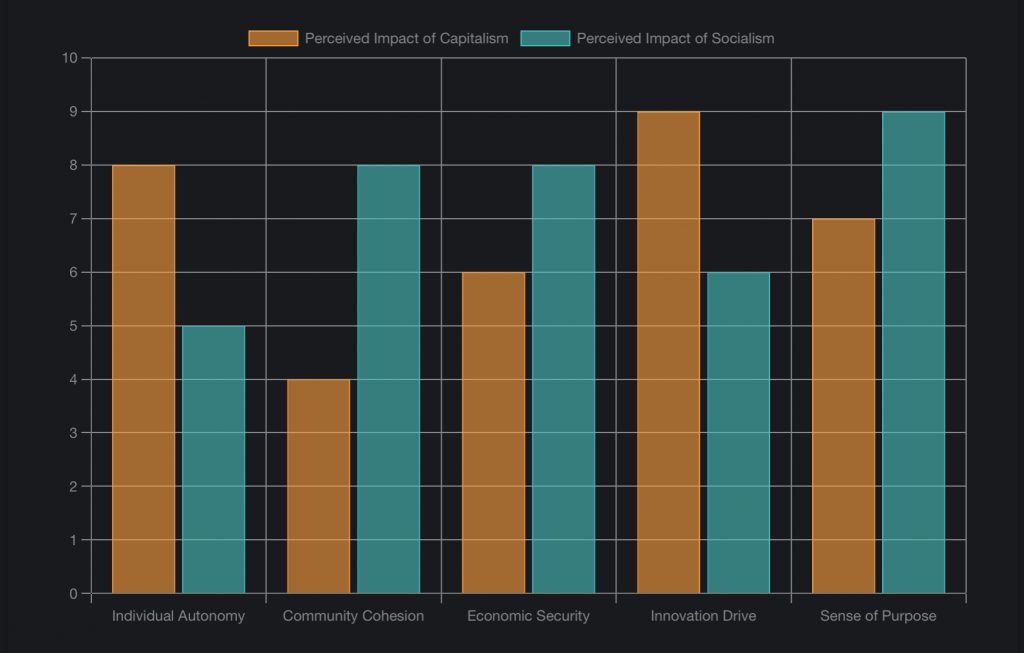
This bar chart compares the perceived impacts of capitalism and socialism on various psychological and social dimensions, based on general public discourse. The scale is from 0 (very low impact) to 10 (very high impact). These are opinionated analyses to illustrate the different focuses of each system, rather than empirical data.
Understanding Criticisms and Counter-Criticisms
The debate around socialism is characterized by deeply entrenched positions. The table below summarizes key criticisms leveled against socialism and the counter-arguments often put forth by its proponents.
| Area of Criticism | Common Criticism of Socialism | Pro-Socialist Counter-Argument / Context |
|---|---|---|
| Economic Efficiency | Eliminates market prices and private property, leading to inefficient resource allocation (economic calculation problem). | Can address market failures, provide public goods, and ensure equitable distribution, leading to a more stable economy. |
| Individual Freedom | Centralized planning and state control erode personal liberties and autonomy. | Can free individuals from economic exploitation, provide universal services (healthcare, education), and enhance collective freedoms. |
| Incentives & Innovation | Weakens individual incentives for hard work, innovation, and risk-taking. | Motivation can stem from collective good, social responsibility, and intrinsic satisfaction; fosters innovation that benefits society, not just profit. |
| Human Nature | Ignores self-interest and competition; fails because it’s incompatible with how people naturally behave. | Emphasizes cooperation and solidarity, arguing that human nature is shaped by social structures and can be altruistic. |
| Historical Record | History shows failures (e.g., Soviet Union, Venezuela) leading to poverty, oppression, and inefficiency. | These were specific authoritarian implementations, not true socialism; many “failures” were due to external pressures or internal misinterpretations. |
| Psychological Impact | Fosters dependency, resentment, and a victimhood mentality; removes worker autonomy. | Reduces alienation created by capitalism, promotes community, and addresses mental health issues linked to inequality. |
The “mind virus” label, while effective as rhetoric, often serves to bypass these nuanced discussions, instead opting for a pathologization of an entire ideology. While socialism clearly has its critics and historical challenges, dismissing it as a mere “virus” risks intellectual dishonesty and hinders any potential for productive dialogue on socio-economic systems.
The Broad Landscape of Ideological Critique
The term “mind virus” isn’t exclusive to socialism. It’s a rhetorical tool used in various ideological battles. The underlying concept suggests that certain thought patterns or beliefs can be contagious and detrimental to rational thought. To illustrate this broader application, consider the following mind map:
mindmap
root[“The “Mind Virus” Concept”]
Criticisms[“Core Criticisms”]
Oversimplifies[“Oversimplifies complex ideas”]
Dehumanizes[“Dehumanizes opponents”]
Polarizes[“Increases societal polarization”]
Hinders_Debate[“Hinders rational debate”]
Application[“Application to Ideologies”]
Socialism[“Socialism #quot;Mind Virus#quot;”]
Economic_Calculation[“Economic Calculation Problem”]
Lack_of_Incentives[“Lack of Incentives”]
Historical_Failures[“Historical Failures”]
Erosion_of_Freedom[“Erosion of Individual Freedom”]
Woke_Ideologies[“Woke Ideologies”]
Identity_Politics[“Identity Politics”]
Cancel_Culture[“Cancel Culture”]
Reality_Denial[“Perceived Reality Denial”]
Authoritarianism[“Authoritarianism”]
Propaganda[“Propaganda”]
Thought_Control[“Thought Control”]
Cult_of_Personality[“Cult of Personality”]
Underlying_Assumption[“Underlying Assumption”]
Irrational_Spread[“Ideas spread irrationally”]
Infection_Metaphor[“Metaphor of intellectual infection”]
Counterpoints[“Counterpoints”]
Nuance_Needed[“Need for nuanced understanding”]
Good_Faith_Debate[“Importance of good-faith debate”]
Complex_Motivation[“Complex motivations for beliefs”]
Effects[“Societal Effects”]
Division[“Increased social division”]
Mistrust[“Erosion of trust”]
Stagnation[“Intellectual stagnation”]
Arguments for a mind map to illustrate the concept of a “mind virus” as applied to ideologies, focusing on its criticisms, applications to different belief systems (including socialism), underlying assumptions, and the counterpoints raised against its use. It highlights how the metaphor is employed to describe perceived irrational or harmful spread of ideas, and the societal consequences of such framing.
The Social and Psychological Dimensions of Economic Systems
The discussions around socialism often intersect with deep psychological and social considerations. Many of the arguments, both for and against, touch upon fundamental aspects of human well-being, community, and individual flourishing.
This dialogue is vividly explored in various media, including videos that delve into the psychological impacts of economic systems. One particularly relevant video titled “Capitalism Hits Home: How Capitalism Breeds Sociopathic Behavior” from the series “Capitalism Hits Home,” featuring Richard D. Wolff, critically examines how capitalist structures might influence individual and social psychology. The video suggests that the inherent competitive nature and emphasis on profit within capitalism could foster behaviors that are detrimental to empathy and community, potentially leading to what some might term sociopathic tendencies. This perspective offers a strong counter-narrative to the “mind virus” assertion against socialism, by turning the critique back on capitalism. It argues that if any system could be described as fostering “unhealthy” mindsets, it might be one that prioritizes individual gain over collective well-being, potentially contributing to mental health challenges like anxiety and alienation. This provides valuable context for understanding the mental health debate surrounding economic systems.
This video, “Capitalism Hits Home: How Capitalism Breeds Sociopathic Behavior,” delves into the psychological and social impacts of capitalist systems, offering a critical perspective that contrasts with the “mind virus” framing of socialism.
Frequently Asked Questions (FAQ)
What does the term “mind virus” mean in this context?
The term “mind virus” is a metaphor used by critics to describe ideologies, such as socialism, that they believe spread like an infection and negatively affect rational thought, leading to what they perceive as harmful societal outcomes. It suggests that these ideas are irrational or pathological and can take hold of individuals’ minds, often by appealing to emotions.
Is there a consensus on whether socialism is a “mind virus”?
No, there is no consensus. The “mind virus” label is a highly contentious and rhetorical term, primarily used by critics of socialism. Many scholars and proponents of socialism argue that this metaphor oversimplifies complex ideologies, stifles legitimate debate, and can lead to the dehumanization of those with differing political views.
What are the main criticisms of using the “mind virus” metaphor?
The main criticisms include that it reduces complex ideological debates to a psychological pathology, making nuanced discussion difficult. It also tends to polarize public discourse, demonize opponents, and ignore the varied forms and goals of socialism, leading to a shallow understanding of the ideology.
What are some substantive criticisms of socialism that are not based on the “mind virus” metaphor?
Substantive criticisms of socialism often include the economic calculation problem (the difficulty of efficient resource allocation without market prices), concerns about disincentives for innovation and productivity due to reduced private property rights, and historical evidence of inefficiencies and lack of individual freedom in centrally planned socialist economies.
How do proponents of socialism respond to these criticisms?
Proponents of socialism argue that it aims to address social and economic inequalities, provide universal access to essential services, and promote collective well-being. They often differentiate between various forms of socialism (e.g., social democracy vs. authoritarian communism) and argue that many criticisms are based on misinterpretations or specific historical examples that do not represent the full scope of socialist thought. They also contend that capitalism has its own inherent flaws, such as exacerbating inequality and alienation.
Conclusion: Beyond the Rhetoric of a “Mind Virus”
The characterization of “socialism as a mind virus” is a potent rhetorical device employed by its critics to discredit the ideology. While it effectively conveys a sense of contagion and perceived irrationality, it ultimately functions as a metaphorical dismissal rather than a substantive critique. This framing tends to oversimplify a diverse and complex set of socio-economic theories and practices, ranging from democratic socialism to centrally planned economies. Critics utilizing this metaphor often focus on concerns regarding economic inefficiency, the alleged erosion of individual freedom, and historical failures of specific socialist regimes. However, such a broad condemnation often overlooks the nuanced objectives of socialist thought, which frequently aim to address issues of inequality, exploitation, and social justice.
The use of the “mind virus” metaphor often stifles productive dialogue, leading to increased polarization rather than fostering a deeper understanding of competing economic and political philosophies. A more constructive approach involves engaging with the specific arguments for and against different forms of socialism, examining their practical implications, and analyzing their historical performance with nuance. Ultimately, whether one views socialism as a desirable path or a flawed system, a comprehensive understanding requires moving beyond charged metaphors and engaging with the intricate economic, social, and psychological dimensions of its proposals.
Recommended Further Exploration
- The economic calculation problem in socialist systems
- Social democracy vs. democratic socialism differences
- Psychological impacts of capitalism and socialism
- Historical analysis of socialist experiments
Referenced Search Results
mises.org
The Socialist Fantasy – Mises Institute
mises.org
The Impossibility of Socialist Economy – Mises Institute
mises.org
Socialism: A Property or Knowledge Problem? – Mises Institute
mises.org
Mind Viruses Creating Social Justice Warriors – Mises Institute
investopedia.com
arnoldkling.substack.com
Speaking of Mind Viruses – Arnold Kling’s Substack
en.wikipedia.org
Criticism of socialism – Wikipedia
courses.lumenlearning.com
The Disadvantages of Socialism – Lumen Learning
mises.org
4 Reasons Why Socialism Fails – Mises Institute
ccta.regent.edu
The Psychological Absurdity of Communism – Regent University
psychologytoday.com
The Psychology of Socialism and Capitalism
hoover.org
kosmosjournal.org
Seeing Wetiko: On Capitalism, Mind Viruses, and Antidotes for a …
geoffjward.medium.com
The ‘mind-virus’ waging war on consciousness | by Geoff Ward | Medium
psychologytoday.com
The Psychology of Socialism and Capitalism
drrichswier.com
What Has Happened To These Bright Minds? – Dr. Rich Swier
convergencemag.com
Socialist Strategy and the Biden Debate – Convergence Magazine
arnoldkling.substack.com
The Woke Virus and its Hosts – by Arnold Kling
thedailyeconomy.org
Virus of the Mind: Critical Theory + Postmodernism | The Daily Economy
kimmonson.com
Socialism and its Effect on Mental Health – The Kim Monson Show
historyofeconomicthought.mcmaster.ca
[PDF] The Psychology of Socialism
reddit.com
good criticism of socialism : r/Socialism_101
reddit.com
Socialism and Mental Health : r/socialism – Reddit
somatosphere.com
Socialism and the Psy-ences: The Past, the Post-, and the Beyond
fraserinstitute.org
Western societies must stop the spread of Marxism
econlib.org
The Leiter-Caplan Socialism Debate – Econlib
digitalcommons.uri.edu
[PDF] Relevance to Psychology of Beliefs About Socialism
dohadebates.com
Definitions drive debates: What we mean by “socialism”
njeconomics.org
New Jersey Council for Economic Education | The “Mind Viruses” Creating Social Justice Warriors
americanconservativemovement.com
American Conservative Movement – American exceptionalism isn’t dead.
blogs.scientificamerican.com
Will COVID-19 Make Us More Socialist? – Scientific American Blog …
fee.org
How Believing in Socialism Can Make You Miserable – FEE.org
twitter.com
reddit.com
r/CapitalismVSocialism on Reddit: Socialism and its Variants are …
socialsci.libretexts.org
16.1E: The Capitalist Critique of Socialism
britannica.com
nature.com
Beyond ideological platitudes: socialism and psychiatry in Eastern …
capx.co
Socialism brings out the worst in people
wsj.com
Mamdani May Herald a New Kind of Class Struggle
socialismtoday.org
Capitalism creates alienation, not psychology – Socialism Today
socialistproject.ca
Crisis and Virus: COVID-19 in Context – Socialist Project
scientificamerican.com
Will COVID-19 Make Us More Socialist? | Scientific American
secularhumanism.org
Waking from Wokism: Inoculating Ourselves against a Mind Virus
pmc.ncbi.nlm.nih.gov
Psychiatry in Former Socialist Countries: Implications for North …
washingtonpost.com
Opinion | How the coronavirus sparked an epidemic of intellectual malpractice – The Washington Post
antonypmueller.substack.com
plato.stanford.edu
Socialism – Stanford Encyclopedia of Philosophy
psychologytoday.com
How Capitalism Shapes the Mind | Psychology Today
sgtreport.com
The “Mind Viruses” Creating Social Justice Warriors | SGT Report
newswars.com
The “Mind Viruses” Creating Social Justice Warriors
igor-chudov.com
DEBATE: Viruses do not exist? Or do they? – by Igor Chudov
wsws.org
The coronavirus pandemic and the perspective of socialism – World Socialist Web Site
werkat.substack.com
Mind Viruses Are Fake, Propaganda Isn’t – by Gary Norman
theecologist.org
oll.libertyfund.org
Karl Marx and the Liberal Critique of Socialism
en.wikipedia.org
thetricontinental.org
CoronaShock and Socialism | Tricontinental: Institute for Social …
fee.org
frontiersin.org
Frontiers | Systems Thinking About SARS-CoV-2
benjaminlcorey.com
“Socialism” Feels Different When You’re The One Needing Help, Huh? – Benjamin L. Corey
quora.com
What is the main criticism of socialism?
socialismonfilm.amdigital.co.uk
Virus – Socialism on Film: The Cold War and International Propaganda – Adam Matthew Digital
overcomingbias.com
objectiveobscence.medium.com
On Mises and the “Calculation Problem” – Objective Obscene – Medium
currentaffairs.org
newdiscourses.com
No, the Woke Won’t Debate You. Here’s Why. – New Discourses
fee.org
quora.com
Is socialism more of a disease rather than an ideology?
Last updated August 18, 2025