
J.C.D. Clark’s provocative re-evaluation challenges long-held beliefs about this pivotal intellectual era.
56+ Sources
- 1.Key Insights into Clark’s Redefinition of the Enlightenment
- 2.Decoding Clark’s Groundbreaking Thesis on the Enlightenment
- 3.The Scholarly Debate and Broader Implications
- 4.The Spectrum of Enlightenment Interpretations
- 5.Insights from Related Media
- 6.Frequently Asked Questions (FAQ)
- 7.Conclusion
- 8.Recommended Further Queries
- 9.Referenced Search Results
Key Insights into Clark’s Redefinition of the Enlightenment
- Challenging Convention: J.C.D. Clark asserts that “the Enlightenment” as a singular, unified historical movement was not recognized in the 18th century but rather emerged as a retrospective construct in the mid-20th century.
- Historiographical Focus: Clark’s work positions “the Enlightenment” primarily as a historiographical concept, a “civil myth” used to underpin narratives of modernization, secularization, and democratization.
- Diverse Tendencies, Not Unified Movement: While “enlightenment” (lowercase) encompassed widespread metaphors of light and critique, Clark argues that the historical reality was a collection of diverse, fragmented intellectual shifts without a coherent, shared program across different nations.
The review “What Is Enlightenment?” by Felice Basbøll and Samuel Rubinstein, published on July 28, 2025, in The Philosophers’ Magazine, critically examines J.C.D. Clark’s 2024 book, The Enlightenment: An Idea and Its History (Oxford University Press). This review highlights Clark’s iconoclastic approach to historical inquiry, particularly his challenge to the conventional understanding of the Enlightenment. Clark, a historian known for deconstructing what he perceives as “liberal pieties” and “civil religions,” now turns his attention to the very concept of the Enlightenment, arguing that much of what is commonly believed about it is a modern, rather than an 18th-century, construct.
Decoding Clark’s Groundbreaking Thesis on the Enlightenment
J.C.D. Clark’s central argument, as presented in his book and elaborated upon by Basbøll and Rubinstein, is that “the Enlightenment” (with a capital ‘E’) was not a unified, self-conscious movement during the 18th century. Instead, it is largely a modern historiographical construct. This contrasts sharply with traditional views that depict the Enlightenment as a coherent period of intellectual and social change driven by reason and science, leading inevitably to modernization, secularization, and democratization.
The “Idea” Versus the “History”
Clark meticulously traces the concept of “the Enlightenment” across England, Scotland, France, Germany, and the United States from approximately 1650 to the present. He argues that while metaphors of “light” and “enlightenment” (lowercase ‘e’) were prevalent, signifying learning, critique, and intellectual awakening, they did not coalesce into a singular, recognized movement with a unified program among contemporary thinkers. The notion of a grand, cohesive Enlightenment only gained significant currency in the mid-20th century, becoming a label applied retrospectively to diverse intellectual and social phenomena.
This perspective implies that the conventional narrative of the Enlightenment as a direct progenitor of modernity and liberal democracies may be oversimplified, if not entirely misleading. Clark contends that historians and public intellectuals have “reified” the term, transforming a convenient label into a supposed historical actor. This reification, he suggests, serves as a “civic myth” to underwrite narratives of inevitable progress, secularization, and the “birth of the modern world.”
Challenging Established Narratives
One of Clark’s most provocative claims, noted by Basbøll and Rubinstein, is that his is the “first ever book on the Enlightenment.” This bold statement is not a dismissal of prior scholarship but rather an assertion that previous works assumed the existence of a discernible “thing” called the Enlightenment. Clark’s approach, conversely, is to investigate the history of the *idea* of the Enlightenment and its later deployment, rather than presuming its inherent existence as a unified historical phenomenon.
This reinterpretation suggests that what is often perceived as a common core of Enlightenment thought—such as reason, natural religion, critique of authority, and legal/political reformism—may dissolve upon closer inspection into more divergent, locally specific trajectories. While similarities undoubtedly exist, Clark emphasizes that differences between various intellectual currents of the period often dominate.
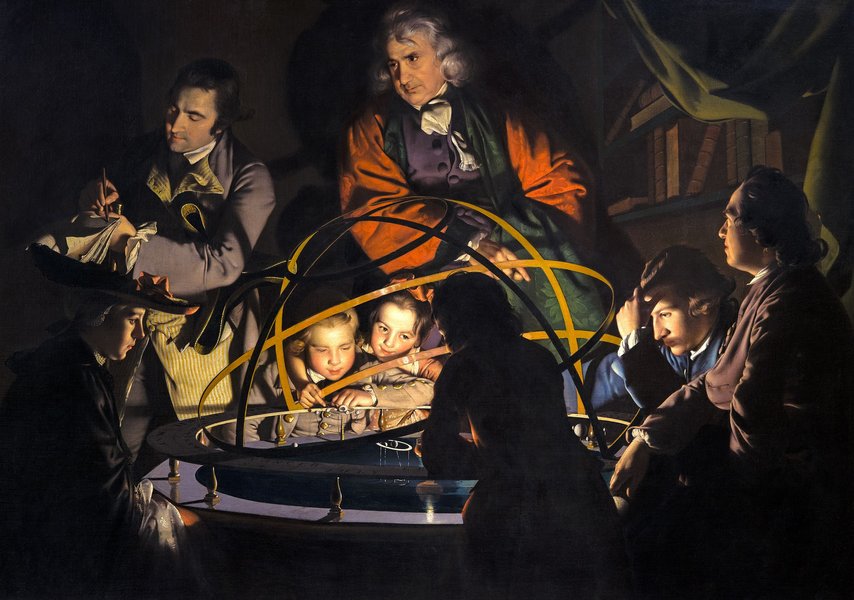
“A Philosopher Lecturing on the Orrery” by Joseph Wright of Derby (c. 1766), often seen as embodying the spirit of scientific inquiry during the Age of Enlightenment.
The Scholarly Debate and Broader Implications
Clark’s work intensifies a long-running revisionist trend within Enlightenment scholarship. While some historians argue that enough “family resemblances” existed to justify a synthetic category, even if plural (“Enlightenments”), Clark goes further by questioning the very coherence of “the Enlightenment” as an 18th-century concept. His formula, “enlightenment was everywhere, but the Enlightenment was nowhere,” succinctly captures his thesis.
Historiographical Impact and Modern Debates
The stakes of Clark’s argument are significant. If “the Enlightenment” is primarily a 20th-century organizing device, then many sweeping claims about a decisive transition to “modernity” and the origins of liberal democracy, secularism, and science’s authority require rethinking. His analysis is particularly relevant in today’s polarized debates, where the Enlightenment is often invoked to defend or critique contemporary societal structures and ideologies.
Clark’s broader career has been characterized by critiques of “Whig interpretations of history”—those that view the past as a linear march toward contemporary values. His demolition of the “self-satisfied mythology” surrounding “democratization,” “secularization,” and “modernization” is seen by Basbøll and Rubinstein as exposing a “hollow core” and “circular argument” in these narratives. The review frames Clark as a “blasphemer” against secular sacred cows, challenging premises like inevitable secular progress.
mindmap
root[“The Enlightenment Reimagined by Clark”]
Clark_Thesis[“Clark’s Core Argument”]
Not_Unified_Movement[“Not a Unified 18th-Century Movement”]
Modern_Construct[“Primarily a Modern Historiographical Construct”]
No_Self_Identification[“18th-Century Thinkers Didn’t Self-Identify”]
Historiographical_Critique[“Critique of Traditional Historiography”]
Reification[“‘Reified’ as Historical Actor”]
Civic_Myth[“Used as ‘Civic Myth’ for Progress”]
Secularization_Myth[“Dismantles ‘Secularization’ Mythology”]
Democratization_Myth[“Challenges ‘Democratization’ Narratives”]
Impact_and_Implications[“Impact & Implications”]
Rethinks_Modernity[“Rethinks Origins of Modernity”]
Challenges_Progress_Narrative[“Challenges Linear Progress Narratives”]
Contemporary_Relevance[“Relevant to Current Cultural Debates”]
Reviewer_Perspective[“Basbøll & Rubinstein’s Emphasis”]
Iconoclast_Clark[“Clark as ‘Iconoclast'”]
Demolition_Job[“Applauds ‘Demolition Job’ on Liberal Pieties”]
First_Ever_Book[“Highlights ‘First Ever Book’ Claim”]
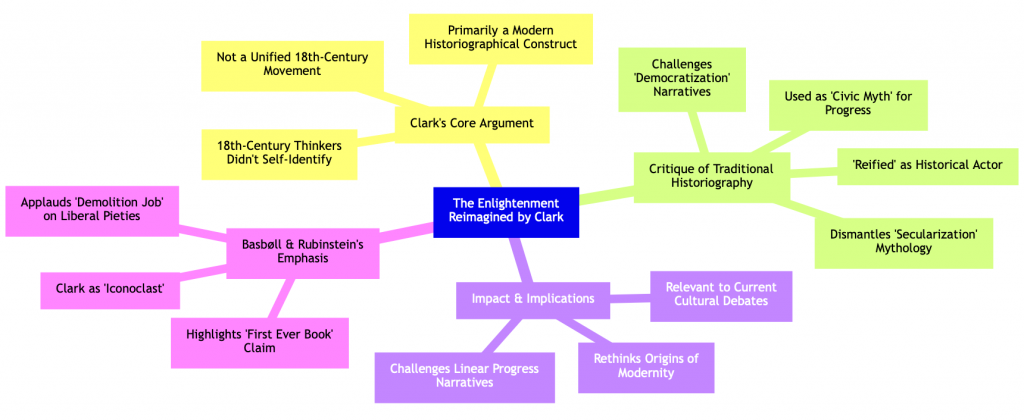
A mindmap illustrating J.C.D. Clark’s central arguments about the Enlightenment and their interpretation by Basbøll and Rubinstein.
Clark’s book is part of Oxford University Press’s extensive series on Enlightenment studies, and its arguments stand in contrast to other significant works from the same publisher that treat the Enlightenment as a verifiable 18th-century movement. Reviews, such as those by David A. Bell and Jeremy Black, have engaged with Clark’s thesis, with some praising its erudition while others find it unconvincing or overstating the absence of shared Enlightenment ideas.
The Spectrum of Enlightenment Interpretations
To further contextualize Clark’s work, it’s helpful to consider different approaches to understanding the Enlightenment. These range from viewing it as a coherent movement to a collection of disparate ideas, and critically examining its influence on contemporary society.
Conceptual Cohesion vs. Historical Reality
While Clark emphasizes the lack of a unified “Enlightenment” in the 18th century, many historians still identify a constellation of shared themes and intellectual pursuits that characterize the era. These include an emphasis on reason, empiricism, individual liberty, and a questioning of traditional authority, particularly religious and political ones. The debate often revolves around the degree of coherence and intentionality among thinkers across different geographical and social contexts.
The following table summarizes key aspects of the Enlightenment, contrasting traditional interpretations with Clark’s revisionist perspective:
| Aspect | Traditional Interpretation | J.C.D. Clark’s Revisionist View |
|---|---|---|
| Nature of the Movement | A unified, self-aware intellectual movement of the 18th century. | Not a unified movement; a retrospective, 20th-century historiographical construct. |
| Recognition at the Time | Thinkers widely identified with “the Enlightenment” (or equivalent terms). | Largely unknown; “enlightenment” (lowercase) existed as metaphor, not a capitalized movement. |
| Core Goals | Advancement of reason, science, liberty, and human rights; challenge to traditional authority. | Diverse, fragmented intellectual shifts; no coherent program across countries. |
| Influence on Modernity | Directly led to secularization, democratization, and modernization. | Used as a “civic myth” to justify narratives of progress; links are often overstated. |
| Scholarly Approach | Focus on mapping shared themes and impact. | Focus on the history of the “idea” of Enlightenment and its later uses. |
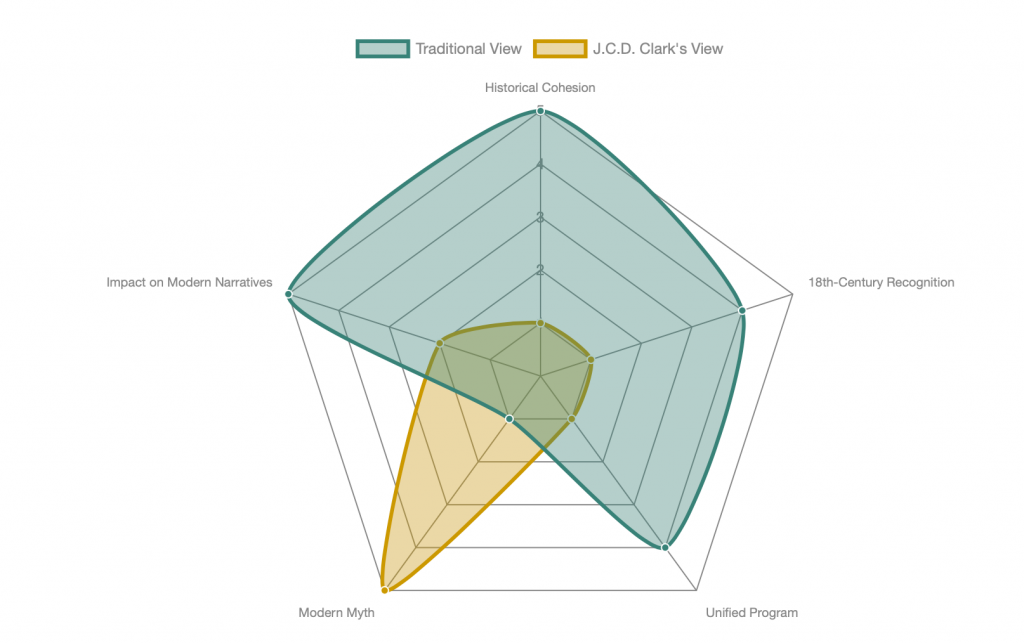
This radar chart visually compares the traditional interpretation of the Enlightenment with J.C.D. Clark’s revisionist perspective across several key attributes. A higher score indicates stronger alignment with the attribute.
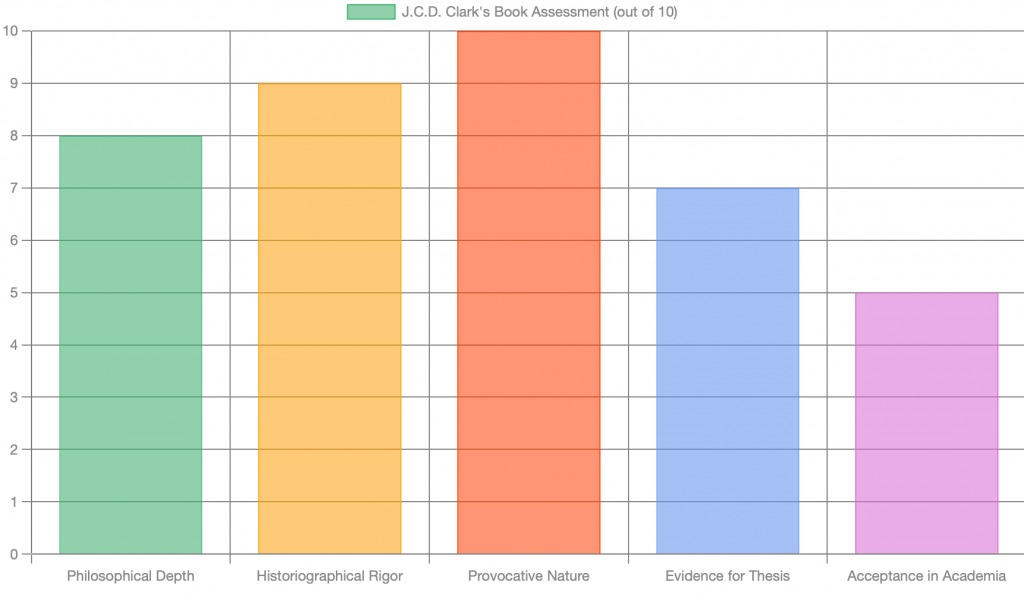
This bar chart offers an assessment of J.C.D. Clark’s book based on various academic criteria, from its philosophical depth to its reception within the scholarly community.
Insights from Related Media
The provided media sources include several YouTube videos that delve into various aspects of the Enlightenment, from its historical context to its philosophical underpinnings and key figures. One particularly relevant video for understanding the broader academic discussion around the Enlightenment is “The Enlightenment: An Idea and Its History by J. C. D. Clark” from Oxford University Press.
Exploring Clark’s Work Directly
Official overview of J.C.D. Clark’s book, “The Enlightenment: An Idea and Its History” by Oxford University Press.
This video from Oxford University Press, directly concerns J.C.D. Clark’s book, The Enlightenment: An Idea and Its History. It is highly relevant as it provides an official summary or perspective on the work that Basbøll and Rubinstein review. By watching this video, one can gain direct insight into the publisher’s framing of Clark’s arguments, which often align with Clark’s own intended message. This complements the review by offering a primary source view of the book’s core claims, allowing for a more complete understanding of why Basbøll and Rubinstein characterize Clark as they do and what specific arguments they are engaging with.
Frequently Asked Questions (FAQ)
What is J.C.D. Clark’s main argument in his book on the Enlightenment?
J.C.D. Clark argues that “the Enlightenment” as a singular, unified historical movement was not recognized in the 18th century but is rather a retrospective, 20th-century historiographical construct, primarily serving as a “civil myth” to support narratives of modernization and secularization.
How does Clark’s view differ from traditional understandings of the Enlightenment?
Traditional views often portray the Enlightenment as a coherent period of intellectual and social change with a unified program, directly leading to modern societal structures. Clark challenges this, suggesting that while “enlightenment” (lowercase) existed as a metaphor for intellectual shifts, “the Enlightenment” (capitalized) was not a self-identified movement by thinkers of the time.
What is the significance of Basbøll and Rubinstein’s review?
The review “What Is Enlightenment?” by Basbøll and Rubinstein highlights Clark’s iconoclastic approach, emphasizing his challenge to long-held “liberal pieties” and “civil religions” surrounding the Enlightenment. It underscores the provocative nature of Clark’s claim that his book is the “first ever” on the Enlightenment in its analytical framework.
Why does Clark call his book the “first ever” on the Enlightenment?
Clark asserts this because he believes previous books assumed the Enlightenment was a pre-existing, discernible historical “thing.” His book, instead, offers a history of the *idea* of the Enlightenment and how it was constructed and deployed over time, rather than a narrative of a unified 18th-century movement.
Conclusion
J.C.D. Clark’s The Enlightenment: An Idea and Its History, as reviewed by Felice Basbøll and Samuel Rubinstein, offers a profound and challenging reinterpretation of one of history’s most pivotal periods. By contending that “the Enlightenment” as a cohesive movement is a modern invention rather than an 18th-century reality, Clark compels scholars and the public alike to re-examine the foundational narratives of modernity, secularism, and democratization. His work emphasizes that while intellectual ferment and “enlightenment” were widespread, the grand, unified movement we often conceptualize was largely a later construct. This revisionist perspective not only deepens our understanding of the 18th century but also reveals the dynamic and often ideologically charged nature of historical interpretation itself.
Recommended Further Queries
- [How did the concept of ‘the Enlightenment’ evolve in the 20th century?](/?query=How did the concept of ‘the Enlightenment’ evolve in the 20th century?)
- [What are other revisionist interpretations of the Enlightenment?](/?query=What are other revisionist interpretations of the Enlightenment?)
- [How do historians define ‘Whig history’ in relation to the Enlightenment?](/?query=How do historians define ‘Whig history’ in relation to the Enlightenment?)
- [What is the debate surrounding the origins of modernity and the Enlightenment?](/?query=What is the debate surrounding the origins of modernity and the Enlightenment?)
Referenced Search Results
philosophersmag.com
What Is Enlightenment? – The Philosophers’ Magazine
global.oup.com
The Enlightenment – J. C. D. Clark – Oxford University Press
news.ku.edu
New book argues Enlightenment was merely a modern concept, not… – University of Kansas
historyreclaimed.co.uk
Jonathan Clark on The Enlightenment – History Reclaimed
davidabell.substack.com
The Enlightenment That Wasn’t – by David A. Bell – French Reflections
youtube.com
The Enlightenment: An Idea and Its History by J. C. D. Clark – YouTube
smarthistory.org
Smarthistory – The Age of Enlightenment, an introduction
gallerease.com
Influence of Enlightment in Art – Gallerease
tota.world
European Artists of the Enlightenment | TOTA
chnmuseum.cn
highlights&master – The Art of the Enlightenment – National Museum …
muckrack.com
Articles by Samuel Rubinstein’s Profile
livingfreedom.uk
The universities: what is to be done? – by LivingFreedom
goodreads.com
The Enlightenment: An Idea and Its History by J.C.D. Clark | Goodreads
amazon.com

The Enlightenment in America (Galaxy Books): May, Henry F.
books.google.com
The Enlightenment: A Very Short Introduction – John Robertson
goodreads.com
Enlightenment by Sarah Perry | Goodreads
amazon.co.uk

The Enlightenment: An Idea and Its History: Amazon.co.uk: Clark, …
blackwells.co.uk
The Enlightenment : J. C. D. Clark : 9780198916284 : Blackwell’s
goodreads.com
JCD Clark – The Enlightenment: An Idea and Its History – Goodreads
academyofideas.uk
Je suis toujours Charlie – by Rob Lyons and Felice Basbøll
felicebasbll.substack.com
Living Freedom – by Felice Basbøll
en.wikipedia.org
Oxford University Studies in the Enlightenment – Wikipedia
cell.com
link.springer.com
J. C. D. Clark, The Enlightenment: An Idea and Its History | Society
jeremyblackhistorian.wordpress.com

Review of Clark’s The Enlightenment | Jeremy Black
amazon.com
Enlightenment, Revolution and the Periodical Press (Oxford …
mh.bmj.com
A portrait of a female body: Rubens and Helena’s legs
theosthinktank.co.uk
What is (The) Enlightenment? In conversation with Jonathan Clark
livingfreedom.uk
Living Freedom | LivingFreedom | Substack
academic.oup.com
The Enlightenment: An Idea and Its History | Oxford Academic
philosophersmag.com
amazon.com
Amazon.com: J. C. D. Clark: books, biography, latest update
x.com
voltaire.ox.ac.uk
Oxford University Studies in the Enlightenment – Voltaire Foundation
amazon.com
Amazon.com: The Enlightenment: An Idea and Its History: 9780198916284: Clark, J. C. D.: Books
folkets.dk
barnesandnoble.com
The Enlightenment: An Idea and Its History by J. C. D. Clark, Hardcover | Barnes & Noble®
liverpooluniversitypress.blog
Oxford University Studies in the Enlightenment at 70: Celebrating …
freespeechchampions.substack.com
Saving feminism from itself: Feminism Against Progress, by Mary Harrington, reviewed
lawliberty.org
Did the Enlightenment Really Happen? – Kevin Schmiesing
global.oup.com
The Enlightenment – John Robertson – Oxford University Press
theguardian.com
Enlightenment by Sarah Perry – a tale of cosmic beauty on the Essex marshes | Fiction | The Guardian
stevenpinker.com
Review Excerpts for Enlightenment Now | Steven Pinker
link.springer.com
Silencing trust: confidence and familiarity in re-engineering knowledge infrastructures
pmc.ncbi.nlm.nih.gov
Is Another kind of Biologization Possible? On Biology and the psy Sciences
the-tls.com
The Enlightenment by J. C. D. Clark | Book review | The TLS
information.dk
Både liberalismen og socialismen har spillet fallit over for klimakrisen
x.com
S. I. Rubinstein (@si_rubinstein) / …
liverpooluniversitypress.manifoldapp.org
Oxford University Studies in the Enlightenment
bookpage.com
Book review of Enlightenment by Sarah Perry
link.springer.com
Rationality, perception, and the all-seeing eye
blog.ayjay.org
Clark’s Enlightenment – The Homebound Symphony
theartofthrowingeggs.substack.com
The Art of Throwing Eggs | Samuel Rubinstein | Substack
philpapers.org
J. C. D. Clark, God” and “the Enlightenment – PhilPapers
plato.stanford.edu
Enlightenment (Stanford Encyclopedia of Philosophy)
morgensternbooks.com
The Enlightenment: An Idea and Its History | Morgenstern Books. …
scholar.google.se
global.oup.com
The Enlightenment – Anthony Pagden – Oxford University Press
freespeechchampions.substack.com
Without free speech there is no social justice
newbooksnetwork.com
J. C. D. Clark, “The Enlightenment: An Idea and Its History” (Oxford …
literaryreview.co.uk
Last updated August 22, 2025