
The Relationship Between Political Affiliation and Demographic Trends
63+ Sources
- Key Insights into Ideology and Fertility
- The Unfolding Narrative of Fertility Rates by Political Spectrum
- Disentangling the “Why”: Factors Driving the Fertility Divergence
- Visualizing the Demographic Divide
- The Intertwined Nature of Politics, Society, and Demography
- Frequently Asked Questions (FAQ)
- Conclusion: A Complex Demographic Tapestry
- Recommended Further Exploration
- Referenced Search Results
Key Insights into Ideology and Fertility
- Widespread Decline: While a notable gap exists, fertility rates are generally declining across the developed world, impacting both conservative and liberal populations, though at different rates.
- The Conservative Fertility Advantage: Conservatives consistently exhibit higher fertility rates and a greater desire for children compared to liberals, a gap that has progressively widened over recent decades.
- Beyond Ideology: Socioeconomic factors such as housing costs, childcare expenses, and cultural shifts also play significant roles in shaping fertility decisions across the political spectrum.
The assertion that birth rates have remained largely stable for right-wing individuals while plummeting for left-wing individuals in recent decades across the U.S. and other developed nations captures a significant, observed demographic trend. However, a nuanced understanding reveals that while conservatives do indeed have a relative “fertility advantage,” the overall trend in birth rates is one of decline across the board, with differences in the *rate* and *magnitude* of that decline between ideological groups. This complex interplay of political identity, cultural values, economic realities, and societal shifts profoundly impacts family formation.
The Unfolding Narrative of Fertility Rates by Political Spectrum
Current research overwhelmingly supports the existence of a widening fertility gap between conservatives and liberals. This phenomenon is not merely anecdotal but is substantiated by comprehensive studies analyzing national and sub-national demographic data in the United States and similar trends observed in European countries.
The Conservative Fertility Advantage: A Consistent Trend
Multiple analyses confirm that individuals and communities aligning with conservative or right-wing ideologies consistently exhibit higher fertility rates. In the U.S., states and counties with a stronger Republican voting history demonstrate higher total fertility rates (TFRs) compared to their Democratic-leaning counterparts. For instance, data from 2023 indicates TFRs around 2.0 in states like South Dakota, contrasted with 1.3-1.5 in blue states such as Vermont or California.
This “conservative fertility advantage” is not a new phenomenon but has become increasingly pronounced. While in the 1970s, fertility rates between liberal and conservative women showed little disparity, by the 2000s, a significant divergence had emerged. This widening gap suggests that political identity is now a more potent predictor of family size preferences than in previous generations. Young Republicans, for example, consistently express a desire for more children than young Democrats.
The “Trump Bump” and Political Optimism
Interestingly, some research points to a “Trump bump” following the 2016 U.S. presidential election, where Republican-leaning areas experienced a relative uptick or slower decline in births compared to Democratic areas. This resulted in a slight shift of national births towards Republican counties, suggesting that political events and sentiments of optimism under a preferred administration can subtly influence fertility decisions.

A visual representation of the fertility rate advantage among conservative-leaning populations.
The Broader Context: Universal Fertility Decline
Despite the conservative advantage, it is crucial to understand that fertility rates are in a general state of decline across the developed world, including within conservative demographics. The U.S. total fertility rate reached a historic low of 1.6 children per woman in 2024, significantly below the replacement level of 2.1 children needed to maintain a stable population without immigration. This decline has been ongoing for nearly two decades, with a notable acceleration since 2007.
Therefore, while the rate of decline may differ, it is inaccurate to claim that birth rates for right-wingers have “barely changed.” Even traditionally high-fertility states like Utah have seen their rates fall, albeit less drastically than in liberal-leaning regions. The overall trend is a broad-based decline, with the ideological gap representing a divergence in the *severity* of this decline rather than a complete exemption for any group.
Contributing Factors to the Overall Decline
The universal decline in fertility is attributed to a confluence of factors:
- Shifting Priorities: Young adults increasingly prioritize education, career advancement, and personal development before family formation.
- Economic Pressures: The rising cost of living, particularly housing and childcare, makes raising children more financially challenging.
- Increased Opportunities for Women: Greater educational and workforce opportunities for women often correlate with delayed childbearing and smaller family sizes.
- Access to Contraception and Family Planning: Widespread availability of effective contraception allows for greater control over family size and timing of births.
Disentangling the “Why”: Factors Driving the Fertility Divergence
The widening gap in fertility rates between conservatives and liberals is not solely due to ideological differences but is influenced by a complex web of cultural, economic, and social factors that often align with political leanings.
Cultural and Value Orientations
Conservative individuals and communities often adhere to more traditional family structures and values, which tend to encourage larger families. This includes a stronger emphasis on marriage and childbearing as central life goals. Religious belief, often correlated with conservative ideologies, also plays a significant role in encouraging higher fertility.
Conversely, liberal or progressive individuals often prioritize personal autonomy, individualism, and career development. While not inherently anti-child, these values can lead to delayed childbearing or a preference for smaller families. Additionally, liberal areas often embrace a broader range of family structures beyond the traditional nuclear family.
Geographic and Economic Disparities
The geographic distribution of political ideologies also plays a role. Republican-leaning states and counties often feature more affordable housing, lower taxes, and a cost of living that is generally more conducive to raising larger families. In contrast, many Democratic-leaning areas are urban centers characterized by high housing costs, expensive childcare, and a competitive job market, making it financially challenging to have multiple children.
This table illustrates some key differentials between conservative and liberal environments that contribute to fertility rate variations:
| Factor | Conservative-Leaning Areas | Liberal-Leaning Areas |
|---|---|---|
| Housing Costs | Generally more affordable, allowing for larger homes. | Higher, especially in urban centers, limiting family size. |
| Cost of Living | Lower overall expenses, including childcare. | Higher, impacting disposable income for families. |
| Cultural Emphasis | Stronger traditional family values, pro-natalist sentiment. | Emphasis on individualism, career, and diverse life paths. |
| Age at First Birth | Tendency towards earlier childbearing. | Tendency towards delayed childbearing. |
| Desired Family Size | Higher desired number of children. | Lower desired number of children. |
The Role of Political Identity in Family Planning
Research suggests that political identity is increasingly intertwined with family size preferences. This isn’t just about economic conditions or cultural values but also how individuals perceive their future within a particular political landscape. Optimism or pessimism about a country’s direction under a specific political administration might subtly influence decisions about family formation.
Visualizing the Demographic Divide
To further illustrate the nuances of fertility rates across the political spectrum, we can consider some analytical representations. While specific, hard data is complex and varies by region and year, these charts offer an opinionated analysis of the trends discussed.
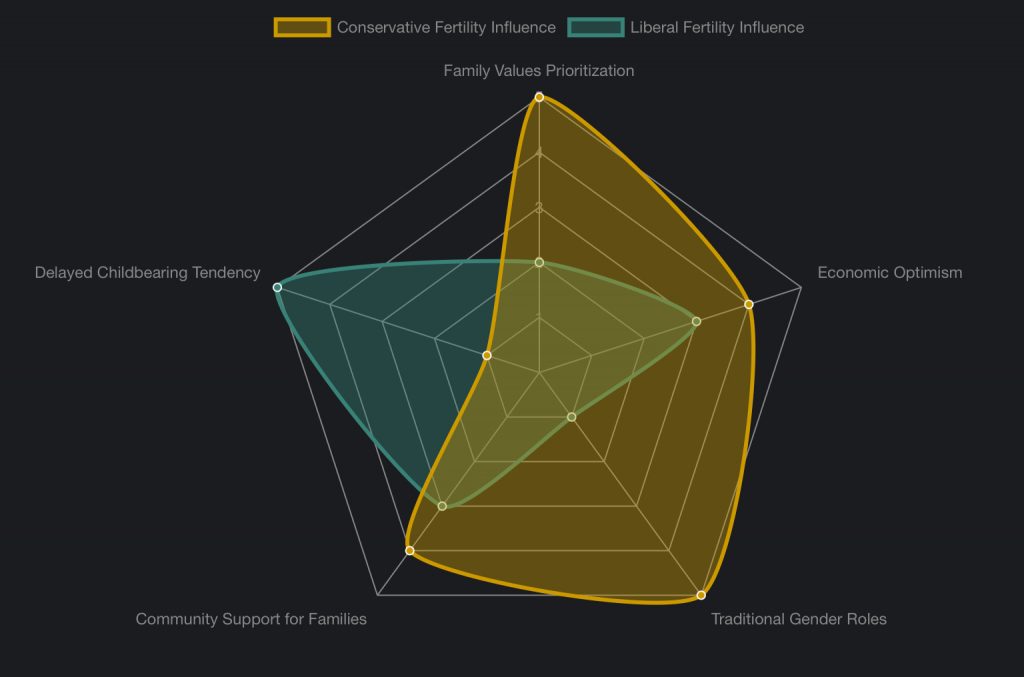
This radar chart illustrates the perceived influence of various factors on fertility decisions, comparing conservative and liberal perspectives. Conservatives tend to place higher emphasis on family values and traditional roles, contributing to a higher fertility inclination, while liberals show a greater tendency towards delayed childbearing.
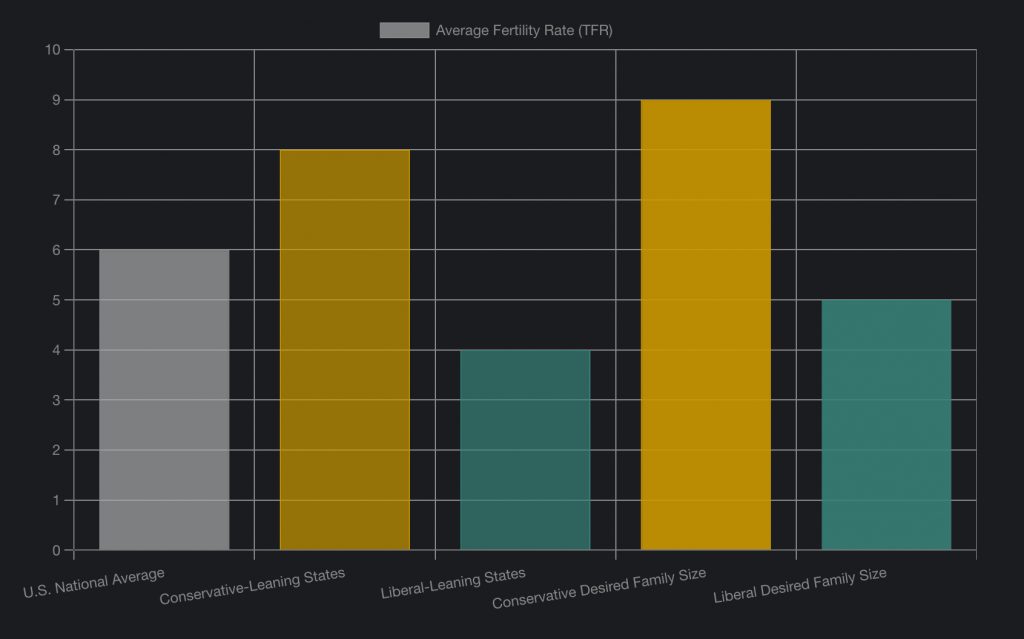
This bar chart offers an analytical comparison of generalized fertility rates and desired family sizes across the U.S. and different political leanings, using a qualitative scale. It underscores the higher actual and desired fertility rates among conservative populations compared to liberals.
The Intertwined Nature of Politics, Society, and Demography
The relationship between political ideology and fertility is multi-faceted, involving not just personal choices but also broader societal trends and policy impacts.
mindmap
root[“Political Ideology & Fertility Rates”]
Ideological_Divide[“Widening Fertility Gap”]
Conservative_Advantage[“Higher Conservative Fertility”]
Traditional_Values[“Emphasis on Traditional Family Values”]
Economic_Conditions_Red[“More Affordable Living (Red States)”]
Religious_Influence[“Stronger Religious Adherence”]
Liberal_Trends[“Lower Liberal Fertility”]
Individualism_Autonomy[“Prioritization of Individualism & Autonomy”]
Economic_Conditions_Blue[“High Cost of Living (Blue States)”]
Delayed_Childbearing[“Increased Age at First Birth”]
Overall_Decline[“Universal Fertility Decline”]
Socioeconomic_Factors[“Broader Socioeconomic Factors”]
Cost_of_Living[“Rising Cost of Raising Children”]
Education_Opportunities[“Increased Education & Career for Women”]
Urbanization[“Urbanization & Smaller Living Spaces”]
Policy_Impacts[“Government Policy & Incentives”]
Pro_Natalist_Policies[“Potential for Pro-Natalist Policies”]
Economic_Support[“Childcare & Housing Support”]
Consequences_Debates[“Societal & Political Implications”]
Demographic_Shifts[“Future Population Composition”]
Economic_Stability[“Impact on Workforce & Social Security”]
Political_Discussions[“Increasingly Political Issue”]
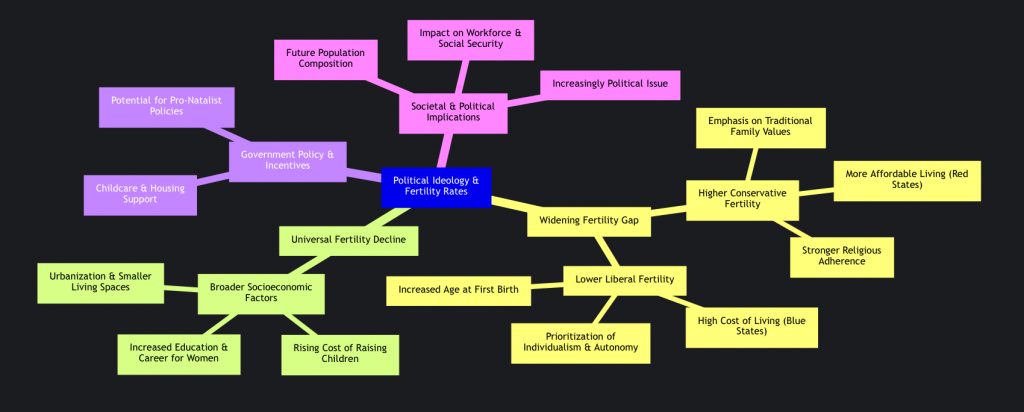
This mindmap illustrates the interconnected factors contributing to the observed differences in fertility rates between political ideologies, alongside the broader context of overall fertility decline and its societal implications.
The Political Salience of Birth Rates
The declining birth rate, particularly in liberal-leaning areas, has become a significant point of discussion and concern, especially among conservatives. Some view it as a threat to national strength, economic growth, and cultural continuity. This has led to calls for pronatalist policies aimed at encouraging higher birth rates.
Conversely, those on the left often highlight the systemic economic barriers to childbearing, advocating for policies that address housing affordability, childcare costs, and parental leave, rather than focusing solely on ideological motivations.
Global Parallels
This political-demographic divergence is not confined to the U.S. Similar patterns are observable in other developed nations, particularly in Europe, where conservative groups tend to exhibit higher fertility than their liberal counterparts. This suggests a broader trend where underlying cultural values and economic conditions, often correlated with political leanings, play a consistent role in shaping demographic outcomes.
This video, titled “Baby Bust: Why Conservatives are Obsessed with Birth Rates…”, explores the political discourse surrounding declining birth rates, particularly from a conservative perspective. It highlights why this demographic trend has become a significant concern for right-wing political thought, touching upon issues of population replacement, national strength, and cultural values.
Frequently Asked Questions (FAQ)
Are conservatives the only group with stable birth rates?
No, while conservatives generally exhibit higher and relatively more stable fertility rates compared to liberals, the overall trend in the developed world, including within conservative groups, is one of declining birth rates. The difference lies in the rate of this decline, which is less severe for conservatives.
What is the “replacement level” fertility rate?
The replacement level fertility rate is approximately 2.1 children per woman. This rate is necessary to maintain a stable population size over time, accounting for mortality and ensuring that each generation replaces itself.
Do economic factors influence fertility more than ideology?
Both economic factors and ideology play significant roles. Economic conditions such as housing costs, childcare expenses, and job security heavily influence family planning decisions. However, ideological and cultural values, such as the importance placed on traditional family structures or personal autonomy, also strongly shape fertility desires and outcomes, often correlating with economic realities.
Is this trend unique to the U.S.?
No, similar patterns of a widening fertility gap between conservative and liberal populations have been observed in many other developed countries, particularly across Europe. This suggests a broader, global trend influenced by similar underlying socio-economic and cultural factors.
Conclusion: A Complex Demographic Tapestry
The observation that birth rates have “barely changed for right-wingers” while falling more steeply for left-wingers captures a significant, real, and widening demographic gap. While all developed nations are experiencing an overall decline in fertility, the rate and magnitude of this decline differ significantly along ideological lines. Conservatives, influenced by traditional values, cultural norms, and often more favorable economic conditions in their geographic areas, tend to maintain higher fertility rates. In contrast, liberals, often in higher-cost urban environments and prioritizing different life paths, have seen a more pronounced decline. Understanding this dynamic requires acknowledging the interplay of political identity, cultural values, and profound socioeconomic shifts that collectively shape the future of population demographics.
Recommended Further Exploration
- Explore how housing affordability influences family size decisions.
- Investigate the global cultural values that correlate with higher or lower birth rates.
- Examine case studies of government policies aimed at boosting fertility rates.
- Delve into how fertility norms are passed down through generations within families.
Referenced Search Results
ifstudies.org
Where Are the Babies? In Red States, Fertility Rates Are Higher – Institute for Family Studies
ifstudies.org
The Trump Bump: The Republican Fertility Advantage in 2024 – Institute for Family Studies
city-journal.org
Deep-Blue Birth Dearth – City Journal
aei.org
The Conservative Fertility Advantage – American Enterprise Institute
psypost.org
ifstudies.org
The Conservative Fertility Advantage | Institute for Family Studies
psypost.org
Research reveals widening gap in fertility desires between Republicans and Democrats – PsyPost
theatlantic.com
The Coming Democratic Baby Bust – The Atlantic
reddit.com
How will an increasingly growing, global, right-wing …
quora.com
Is there a difference in the number of children between Democrats …
open.canada.ca
Family Size, Canada, Provinces and Territories – Open Government
newsweek.com
Plummeting Birth Rates Could Lead to a Hyper Liberal Future – Newsweek
census.gov
Nearly Two-Thirds of U.S. Households are Family Households
aeaweb.org
Partisan Fertility and Presidential Elections
reddit.com
r/YAPms on Reddit: Conservative-Liberal Fertility Divides (or …
ukcolumn.org
‘One Health’ and the demotion of humankind to the level of livestock | UKColumn
cosm.aei.org
The Geography of Fertility — Where are the Babies?
washingtonpost.com
Opinion | Trump wants a baby boom. Here’s how to spur Americans to have kids. – Washington Post
express.co.uk
theconversation.com
npr.org
americanthinker.com
Polarized by Birth: The Biological Roots of America’s Political Divide – American Thinker
cia.gov
Philippines – The World Factbook
reddit.com
fatherly.com
US Birth Rate Shows Republicans Have More Children Than Democrats
dailymail.co.uk
independentmediainstitute.org
The Sustainability Scam: How Self-Interest Ruins Good Ideas – Independent Media Institute
link.springer.com
forbes.com
America’s Declining Birth Rate Has Become A Hot-Button Political Issue—Here’s What To Know
politico.com
The political shockwaves of America’s falling birth rates
city-journal.org
pewresearch.org
U.S. household size is increasing for first time in at least 160 years
genus.springeropen.com
A global perspective on household size and composition, 1970–2020
reddit.com
Why have conservative governments globally had such …
economist.com
Trump’s first term coincided with a MAGA baby boom. Will his second?
census.gov
Families and Households – U.S. Census Bureau
mustreadalaska.com
Red state, blue state: Birth rates during Covid pandemic show fear-factor and political leanings
today.yougov.com
Too many babies? Too few? What Americans think about the birth rate | YouGov
axios.com
Why the conservative push to increase the birth rate looks doomed
prb.org
U.S. Household Composition Shifts as the Population Grows Older
thetimes.com
How Trump’s presidency could change where babies are born
macrotrends.net
pewresearch.org
Party affiliation of US voters by income, home ownership, union and …
pmc.ncbi.nlm.nih.gov
Parent Contributions to the Development of Political Attitudes in …
worldpopulationreview.com
Family Size by Country 2025 – World Population Review
scholarsarchive.byu.edu
Does Large Family Size Predict Political Centrism?
econweb.ucsd.edu
econofact.org
The Mystery of the Declining U.S. Birth Rate | Econofact
washingtonstand.com
Conservative States Have More Babies than Liberal States: Study
briefingbook.info
Local immigration surges did not swing the local presidential vote in 2024
financedictionarypro.com
Post-War Era: Economic Reconstruction and Baby Boom | Financial Terms Explained
quora.com
Why do right wingers often see declining birth rates in the …
cia.gov
pewresearch.org
Family Size Among Mothers | Pew Research Center
theamericanconservative.com
today.ucsd.edu
The Trump Baby Bump Among Republicans After the 2016 Election
www23.statcan.gc.ca
Family size (for census family) – Statistique Canada
frontiersin.org
Political Attitude and Fertility: Is There a Selection for the Political Extreme?
deseret.com
Perspective: The geography of fertility — where are the babies?
populationeducation.org
World Population by Religion, Global Stats – Population Education
data.worldbank.org
Fertility rate, total (births per woman) | Data
statista.com
Distribution of U.S. households by size 1970-2024 – Statista
ncbi.nlm.nih.gov
Political Attitude and Fertility: Is There a Selection for the Political Extreme? – PMC
Last updated August 29, 2025