The subtle mechanisms of modern control, from philosophical story telling to pervasive narratives.
72+ Sources
- 1.Key Insights into Intelligent Totalitarianism
- 2.Albert Camus: A Beacon Against Totalitarianism
- 3.Social Engineering: The Architects of Control
- 4.The “Great Replacement” Theory: A Modern Tool of Division
- 5.Intersections: The Nexus of Intelligent Totalitarianism
- 6.The Evolution of Control: From Overt to Insidious
- 7.Mapping the Web of Intelligent Totalitarianism
- 8.Conclusion: Vigilance in an Age of Intelligent Control
- 9.Frequently Asked Questions
- 10.Recommended Further Exploration
- 11.Referenced Search Results
Key Insights into Intelligent Totalitarianism
- Albert Camus vehemently opposed totalitarianism, advocating for human dignity and individual freedom against any system that justifies oppressive means with utopian ends.
- Social engineering serves as a sophisticated tool for totalitarian regimes, subtly manipulating public behavior and thought through propaganda, media control, and policy, making control less visible but deeply effective.
- The “Great Replacement” theory, while a controversial conspiracy theory, exemplifies how divisive narratives can be leveraged through social engineering to foster fear, division, and potentially support for authoritarian policies.
The concept of “Most Intelligent Totalitarianism” presents a chilling evolution of control, moving beyond overt coercion to more nuanced forms of manipulation. This sophisticated approach leverages intellectual frameworks, psychological tactics, and pervasive narratives to shape societal beliefs and behaviors. To fully grasp this phenomenon, it’s essential to explore the philosophical resistance offered by figures like Albert Camus, the pervasive influence of social engineering, and the divisive nature of theories such as the “Great Replacement.”
Albert Camus: A Beacon Against Totalitarianism
Albert Camus, the distinguished French-Algerian philosopher and Nobel laureate, stood as a formidable critic of totalitarian systems. His body of work, including seminal texts like The Rebel and The Plague, consistently articulated the dangers of ideologies that sought to control every facet of human existence. Camus vehemently rejected the notion that “the ends justify the means,” arguing that such a philosophy inevitably leads to tyranny and the suppression of individual liberty.
Camus’s Core Philosophical Stance
Camus’s critique was rooted in a deep humanism and an unwavering commitment to individual freedom and moral responsibility. He believed that totalitarian regimes, whether of the fascist or communist variety, fundamentally denied human dignity by subordinating individuals to abstract ideals or historical determinism. For Camus, genuine moral progress stemmed not from the imposition of a “perfect” society, but from a collective, compassionate rejection of injustice.

Albert Camus, a steadfast opponent of totalitarianism.
His philosophy emphasized:
- Revolt, Not Revolution: Camus advocated for a “rebellion” that respected human limits and rejected violence in the name of utopian ideals. This contrasted sharply with revolutionary ideologies that often justified widespread suffering for a future, idealized state.
- Limits and Moderation: He argued that politics must be bounded by ethical limits and moderation, rather than driven by absolute ideologies. The pursuit of “absolute justice” or “absolute freedom” often led to oppression.
- Truth and Language: Camus was acutely aware of how language could be manipulated by totalitarian regimes to degrade truth and justify domination. His works often exposed bureaucratic euphemisms and propaganda as tools of control.
For Camus, the “most intelligent” totalitarianism was not something to be admired but to be feared most deeply. It represented a system that skillfully cloaked its oppressive nature in rational plans, moral justifications, and administrative efficiency, making its insidious control harder to discern and resist. This “intelligence” lay in its ability to commit “crimes of logic,” where abstract reasoning led to inhumane outcomes.
Social Engineering: The Architects of Control
In the context of totalitarianism, social engineering refers to the deliberate, large-scale manipulation of societal behavior and institutions by states, political parties, or elite groups. It’s a sophisticated method of control that aims to shape public opinion, values, and actions to align with a specific ideology or agenda. Unlike brute force, social engineering often operates subtly, making its mechanisms less obvious to the populace.
Mechanisms of Societal Manipulation
Totalitarian regimes utilize various social engineering tactics to achieve their objectives:
- Propaganda and Media Control: Disseminating carefully curated information and suppressing dissenting voices to create a unified, state-sanctioned narrative. This includes controlling news, entertainment, and educational content.
- Policy Manipulation: Implementing laws and policies designed to steer societal behavior in desired directions, often under the guise of public good or progress. This can involve incentives, disincentives, and restrictions on individual choices.
- Erosion of Traditional Ties: Dismantling independent social structures like families, religious organizations, or community groups, and replacing them with artificial ties directly to the state and its ideology.
- Psychological Manipulation: Exploiting human cognitive biases and emotional vulnerabilities to induce compliance, fear, or loyalty. This can range from subtle messaging to more overt forms of intimidation.
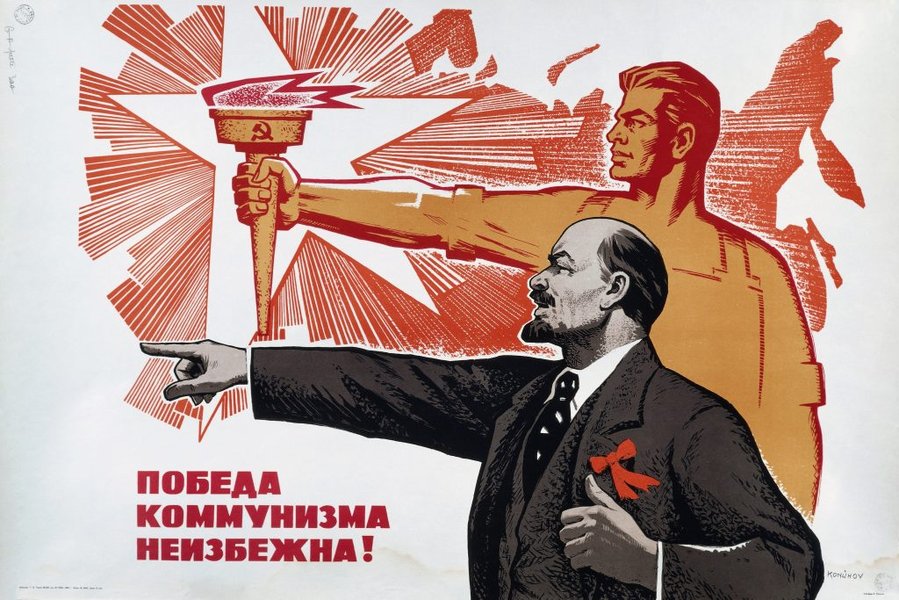
Soviet propaganda posters, a classic example of social engineering through visual media.
The “intelligence” in this form of totalitarianism lies in its capacity to deeply infiltrate and reshape human cognition and social structures. It seeks to enforce a singular “correct” way of living, making individuals more amenable to absorption into a unified movement and suppressing individualism and pluralism.
Distinction: Political vs. Cybersecurity Social Engineering
It is important to note that while the term “social engineering” is also used in cybersecurity, its application there differs significantly. In cybersecurity, it refers to psychological manipulation tactics used by attackers to trick individuals into revealing sensitive information or making security mistakes (e.g., phishing). In the context of totalitarianism, it’s a broader, systemic effort to control an entire populace.
The “Great Replacement” Theory: A Modern Tool of Division
The “Great Replacement” theory, originally coined by French writer Renaud Camus (distinct from Albert Camus), is a prominent contemporary example of how fear-mongering narratives can be employed to engineer societal division and potentially pave the way for more restrictive policies. This theory asserts that there is a deliberate, orchestrated effort to replace white populations in Western countries with non-white immigrants, often with an underlying tone of a cultural or demographic “invasion.”
The Narrative and its Impact
While widely debunked as a white nationalist conspiracy theory, its propagation exploits anxieties about demographic change and cultural identity. Renaud Camus frames it as “global replacism” or even a “genocide by substitution,” portraying it as a crime against humanity. This narrative, despite its lack of factual basis, serves as a powerful tool for social engineering by:
- Exploiting Fear: Tapping into fears of cultural erosion, economic insecurity, and loss of national identity.
- Fostering Division: Creating an “us vs. them” mentality, demonizing immigrant populations, and fueling xenophobia.
- Justifying Exclusion: Providing a pseudo-intellectual basis for policies that are discriminatory or restrictive regarding immigration and multiculturalism.
The dangerous aspect of this theory, in the context of “intelligent totalitarianism,” is its ability to manipulate public perception and mobilize segments of the population. It demonstrates how narratives, even those based on conspiracy, can be leveraged to reshape societal identity and demographic realities, potentially leading to increased societal control by those who promise to “solve” the perceived “replacement.”
Hereby the “Great Replacement Theory” and how manipulative propaganda functions. This video contextualizes how such theories, while often debunked, can be used to influence public opinion, aligning with the broader concept of social engineering in the service of control.
Intersections: The Nexus of Intelligent Totalitarianism
The “most intelligent totalitarianism” emerges at the intersection of these concepts. It is a form of control that does not necessarily rely on overt violence or a single dictatorial figure but rather on the subtle, pervasive manipulation of society. This “intelligence” is characterized by:
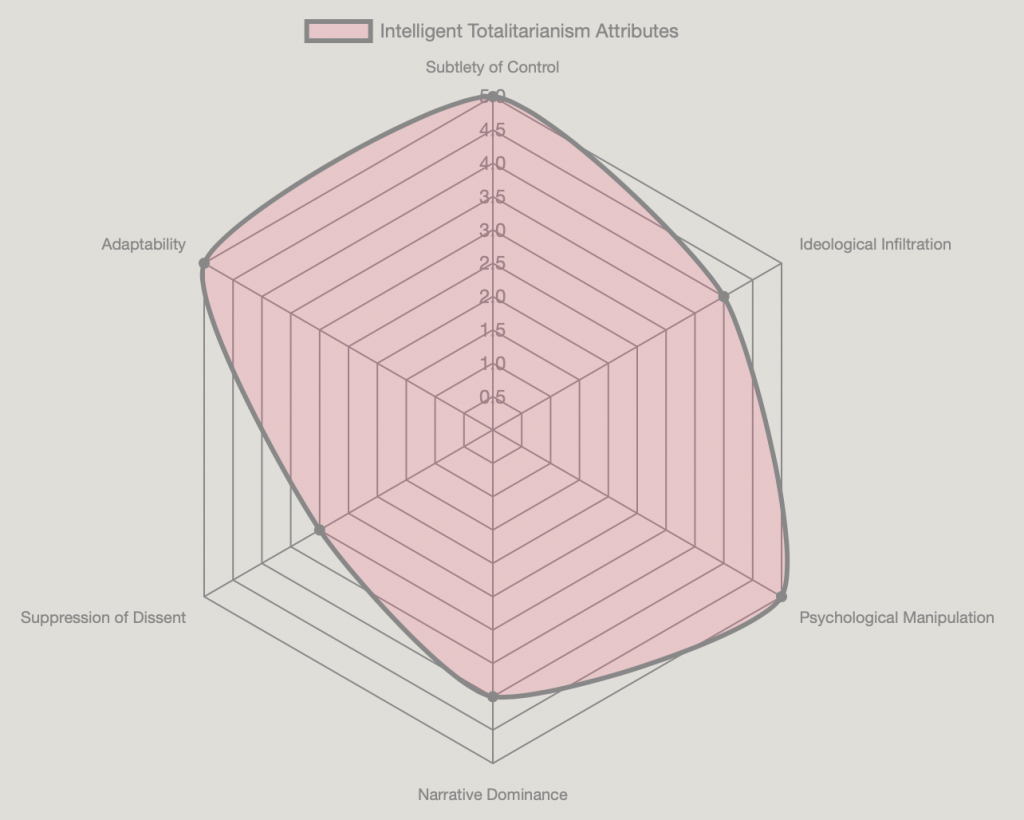
This radar chart illustrates the key attributes of “Intelligent Totalitarianism” on a scale of 0 to 5. It highlights its proficiency in subtle control, deep ideological infiltration, and psychological manipulation, alongside its capacity for narrative dominance and adaptability, even if overt suppression of dissent might be less visible than in traditional totalitarian states.
The Subtle Power of Narrative Control
When sophisticated social engineering techniques are applied to propagate narratives like the “Great Replacement,” the result is a society where fear and division can be manufactured and sustained. This manipulation doesn’t require overt displays of force; instead, it reshapes the collective consciousness through the constant reinforcement of specific ideas and the suppression of alternative perspectives.
Camus’s philosophical stance directly challenges this insidious form of control. His emphasis on human dignity, individual freedom, and the rejection of all forms of absolutism serves as a crucial antidote. He would undoubtedly view the “Great Replacement” theory, with its inherent xenophobia and divisive potential, as a prime example of the kind of “crime of logic” that leads to dehumanization and ultimately, a more subtle but equally dangerous form of tyranny.
The Evolution of Control: From Overt to Insidious
Historically, totalitarianism has often been associated with strongmen, secret police, and overt suppression. However, the concept of “most intelligent totalitarianism” suggests a shift towards a more sophisticated model where control is exercised through the very ideas and narratives that shape public discourse. This evolution means that the mechanisms of oppression become harder to identify, as they are woven into the fabric of everyday information and societal norms.
A Comparison of Totalitarian Approaches
To better understand this evolution, consider the following comparison between traditional and “intelligent” totalitarianism:
| Feature | Traditional Totalitarianism | “Intelligent” Totalitarianism |
|---|---|---|
| Primary Method of Control | Overt coercion, fear, violence, direct censorship | Subtle social engineering, psychological manipulation, narrative control |
| Visibility of Control | Highly visible, state-controlled apparatus | Often hidden within media, education, and cultural discourse |
| Role of Ideology | Strict, dogmatic, enforced top-down | Pervasive, adaptable, often presented as common sense or “truth” |
| Citizen Response | Open resistance, passive compliance, fear | Internalized beliefs, self-censorship, willing participation |
| Threat to Freedom | Direct curtailment of rights | Erosion of critical thought and individual autonomy |
This shift underscores the importance of critical awareness and intellectual vigilance. Camus’s warnings against accepting absolute truths and the importance of individual rebellion against injustice become even more pertinent in an era where control can be exercised through the manipulation of information and the widespread acceptance of divisive narratives.
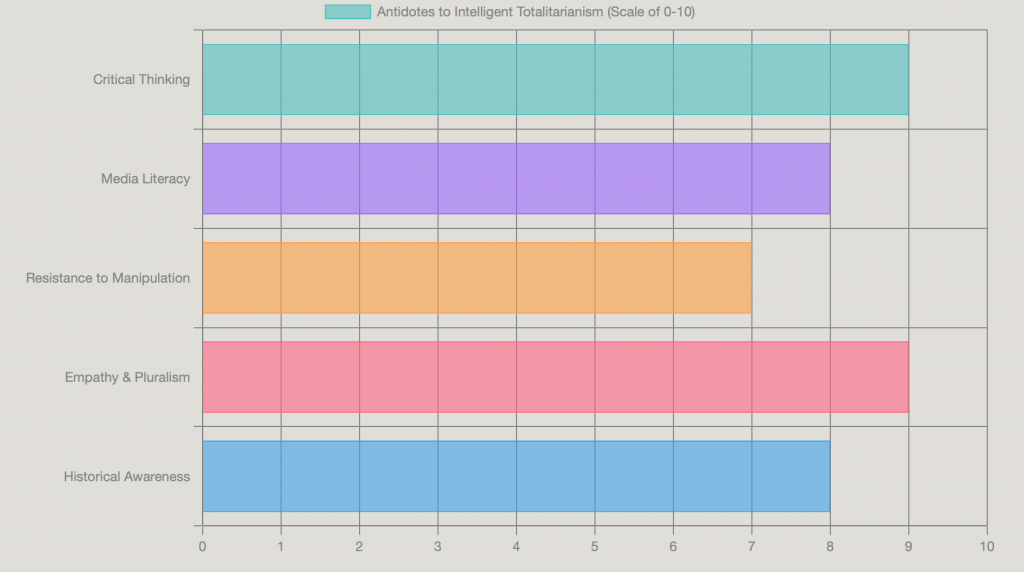
This bar chart outlines essential antidotes to “Intelligent Totalitarianism” on a scale of 0 to 10. It underscores the vital roles of critical thinking, media literacy, resistance to manipulation, empathy, pluralism, and historical awareness in safeguarding against subtle forms of control.
Mapping the Web of Intelligent Totalitarianism
mindmap
root[“Intelligent Totalitarianism”]
CamusCritique[“Albert Camus’ Critique”]
MoralLimits[“Advocates for Moral Limits”]
IndividualFreedom[“Champions Individual Freedom”]
RejectsAbsolutism[“Rejects Ideological Absolutism”]
WarnsOfSubtlety[“Warns of ‘Crimes of Logic'”]
SocialEngineering[“Social Engineering”]
PropagandaControl[“Propaganda & Media Control”]
BehavioralShaping[“Shaping Public Behavior”]
ErosionOfDissent[“Erosion of Independent Thought”]
PsychologicalTactics[“Utilizes Psychological Tactics”]
GreatReplacementTheory[“‘Great Replacement’ Theory”]
RenaudCamusOrigin[“Originated by Renaud Camus”]
ConspiracyNarrative[“Racist Conspiracy Narrative”]
ExploitsFear[“Exploits Demographic Fears”]
FostersDivision[“Fosters Societal Division”]
JustifiesExclusion[“Justifies Exclusionary Policies”]
Consequences[“Societal Consequences”]
ErodesTrust[“Erodes Social Trust”]
IncreasesPolarization[“Increases Polarization”]
NormalizesControl[“Normalizes Subtle Control”]
ThreatensDemocracy[“Threatens Democratic Values”]
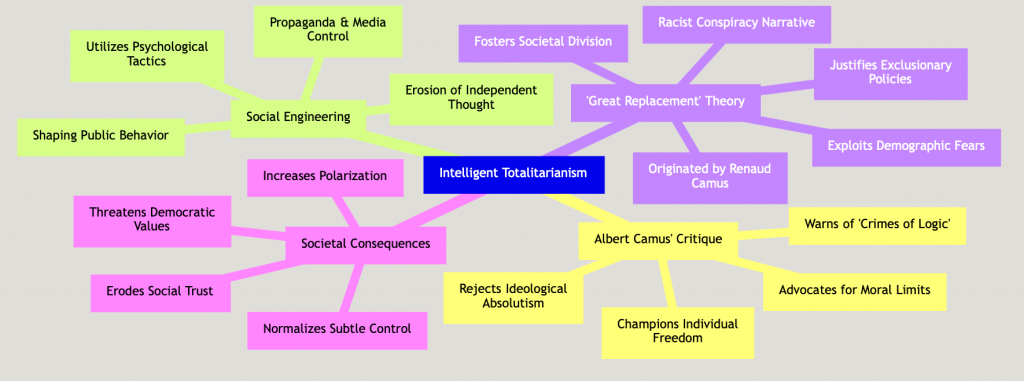
This mindmap illustrates the interconnected elements of “Intelligent Totalitarianism,” showing how Albert Camus’s philosophical critiques provide a counter-narrative to the manipulative practices of social engineering, exemplified by the “Great Replacement” theory, and ultimately highlighting the broad societal consequences.
Conclusion: Vigilance in an Age of Intelligent Control
The “Most Intelligent Totalitarianism” represents a profound challenge to modern societies. It is a form of control that transcends traditional authoritarian models, relying instead on sophisticated social engineering and the pervasive influence of narratives, even those based on conspiracy. Albert Camus’s unwavering commitment to individual freedom, moral limits, and the rejection of intellectual justifications for oppression remains a vital intellectual bulwark against this evolving threat. Recognizing the subtle mechanisms of control, from pervasive propaganda to divisive theories like the “Great Replacement,” is the first step in safeguarding democratic values and human dignity. In an age where information is abundant but truth is often contested, cultivating critical thinking, media literacy, and a robust commitment to pluralism is paramount.
Frequently Asked Questions
What is “Most Intelligent Totalitarianism”?
“Most Intelligent Totalitarianism” describes a sophisticated form of control that relies on subtle manipulation of public thought and behavior through social engineering and pervasive narratives, rather than overt coercion. It uses intellectual frameworks to justify and implement control, making it harder to identify and resist.
How does Albert Camus relate to totalitarianism?
Albert Camus was a fierce critic of all forms of totalitarianism. He argued against ideologies that sacrifice individual freedom and human dignity for abstract ideals or “perfect” societies. His work emphasizes moral responsibility, individual revolt against injustice, and the dangers of justifying harmful means by utopian ends.
What role does social engineering play in this concept?
Social engineering is a primary tool for “intelligent totalitarianism.” It involves the systematic manipulation of societal norms, beliefs, and behaviors through propaganda, media control, and policy. This subtle influence aims to create conformity and suppress dissent without visible force.
Is the “Great Replacement” theory an example of social engineering?
While a controversial and debunked conspiracy theory, the “Great Replacement” theory can be seen as an example of how divisive narratives are used for social engineering. It exploits fears of demographic change to foster xenophobia and division, potentially mobilizing support for restrictive policies and ultimately contributing to subtle forms of societal control.
Recommended Further Exploration
- Explore Albert Camus’ philosophy of rebellion and its relevance to modern challenges.
- Investigate the psychological mechanisms of propaganda and its societal impact.
- Understand the critical distinctions between social engineering in cybersecurity and political contexts.
- Examine how conspiracy theories are formed and their influence on contemporary political discourse.
Referenced Search Results
thedailyeconomy.org
The Root of Totalitarianism is Social Engineering | The Daily Economy
realclearpolicy.com
The Root of Totalitarianism is Social Engineering – RealClearPolicy
plato.stanford.edu
Albert Camus – Stanford Encyclopedia of Philosophy
unherd.com
Camus’ rejection of tyranny is worth remembering today
quillette.com
Albert Camus: Unfashionable Anti-Totalitarian
theconversation.com
What is the ‘great replacement theory’? A scholar of race relations explains
cisco.com
What Is Social Engineering in Cybersecurity? – Cisco
ibm.com
What is Social Engineering? | IBM
immigrationforum.org
[PDF] The ‘Great Replacement’ Theory, Explained
steelsnowflake.org
tabletmag.com
The Gay French Poet Behind the Alt-Right’s Favorite Catch Phrase
en.wikiquote.org
splcenter.org
The Racist ‘Great Replacement’ Conspiracy Theory Explained
machine-learning-made-simple.medium.com
Why You Should Read: Albert Camus | by Devansh – Medium
europeanconservative.com
“There is nothing extreme about resistance to invasion”: An Interview with Renaud Camus
amazon.com

newyorker.com
How Albert Camus Faced History | The New Yorker
britannica.com
Albert Camus | Biography, Books, Philosophy, Death, & Facts | Britannica
thenation.com
How Gay Icon Renaud Camus Became the Ideologue of White Supremacy
medium.com
What Albert Camus taught us about freedom
washingtonstand.com
Totalitarian Social Engineering (Part 4): Intellectualism
cybersecurity.springeropen.com
Social engineering in cybersecurity: a domain ontology and knowledge …
instytutpileckiego.pl
Tools and Objectives of Genocidal Social Engineering. Man and the …
reddit.com
Help me understand a statement from the fall by camus
britannica.com
Totalitarianism | Definition, Characteristics, Examples, & Facts | Britannica
ieeexplore.ieee.org
Social Engineering Analysis Framework: A Comprehensive …
amazon.com
The Great Replacement: Introduction to Global Replacism
web.archive.org
The Gay French Poet Behind the Alt-Right’s Favorite Catch Phrase – Tablet Magazine
imperva.com
What is Social Engineering | Attack Techniques & Prevention Methods
encyclopedia.com
Social Engineering | Encyclopedia.com
en.wikipedia.org
Great Replacement conspiracy theory – Wikipedia
en.wikipedia.org
Social engineering (political science) – Wikipedia
britannica.com
Le Grand Remplacement | work by Camus | Britannica
reddit.com
r/philosophy on Reddit: Albert Camus: Unfashionable Anti-Totalitarian
reddit.com
www2.hawaii.edu
iep.utm.edu
Totalitarianism | Internet Encyclopedia of Philosophy
dl.acm.org
Cognition in Social Engineering Empirical Research: A Systematic …
theeconomyjournal.eu
Totalitarian communication, a social engineering technique
cisa.gov
Avoiding Social Engineering and Phishing Attacks | CISA
journals.ehu.lt
[PDF] SOCIAL ORDER AMD SOCIAL ENGINEERING: BETWEEN CHAOS …
pmc.ncbi.nlm.nih.gov
Human Cognition Through the Lens of Social Engineering …
sciencedirect.com
An interdisciplinary view of social engineering: A call to action …
isdglobal.org
[PDF] “The Great Replacement” | ISD
en.wikipedia.org
comptia.org
What Is Social Engineering – The Human Element in …
britannica.com
Totalitarianism – Oppression, Dictatorship, Control | Britannica
washingtonstand.com
Totalitarian Social Engineering (Part 7): The Role of Women
thecritic.co.uk
Orwell, Camus and truth | William Fear | The Critic Magazine
dl.acm.org
CAMUS: Attribute-Aware Counterfactual Augmentation for Minority …
nytimes.com
The Man Behind a Toxic Slogan Promoting White Supremacy
en.wikipedia.org
Social engineering (security) – Wikipedia
en.wikipedia.org
legatum-books.com
What Is the Great Replacement? By Renaud Camus – Legatum Publishing
aeon.co
How Camus and Sartre split up over the question of how to be free | Aeon Ideas
washingtonpost.com
‘Great replacement’ theory coined by French author Renaud Camus
en.wikipedia.org
beta.demokracija.eu
Renaud Camus: Global Replacism is the most active form of contemporary totalitarianism – Demokracija
amazon.com
mdpi.com
A Study on the Psychology of Social Engineering-Based … – MDPI
linkedin.com
The Root of Totalitarianism is Social Engineering | Mani Basharzad
adl.org
“The Great Replacement:” An Explainer – ADL
tandfonline.com
Executing Effective Social Engineering Penetration Tests
bavo.biz
The New Myth of Relative Social Engineering – BAVO
loc.gov
academicworks.cuny.edu
Albert Camus’ political thought: from passion to compassion
researchgate.net
(PDF) The Analysis of Social Facts in “The Plague” by Albert Camus
iep.utm.edu
Camus, Albert | Internet Encyclopedia of Philosophy
social-epistemology.com
What is Right and Wrong with Social Engineering? Alexandra A. …
blogs.timesofisrael.com
Martin Heidegger, French Theory & Great Replacement: A Talk with Renaud Camus
sciencedirect.com
A comprehensive survey on social engineering attacks …
cambridge.org
Frameworks for Social Engineering (Chapter 6)
Last updated August 22, 2025