
The groundbreaking technology behind China’s fast neutron reactor and its implications for global energy.
71+ Sources
- Key Insights into the CFR-1000 Reactor
- The Core Innovation: Why Liquid Sodium?
- The Power of “Fast”: Fuel Breeding and Waste Minimization
- China’s Nuclear Energy Roadmap and Generation IV Ambitions
- Addressing the Challenges: Safety and Engineering with Sodium
- CFR-1000: Technical Specifications and Comparison
- The Future Landscape: Global Implications and Challenges
- Frequently Asked Questions
- Conclusion
- Recommended Further Reading
- Referenced Search Results
China’s recently unveiled CFR-1000 fast neutron reactor represents a monumental stride in nuclear energy technology. This Generation IV reactor, designed to produce up to 1.2 gigawatts of electricity—enough to power approximately one million homes—distinguishes itself from conventional designs primarily through its innovative use of liquid sodium as a coolant. This choice is not arbitrary; it underpins the reactor’s enhanced performance, sustainability benefits, and strategic importance in shaping the future of nuclear power.
Key Insights into the CFR-1000 Reactor
- Sodium’s Superiority: Liquid sodium’s exceptional heat transfer properties and non-moderating nature are crucial for the CFR-1000’s efficient fast neutron operation, enabling higher temperatures and greater power output compared to water-cooled reactors.
- Sustainable Fuel Cycle: As a fast neutron reactor, the CFR-1000 can “breed” new fuel from non-fissile uranium-238, significantly increasing fuel efficiency by 60-100 times and substantially reducing long-lived radioactive waste.
- Generation IV Leadership: The CFR-1000 positions China at the vanguard of Generation IV nuclear technology, aligning with global goals for enhanced safety, sustainability, economic viability, and proliferation resistance, with operations anticipated post-2030.

An artist’s rendition of a modern nuclear power plant, symbolizing the scale and ambition of projects like the CFR-1000.
The Core Innovation: Why Liquid Sodium?
The decision to utilize liquid sodium as a coolant in the CFR-1000 is central to its advanced design and operational philosophy. Unlike the pressurized water found in most traditional reactors, liquid sodium offers several critical advantages that are indispensable for a fast neutron reactor.
Unmatched Thermal Performance
Liquid sodium boasts exceptional thermal conductivity and a remarkably high boiling point, around 883°C. These properties enable the CFR-1000 to operate at much higher temperatures (typically 500-550°C) than water-cooled reactors, leading to more efficient heat transfer and a higher overall thermal efficiency. This translates directly into greater power output and a more compact core design. The ability to manage such high temperatures efficiently is a cornerstone of the reactor’s superior performance.
Preserving the Fast Neutron Spectrum
A fundamental distinction of the CFR-1000 is its operation within a “fast neutron spectrum.” Traditional reactors use moderators, like water, to slow down neutrons, making them “thermal” neutrons. However, for a fast neutron reactor, it is crucial to maintain high-energy, unmoderated neutrons. Liquid sodium does not moderate neutrons, meaning it allows these fast neutrons to sustain the chain reaction. This preservation of the fast spectrum is essential for the reactor’s ability to “breed” new fuel, a process detailed further below.
Low Neutron Absorption
Beyond its thermal and non-moderating characteristics, liquid sodium exhibits low neutron absorption. This property is vital for maintaining the neutron economy within the reactor core, ensuring that enough fast neutrons are available for both fission and the breeding process, thereby maximizing fuel utilization. This minimal absorption contributes significantly to the overall efficiency and sustainability goals of fast reactors.
The Power of “Fast”: Fuel Breeding and Waste Minimization
The term “fast neutron reactor” signifies a profound shift in how nuclear fuel is utilized and managed. The CFR-1000, as a fast reactor, unlocks capabilities that are largely inaccessible to conventional thermal reactors.
Revolutionizing Fuel Efficiency
One of the most compelling advantages of fast reactors like the CFR-1000 is their ability to “breed” new fissile fuel. This process involves converting abundant, non-fissile uranium-238 into plutonium-239, a fissile material. This capability dramatically extends the energy extracted from uranium resources, often cited as a 60 to 100-fold increase compared to the once-through fuel cycles of thermal reactors. This transformation effectively turns what would otherwise be nuclear waste into a valuable energy source, significantly enhancing resource sustainability.
A Path to Waste Minimization
The fast neutron spectrum also enables the efficient fissioning of long-lived transuranic elements (such as plutonium, americium, and curium) present in spent nuclear fuel. By consuming these elements, fast reactors can substantially reduce the volume and radiotoxicity of long-lived radioactive waste. This minimizes the long-term burden of waste management and storage, addressing one of the most significant challenges associated with nuclear power. While fission products still require disposal, their hazard profile and decay times are considerably shorter than those of transuranics.
China’s Nuclear Energy Roadmap and Generation IV Ambitions
The CFR-1000 is not an isolated project but a cornerstone of China’s ambitious three-step nuclear energy roadmap, which envisions a progression from thermal reactors to fast reactors and, eventually, fusion reactors. This initiative firmly places China at the forefront of Generation IV nuclear technology development.
Aligning with Global Sustainability Goals
Generation IV reactors are a class of advanced nuclear designs developed with enhanced goals for safety, sustainability, economic viability, and proliferation resistance. The CFR-1000 aligns perfectly with these objectives, promising cleaner, more efficient, and more secure nuclear power generation. With over 400 reactor-years of operational experience worldwide with sodium-cooled fast reactors, this technology is among the most mature within the Generation IV framework.
Projected Timeline and Impact
Having completed its preliminary design phase, the CFR-1000 is currently awaiting regulatory approval. Operations are anticipated to commence after 2030, potentially around 2034. When operational, it will be China’s first gigawatt-class commercial fast reactor, building upon lessons learned from its experimental CEFR (20 MWe) and demonstration CFR-600 (600 MWe) reactors. This progression underscores China’s commitment to closing the nuclear fuel cycle and developing domestic capabilities in advanced nuclear technology.
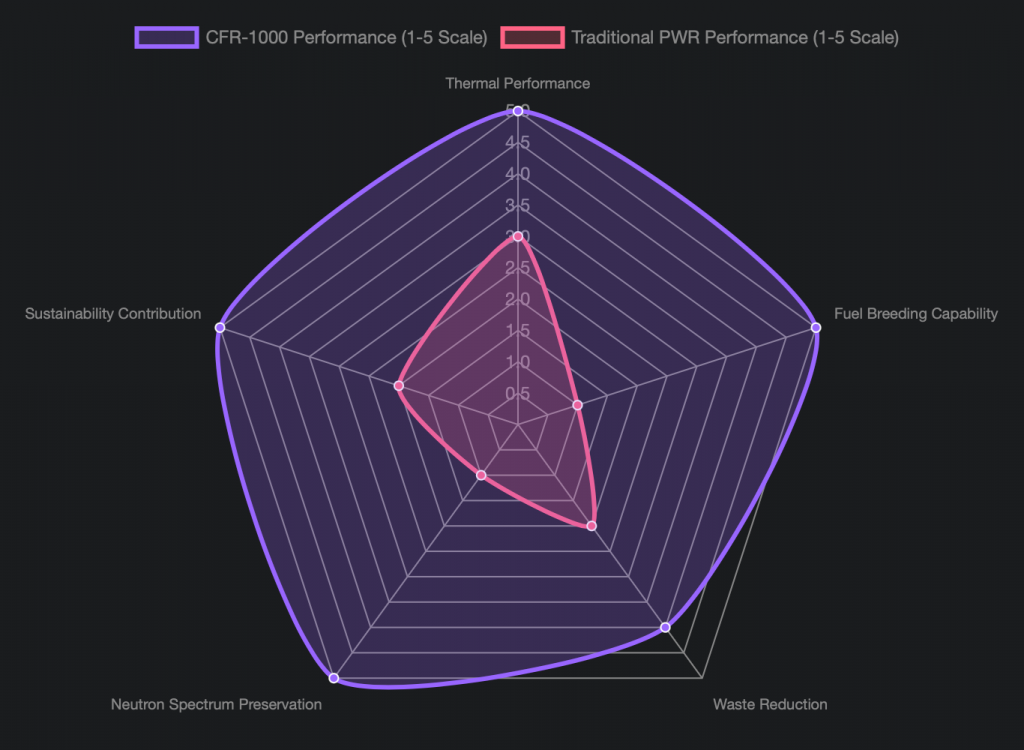
The radar chart above visually compares the CFR-1000’s performance across key metrics relevant to advanced nuclear reactors against a hypothetical traditional Pressurized Water Reactor (PWR). It highlights the CFR-1000’s strong emphasis on thermal performance, fuel breeding, waste reduction, and the preservation of the fast neutron spectrum, all of which contribute significantly to its sustainability.
Addressing the Challenges: Safety and Engineering with Sodium
While the benefits of liquid sodium are substantial, its inherent reactivity with air and water presents engineering and safety challenges that require sophisticated design and operational protocols.
Managing Sodium’s Reactivity
Sodium reacts vigorously with water and can ignite in air, necessitating robust containment and safety measures. Designs typically incorporate an intermediate sodium loop to isolate the primary reactor coolant from the water/steam side of the power generation system. Furthermore, inert cover gas systems, advanced leak detection technologies, and fire protection systems are integral to mitigating potential risks. Despite these challenges, the extensive operational experience with sodium-cooled fast reactors globally provides a strong foundation for managing these complexities.
Material Compatibility and Chemical Control
Operating with liquid sodium at high temperatures demands meticulous control over the chemistry of the coolant, particularly concerning oxygen and hydrogen levels, to prevent corrosion of reactor components. Specialized materials and component designs for pumps, valves, and intermediate heat exchangers are critical. These engineering considerations, while exacting, have matured over decades of research and development in fast reactor technology.
mindmap
root[“CFR-1000 Key Aspects”]
design[“Design & Technology”]
output[“1.2 GW Electrical Output”]
coolant[“Liquid Sodium Coolant”]
advantages[“Advantages of Sodium”]
thermal_conductivity[“High Thermal Conductivity”]
boiling_point[“High Boiling Point (~883°C)”]
non_moderating[“Does Not Moderate Neutrons”]
low_absorption[“Low Neutron Absorption”]
challenges[“Sodium Challenges”]
reactivity_water[“Vigorous Reaction with Water”]
reactivity_air[“Oxidizes/Burns in Air”]
engineering_controls[“Requires Complex Engineering Controls”]
type[“Fast Neutron Reactor (SFR)”]
generation[“Generation IV Technology”]
benefits[“Advantages & Sustainability”]
fuel_efficiency[“Fuel Efficiency & Breeding”]
breed_plutonium[“Converts U-238 to Pu-239”]
extends_uranium[“Extends Uranium Resources (60-100x)”]
waste_minimization[“Waste Minimization”]
transuranics[“Fissions Long-lived Transuranics”]
reduces_radiotoxicity[“Reduces Radiotoxicity & Heat Load”]
clean_power[“Clean, Firm Power”]
low_carbon[“Low-Carbon Electricity”]
baseload[“Reliable Baseload Power”]
economic[“Economic Benefits”]
lower_fuel_costs[“Potentially Lower Fuel Costs”]
higher_yield[“Higher Energy Yield”]
roadmap[“China’s Nuclear Roadmap”]
three_step[“Three-Step Evolution”]
cefr[“CEFR (Experimental)”]
cfr600[“CFR-600 (Demonstration)”]
cfr1000_commercial[“CFR-1000 (Commercial)”]
timeline[“Expected Operation After 2030 (c. 2034)”]
goals[“Aligns with Gen IV Goals”]
safety[“Enhanced Safety”]
sustainability[“Sustainability”]
economics[“Economic Viability”]
proliferation[“Proliferation Resistance”]
challenges_future[“Future Considerations”]
regulatory_approval[“Regulatory Scrutiny”]
public_acceptance[“Public Acceptance”]
fuel_cycle_safeguards[“Fuel Cycle & Nonproliferation”]
economics_scale[“Commercial Scale & Economics”]
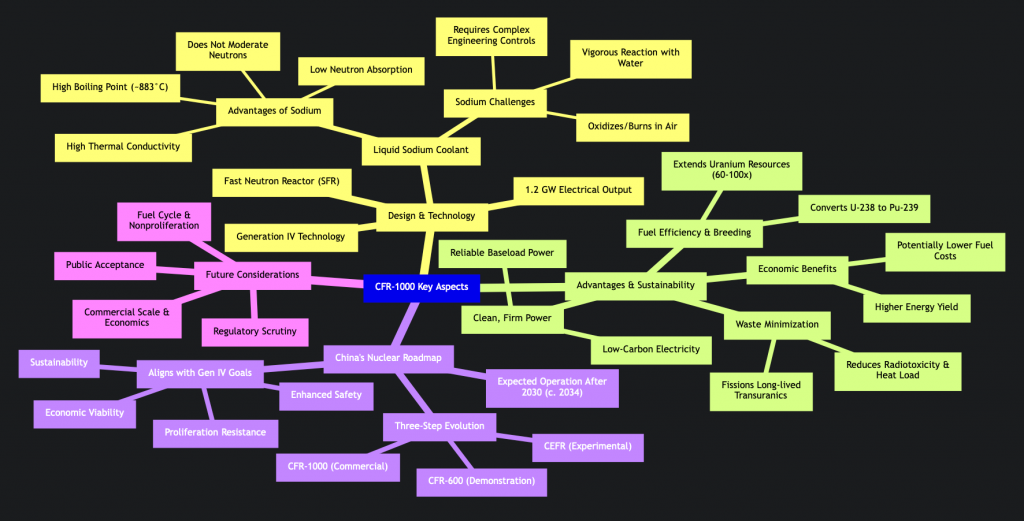
The mindmap above provides a comprehensive overview of the CFR-1000 reactor, dissecting its design features, the advantages and challenges associated with liquid sodium cooling, its significant benefits for sustainability and waste management, and its strategic placement within China’s broader nuclear energy objectives.
CFR-1000: Technical Specifications and Comparison
To further illustrate the advancements of the CFR-1000, let’s look at its technical specifications and how it compares to previous reactor generations and types.
| Feature/Parameter | CFR-1000 (Fast Neutron Reactor) | Typical PWR (Light Water Reactor) | CFR-600 (Demonstration Fast Reactor) |
|---|---|---|---|
| Coolant Type | Liquid Sodium | Pressurized Water | Liquid Sodium |
| Neutron Spectrum | Fast | Thermal (Moderated) | Fast |
| Electrical Output | ~1000-1200 MWe | ~1000-1600 MWe | 600 MWe |
| Operating Temperature | ~500-550°C | ~300-330°C | ~500-550°C |
| Fuel Breeding Capability | High (converts U-238 to Pu-239) | None (consumes U-235) | High |
| Fuel Utilization | Extremely High (60-100x more efficient) | Lower | High |
| Waste Minimization | Significantly reduces long-lived waste | Produces long-lived waste | Significantly reduces long-lived waste |
| Generation | Generation IV | Generation II/III | Generation IV (Demonstration) |
| Primary Goal | Commercial power, closed fuel cycle | Commercial power | Demonstration, technological validation |
This table provides a concise comparison of the CFR-1000’s key characteristics against traditional pressurized water reactors (PWRs) and its predecessor, the CFR-600. It highlights the significant advancements in coolant, neutron spectrum, fuel utilization, and waste reduction that define this next-generation reactor.
The Future Landscape: Global Implications and Challenges
The successful deployment of the CFR-1000 could have profound implications for the global energy landscape, but it also faces significant hurdles.
Redefining Nuclear Energy
If the CFR-1000 meets its ambitious targets for performance and safety, it will mark a critical milestone for Generation IV fast reactors. This could inspire further investment and development in similar technologies worldwide, accelerating the transition to a more sustainable and low-carbon energy future. The ability to dramatically extend uranium resources and minimize nuclear waste offers a compelling vision for nuclear power’s long-term viability.
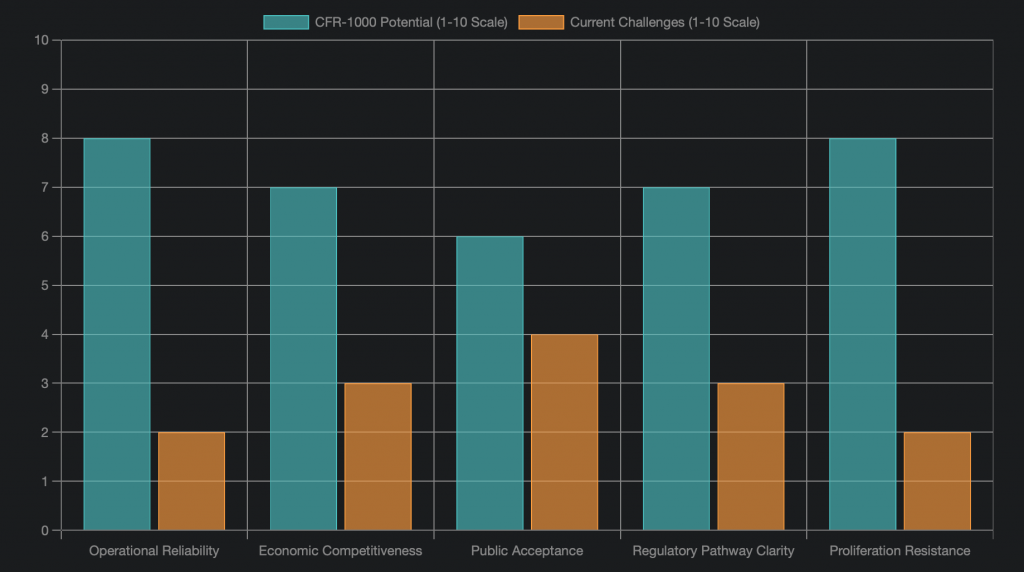
This bar chart illustrates the CFR-1000’s potential in various aspects crucial for its success and adoption, contrasted with the current challenges it faces. It highlights areas like operational reliability and proliferation resistance as having high potential, while economic competitiveness and regulatory pathway clarity still present significant hurdles that need to be overcome.
Navigating Regulatory and Public Acceptance
The “reactivity problem” of sodium will undoubtedly be a central focus for regulators. Ensuring stringent safety protocols, effective emergency planning, and robust severe-accident mitigation strategies will be paramount. Public acceptance will also hinge on transparent communication about the benefits and risks of this advanced technology.
This video, “Thorium and Fast Neutron Nuclear Reactors,” provides an insightful overview of fast neutron reactors and their role in the future of nuclear energy, including discussions relevant to Generation IV technologies like the CFR-1000. It offers valuable context on the advantages and challenges associated with these advanced designs, particularly concerning fuel cycles and sustainability.
Proliferation Concerns and Economics
Fast reactors, by their nature, can produce plutonium, which raises proliferation concerns. Therefore, robust international safeguards and transparent management of the nuclear fuel cycle are essential. Economically, demonstrating cost-effectiveness at a gigawatt scale, securing specialized components, and ensuring high operational availability will be critical for commercial success.
Frequently Asked Questions
What is the primary difference between the CFR-1000 and traditional nuclear reactors?
The primary difference lies in the coolant and the neutron spectrum. Traditional reactors typically use pressurized water as a coolant and operate with thermal (slowed down) neutrons. The CFR-1000, however, uses liquid sodium as a coolant, which allows it to operate with fast (unmoderated) neutrons. This enables higher operating temperatures, more efficient heat transfer, and the ability to “breed” new fuel.
How does the CFR-1000 reduce nuclear waste?
The CFR-1000 reduces nuclear waste by being a “fast neutron reactor.” This means it can fission (break down) long-lived transuranic elements, which are a major component of radioactive waste from traditional reactors. By consuming these elements, it significantly reduces the volume and radiotoxicity of the waste, shortening the required isolation period for radioactive materials.
What are the main advantages of using liquid sodium as a coolant?
Liquid sodium offers several key advantages: it has excellent heat transfer properties and a very high boiling point, allowing the reactor to operate at higher temperatures and thus achieve greater thermal efficiency. Crucially, it does not moderate (slow down) neutrons, which is essential for maintaining the fast neutron spectrum required for fuel breeding in fast reactors.
What are the safety concerns associated with liquid sodium?
The main safety concern with liquid sodium is its high reactivity with water and air. Sodium reacts vigorously with water and can burn in air. To mitigate these risks, advanced safety measures are implemented, such as intermediate sodium loops to separate the reactor coolant from the water/steam system, inert gas blankets, and sophisticated leak detection and fire suppression systems.
When is the CFR-1000 expected to become operational?
The CFR-1000 has completed its preliminary design phase and is awaiting regulatory approval. Operations are anticipated to begin after 2030, with some sources citing around 2034, depending on the approval process and project execution.
Conclusion
The CFR-1000 fast neutron reactor stands as a testament to China’s ambitious vision for a sustainable energy future. By leveraging the unique properties of liquid sodium and the principles of fast neutron physics, this reactor promises to deliver unparalleled fuel efficiency, significant waste reduction, and clean, reliable power. While the engineering and regulatory challenges associated with liquid sodium are considerable, the extensive experience and ongoing advancements in Generation IV nuclear technology position the CFR-1000 as a potential game-changer. Its successful deployment could profoundly influence global discussions on nuclear energy, offering a pathway towards a cleaner, more resource-efficient, and ultimately more sustainable world.
Recommended Further Reading
- [How do fast neutron reactors breed new fuel?](/?query=How do fast neutron reactors breed new fuel?)
- [What are the Generation IV nuclear reactor goals?](/?query=What are the Generation IV nuclear reactor goals?)
- [Comparison of sodium-cooled fast reactors vs. molten salt reactors](/?query=Comparison of sodium-cooled fast reactors vs. molten salt reactors)
- [Safety features and challenges of liquid metal coolants in nuclear reactors](/?query=Safety features and challenges of liquid metal coolants in nuclear reactors)
Referenced Search Results
energy-reporters.com
impactlab.com
China’s CFR-1000 Reactor: A Measured Step Toward the Next Era of Nuclear Power – Impact Lab
english.news.cn
China completes preliminary design of 4th-generation commercial fast reactor-Xinhua
swarajyamag.com
iaea.org
Fast-neutron reactors, Fast nuclear reactors | IAEA
nuclear-power.com
Sodium and NaK – Reactor Coolant – Nuclear Power
gen-4.org
Sodium Fast Reactor (SFR) | GIF Portal
gen-4.org
Welcome to the Generation IV International Forum | GIF Portal
energy-reporters.com
China CFR-1000 Reactor Ignites Fierce Global Debate as Terrified … – Energy Reporters
sciencedirect.com
Sodium-Cooled Fast Reactor – an overview | ScienceDirect Topics
fissionliquide.fr
lpsc.in2p3.fr
en.wikipedia.org
Fast-neutron reactor – Wikipedia
sustainability-times.com
powermag.com
Rapid Advancements for Fast Nuclear Reactors
neimagazine.com
China finalises design of CFR-1000 fast reactor – Nuclear Engineering International
asiafinancial.com
China fires up nuclear fusion reactor
sciencedirect.com
Fast Neutron Reactor – an overview | ScienceDirect Topics
whatisnuclear.com
gevernova.com
Sodium Fast Reactors | GE Hitachi Nuclear Energy
rosatom-asia.com
ROSATOM ships fuel for China’s CFR-600 fast reactor launch
polytechnique-insights.com
Nuclear: what is a 4th generation reactor?
en.wikipedia.org
reddit.com
r/nuclear on Reddit: Some slides on CiFR1200 (aka CFR-1000) plans, construction in 2031-35
world-nuclear.org
Generation IV Nuclear Reactors
quora.com
What are the advantages of a fast neutron reactor over a slow …
gain.inl.gov
Fast Reactors – Gateway for Accelerated Innovation in Nuclear
britannica.com
Nuclear reactor – Thermal, Intermediate, Fast | Britannica
reddit.com
r/AskScienceDiscussion on Reddit: Why aren’t we using fast breeder …
world-nuclear-news.org
Chinese fast reactor begins high-power operation – World Nuclear News
energy-reporters.com
web.i2massociates.com
China’s CFR-1000 Reactor – A Significant Milestone in Nuclear … – I2M
gen-4.org
Generation IV Goals, Technologies and GIF R&D Roadmap
reddit.com
r/nuclear on Reddit: Thoughts? Chinas gen iv 1.2 gw fast neutron reactor
enertherm-engineering.com
China Unveils Design For Gigawatt-Level Fast Neutron Reactor, CFR-1000
education.cfr.org
education.cfr.org
en.wikipedia.org
sciencedirect.com
Generation-IV nuclear power: A review of the state …
globalconstructionreview.com
China’s first fast reactor completes testing milestone – Global Construction Review
xylenepower.com
FAST NEUTRON REACTORS – Xylene Power Ltd.
dual-fluid.com
Technology – Dual Fluid Reactor
fissilematerials.org
China started operation of its first CFR-600 breeder reactor – IPFM Blog
energy.gov
Nuclear 101: What is a Fast Reactor? | Department of Energy
nrc.gov
nrc.gov
oecd-nea.org
[PDF] THE GENERATION IV NUCLEAR ENERGY SYSTEMS …
en.cnnc.com.cn
China’s 4th-generation commercial fast reactor preliminary design …
en.wikipedia.org
energy-reporters.com
world-nuclear.org
Fast Neutron Reactors – World Nuclear Association
interestingengineering.com
CFR-1000: China unveils gigawatt-level fast neutron reactor design
terrapower.com
TerraPower Natrium | Advanced Nuclear Energy
iaea.org
Fast Reactors Provide Sustainable Nuclear Power for “Thousands of …
iaea.org
Liquid Metal Coolants for Fast Reactors Cooled by Sodium, Lead …
world-nuclear-news.org
Work begins on first US Gen IV reactor – World Nuclear News
en.wikipedia.org
Sodium-cooled fast reactor – Wikipedia
dual-fluid.com
What is the DFR? – Dual Fluid Reactor
thorconpower.com
History liquid fuel reactors – ThorCon
anl.gov
Fast reactor technology is an American clean, green and secure …
cfr.org
anl.gov
Argonne’s nuclear energy research drives innovation in Gen-IV …
energy-reporters.com
nrc.gov
fluidfuelreactors.com
energy.gov
3 Advanced Reactor Systems to Watch by 2030
scmp.com
datacenterknowledge.com
Pros and Cons of Sodium-Cooled Nuclear Reactors for Data Center …
x.com
world-nuclear.org
nrc.gov
U.S. Nuclear Regulatory Commission Preparations for the Export of Advanced Reactors | NRC.gov
Last updated September 13, 2025