The unique blend of economic pragmatism and cultural preservation that propelled Poland to unprecedented success.
72+ Sources
- A Visionary Path: Economic Transformation Paired with Cultural Safeguarding
- Strategic Investments and Robust Domestic Dynamics
- Resilience and Pragmatism: Navigating Global Challenges
- The Interplay of Tradition and Modernity: A Mindmap of Poland’s Success
- A Contrasting Approach: What Poland Did Differently
- A Closer Look at Poland’s Economic Narrative
- Frequently Asked Questions (FAQ)
- Conclusion
- Recommended Further Exploration
- Referenced Search Results
- Economic Liberalization with Cultural Anchors: Poland successfully transitioned to a market economy through strategic reforms and EU integration while steadfastly preserving its national identity and traditional values, particularly its strong Catholic heritage.
- Strategic Investment and Domestic Strength: Leveraging significant EU funds, Poland invested heavily in infrastructure and human capital, fostering a diversified economy driven by robust domestic consumption and a strong export base.
- Resilience and Pragmatism: Poland’s prudent fiscal policies and a pragmatic approach to governance enabled it to navigate global economic crises, maintaining consistent growth where many Western nations faltered.
Poland’s recent achievement of becoming a $1 trillion economy marks a significant milestone, distinguishing its developmental path from many Western nations. This remarkable growth has occurred alongside a deliberate preservation of its cultural and religious identity, challenging the notion that modernization necessitates the abandonment of tradition or an “open borders” approach to immigration. Poland’s journey offers compelling insights into a model of economic prosperity intertwined with national sovereignty and social cohesion.
A Visionary Path: Economic Transformation Paired with Cultural Safeguarding
Since the fall of communism in 1989, Poland embarked on a transformative journey, shifting from a centrally planned system to a dynamic market economy. This transition, often referred to as “shock therapy,” involved widespread privatization, price liberalization, and a welcoming stance towards foreign direct investment (FDI). However, what sets Poland apart is its simultaneous commitment to its cultural heritage and traditional values.
The Foundation of Economic Liberalization
Poland’s economic reforms were swift and decisive. The country prioritized creating a business-friendly environment, attracting substantial FDI, and integrating into global and regional supply chains. This strategic liberalization fostered a competitive market, transforming Poland into a significant manufacturing and export hub, particularly for industries such as automotive, electronics, and food processing. The accession to the European Union in 2004 further solidified this trajectory, providing access to the EU single market and substantial structural funds.

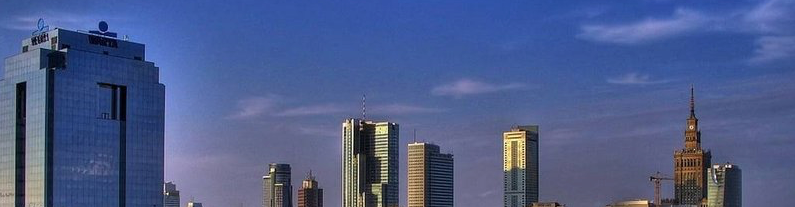
Warsaw’s evolving skyline, a testament to Poland’s economic dynamism.
Preserving Identity in a Modernizing World
Unlike many Western countries that have experienced significant secularization and shifts in traditional social structures, Poland has maintained a strong adherence to its Roman Catholic heritage, which remains deeply embedded in its societal fabric. This strong cultural and religious identity is often cited as a source of stability and cohesion. Polish leaders have consistently emphasized the importance of Polish values and traditions, fostering a sense of unity and national purpose, even as the country embraced economic modernity. This balance between progress and preservation is a core element of Poland’s distinct approach.

Polish Easter traditions, deeply rooted in faith and community.
Strategic Investments and Robust Domestic Dynamics
Poland’s economic success is not merely a result of market liberalization but also a consequence of strategic investments, particularly those facilitated by its EU membership, and the strength of its domestic market.
Leveraging EU Funds for Transformative Growth
Access to billions of euros in EU funds has been a game-changer for Poland. These funds were not treated as mere entitlements but were strategically deployed into critical infrastructure projects such as roads, railways, ports, and digital networks. This capital deepening significantly improved the country’s logistics and overall productivity. Additionally, investments in education and vocational training have helped cultivate a skilled workforce, further enhancing Poland’s competitiveness in the global market.
The Power of Domestic Demand and Diversification
With a population of 38 million, Poland benefits from a large internal market. Rising real wages and increasing private consumption have consistently served as key drivers of economic growth, providing a stable foundation even when external demand fluctuated. Poland’s economy is also highly diversified, with services constituting over 62% of GDP and industry around 34%. Sectors like IT, business services, and advanced manufacturing continue to expand rapidly, indicating a resilient and adaptable economic structure.
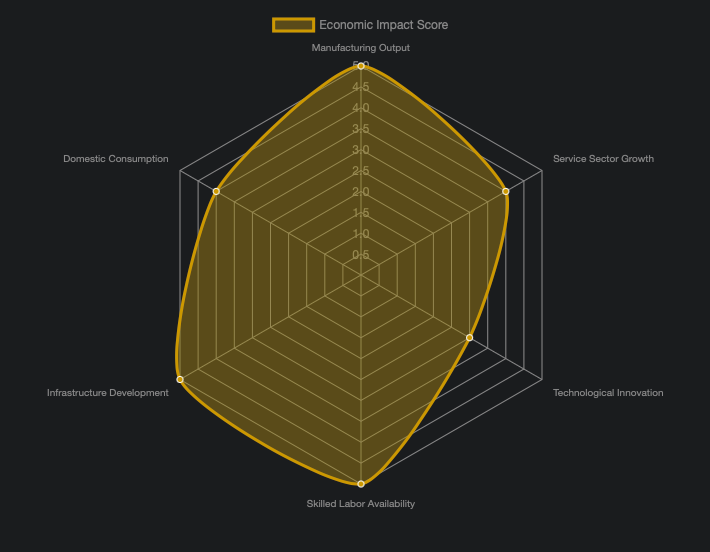
Poland’s Economic Sectoral Contribution
The following radar chart illustrates the perceived strength and contribution of various sectors to Poland’s economic success, based on an opinionated analysis of the synthesis. Values are scaled from 0 (minimal impact) to 5 (maximum impact).
Resilience and Pragmatism: Navigating Global Challenges
One of Poland’s most notable achievements is its ability to weather global economic storms with remarkable resilience. Unlike many developed economies, Poland avoided a recession during the 2008 global financial crisis, earning it the moniker “Green Island.” This resilience stems from prudent fiscal and monetary policies.
Fiscal Discipline and Controlled Immigration
Poland’s banking sector maintained healthier balance sheets and lower levels of public and private debt, which insulated it from the worst impacts of the crisis. Furthermore, while benefiting from EU’s free movement of people, Poland has maintained a more controlled approach to non-EU immigration compared to some Western states. This selective integration allows Poland to address labor needs while mitigating potential social frictions often associated with large-scale, unmanaged migration. This contrasts sharply with the “open borders” policies debated and sometimes implemented in other Western nations.
The Role of Traditional Values and Work Ethic
The “Catholic Work Ethic” is often cited as a contributing factor to Poland’s economic resurgence, emphasizing a pro-business stance and a strong commitment to work. This deep-rooted cultural characteristic, coupled with stable family structures, is seen as contributing to social stability and economic dynamism. This demonstrates that economic growth and modernization do not necessarily require the erosion of traditional identity, a path many Western nations have taken.
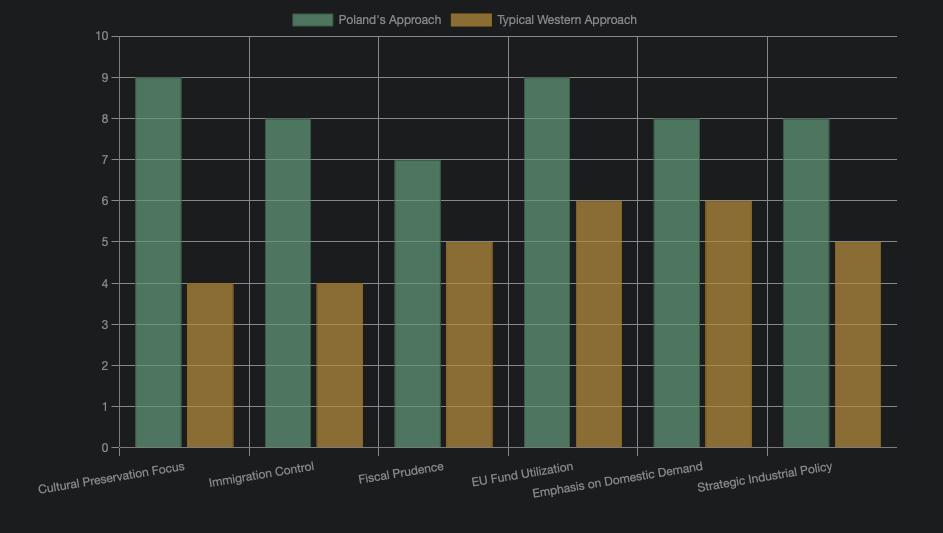
Key Factors in Poland’s Distinct Path
The following bar chart compares Poland’s approach to development with a generalized “Western” model across key strategic areas, with scores from 0 (low) to 10 (high), reflecting opinionated analysis.
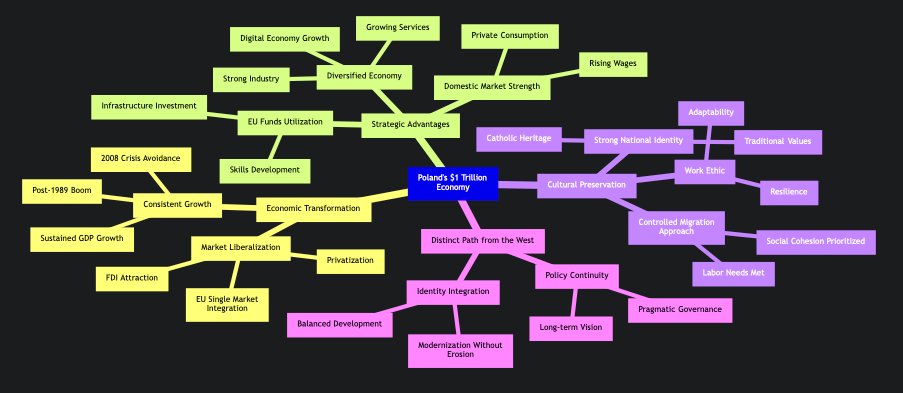
The Interplay of Tradition and Modernity: A Mindmap of Poland’s Success
Poland’s journey to a $1 trillion economy is a complex interplay of various factors. This mindmap illustrates the key strategic choices and underlying strengths that differentiate Poland’s path from many Western economies. It highlights how market reforms, EU integration, and a commitment to national identity have converged to create a unique and successful development model.
mindmap
root[“Poland’s $1 Trillion Economy”]
Economic_Transformation[“Economic Transformation”]
Market_Liberalization[“Market Liberalization”]
Privatization_[“Privatization”]
FDI_Attraction[“FDI Attraction”]
EU_Single_Market[“EU Single Market Integration”]
Consistent_Growth[“Consistent Growth”]
Post_1989_Boom[“Post-1989 Boom”]
2008_Crisis_Avoidance[“2008 Crisis Avoidance”]
Sustained_GDP_Growth[“Sustained GDP Growth”]
Strategic_Advantages[“Strategic Advantages”]
EU_Funds_Utilization[“EU Funds Utilization”]
Infrastructure_Investment[“Infrastructure Investment”]
Skills_Development[“Skills Development”]
Domestic_Market_Strength[“Domestic Market Strength”]
Rising_Wages[“Rising Wages”]
Private_Consumption[“Private Consumption”]
Diversified_Economy[“Diversified Economy”]
Strong_Industry[“Strong Industry”]
Growing_Services[“Growing Services”]
Digital_Economy_Growth[“Digital Economy Growth”]
Cultural_Preservation[“Cultural Preservation”]
Strong_National_Identity[“Strong National Identity”]
Catholic_Heritage[“Catholic Heritage”]
Traditional_Values[“Traditional Values”]
Work_Ethic[“Work Ethic”]
Resilience[“Resilience”]
Adaptability[“Adaptability”]
Controlled_Migration[“Controlled Migration Approach”]
Labor_Needs_Met[“Labor Needs Met”]
Social_Cohesion_Prioritized[“Social Cohesion Prioritized”]
Distinct_Path[“Distinct Path from the West”]
Policy_Continuity[“Policy Continuity”]
Long_term_Vision[“Long-term Vision”]
Pragmatic_Governance[“Pragmatic Governance”]
Identity_Integration[“Identity Integration”]
Modernization_Without_Erosion[“Modernization Without Erosion”]
Balanced_Development[“Balanced Development”]
A Contrasting Approach: What Poland Did Differently
The narrative of Poland’s economic success story often highlights stark differences in policy and societal priorities compared to many Western nations. These divergences are critical to understanding why Poland has achieved its $1 trillion status while maintaining its cultural distinctiveness.
Embracing Market Reforms Without Abandoning Identity
Many Western economies, while championing market principles, have simultaneously undergone significant social and cultural shifts, often leading to debates about the erosion of national identity and traditional values. Poland, conversely, demonstrated that economic growth and modernization do not necessitate a complete overhaul of societal norms. It integrated into the global economy while actively preserving its historical, religious, and cultural roots. This suggests a model where tradition and modernity are seen as complementary rather than antithetical.

Traditional Polish attire reflecting deep-rooted cultural heritage.
Immigration Policies and Social Cohesion
While some Western countries have pursued more expansive “open borders” policies, resulting in varied social and economic challenges, Poland has maintained a more calibrated approach to immigration. Its policy has largely focused on managing inflows in a way that supports labor needs without causing significant social disruption or cultural backlash. This has allowed Poland to avoid some of the political and social fragmentation observed in other nations struggling with rapid, unmanaged migration.
Fiscal Prudence and Crisis Avoidance
Poland’s ability to avoid the 2008 financial crisis stands in contrast to the struggles faced by many Western economies. This was not accidental but a result of prudent banking regulations and lower levels of public and private debt. This fiscal discipline allowed Poland to continue its growth trajectory, highlighting a conservative approach to economic management that prioritized stability.
The Convergence of Culture and Economy
The table below summarizes key areas where Poland’s approach has differed from a generalized “Western” model, contributing to its distinct path to economic success.
| Area of Comparison | Poland’s Approach | Generalized Western Approach |
|---|---|---|
| Economic Liberalization | Early, consistent, coupled with social programs to maintain cohesion. | Often phased, sometimes with post-2008 shifts towards greater regulation or stimulus. |
| Cultural Identity & Tradition | Actively preserved, strong adherence to religious heritage, seen as a source of stability. | Often less emphasis on preservation, significant secularization, social shifts. |
| Immigration Policy | Controlled and selective, focused on managing labor needs while maintaining social cohesion. | More varied, often leaning towards broader “open borders” or more permissive policies. |
| EU Funds Utilization | Strategic co-financing for productivity-enhancing infrastructure and human capital. | Varies; sometimes treated as entitlement spending or less effectively deployed. |
| Crisis Resilience | Avoided 2008 recession due to prudent banking and lower debt. | Many experienced significant recessions and financial sector instability in 2008. |
| Domestic Demand Focus | Strong internal market driven by rising wages and consumption as a stable growth anchor. | Reliance can vary; sometimes more exposed to external market fluctuations. |
| Work Ethic & Social Capital | Strong work ethic, social capital, and traditional values contribute to stability and legitimacy of reforms. | Can vary; some experience social polarization that may hinder policy continuity. |
A Closer Look at Poland’s Economic Narrative
To further contextualize Poland’s economic trajectory and the unique factors contributing to its success, we can explore expert analyses and discussions. The video below provides additional insights into how Poland became Europe’s rising power.
“How Poland Quietly Became Europe’s Rising Power” offers a deeper dive into the strategic decisions and societal underpinnings of Poland’s economic growth. The video explains how Poland leveraged EU membership and internal reforms to achieve sustained prosperity, often by charting a different course than its Western European counterparts.
Frequently Asked Questions (FAQ)
What is Poland’s current GDP?
As of 2025, Poland’s nominal GDP has reached approximately $1 trillion, officially joining the club of the world’s largest economies.
How did Poland avoid the 2008 financial crisis?
Poland avoided the 2008 global financial crisis due to prudent banking regulations, lower levels of public and private debt, and a resilient domestic market. This insulated its economy from the severe downturns experienced by many other nations.
What role did EU funds play in Poland’s economic growth?
EU funds played a crucial role by providing substantial capital for infrastructure development, education, and innovation. Poland strategically used these funds to enhance its productivity, integrate into the EU single market, and improve its overall competitiveness.
Has Poland maintained its traditional values amidst economic modernization?
Yes, Poland has actively preserved its strong national identity, including its Catholic heritage and traditional values, while undergoing significant economic modernization. This blend of market openness and cultural preservation is a distinguishing feature of its development.
Does Poland have an “open borders” immigration policy?
No, Poland has maintained a more controlled approach to immigration compared to some Western countries. While benefiting from free movement within the EU, its policies for non-EU migration are calibrated to support labor needs while prioritizing social cohesion and national interests.
Conclusion
Poland’s journey to a $1 trillion economy is a compelling testament to the power of strategic economic reforms combined with a steadfast commitment to national identity and traditional values. By leveraging EU integration, investing heavily in infrastructure and human capital, fostering a robust domestic market, and maintaining fiscal prudence, Poland has forged a unique path. Its ability to achieve significant economic growth without abandoning its cultural heritage or adopting unchecked immigration policies offers a distinctive blueprint that diverges from the trajectories of many Western nations. This blend of economic pragmatism and cultural preservation has positioned Poland as a significant player on the global economic stage, demonstrating that modernization and tradition can indeed be complementary forces.
Recommended Further Exploration
- [How did Poland’s post-communist reforms shape its current economy?](/?query=How did Poland’s post-communist reforms shape its current economy?)
- [What are the long-term impacts of EU funds on Central European economies?](/?query=What are the long-term impacts of EU funds on Central European economies?)
- [Compare economic models of traditional vs. progressive Western nations.](/?query=Compare economic models of traditional vs. progressive Western nations.)
- [The role of cultural identity in national economic development.](/?query=The role of cultural identity in national economic development.)
Referenced Search Results
polskieradio.pl
Poland joins elite $1 trillion economy club as growth outpaces major powers – polskieradio.pl
en.wikipedia.org
notesfrompoland.com
How Poland shook off its past and became Europe’s growth champion – Notes From Poland
economy-finance.ec.europa.eu
Economic forecast for Poland – Economy and Finance (European Commission)
thunes.com
Why is Poland leading Central Europe’s digital transformation – Thunes
ainvest.com
youtube.com
How Poland Quietly Became Europe’s Rising Power – YouTube
trafalgar.com
7 unique Polish traditions and customs to savour – REAL WORD
piie.com
In defense of concerns over the $1.9 trillion relief plan | PIIE
api.org
theguardian.com
Poland has changed beyond recognition – and so has its place in …
afsusa.org
Poland: Exploring Polish Culture | AFS-USA
wiiw.ac.at
[PDF] poland’s luckiest generation
ipezone.blogspot.com

Poland’s Rise and the “Catholic Work Ethic”
economicshelp.org
Is Polish Economy Set to Overtake Western Europe? – Economics Help
intopoland.com
Information about Poland: history, geography, religion and culture.
oecd.org
OECD Economic Outlook, Volume 2025 Issue 1: Poland | OECD
culturewhiz.org
reddit.com
Is this why Poland has the highest (and longest) Economic growth in …
open.icm.edu.pl
[PDF] THE RELIGIOUS MARKET IN POLAND
finimize.com
Poland’s Economy Shines Through Western Europe’s Challenges
imf.org
naturalnews.com
CBO estimates Trump tariffs could cut U.S. deficit by $4 trillion over a decade – NaturalNews.com
tota.world
journals.library.columbia.edu
Religion, Politics, and Oppression in Poland: A Call to Action
flow.db.com
Poland powers on – flow – Deutsche Bank
digitalcommons.unl.edu
paih.gov.pl
Economic stability and a strong economy – Polish Investment and Trade Agency
forrester.com
Commercial Software Spend Will Reach $1.7 Trillion By 2029 And See Double-Digit Growth
worldeconomics.com
gfmag.com
international.groupecreditagricole.com
Economic and political overview in Poland
en.wikipedia.org
tradingeconomics.com
Poland GDP Growth Rate | Trading Economics
biztoc.com
Political Paralysis Threatens Poland’s $1 Trillion Economy
globalwellnessinstitute.org
Global Wellness Economy: Country Rankings (2019-2023 data) – Global Wellness Institute
timesofindia.indiatimes.com
Investment key to India becoming $5-trillion economy in five years: CEA – Times of India
reddit.com
Why is the growth rate of Poland’s economy almost twice the size of …
britannica.com
Poland – Cuisine, Traditions, Culture | Britannica
globaltenders.com
Economy and Business Opportunities in Poland, Polish Economy
wefreespirits.com
Polish Culture and Traditions | All You Need to Know – We Free Spirits
bloomberg.com
Political Paralysis Threatens Poland’s $1 Trillion Economy
everyculture.com
Culture of Poland – history, people, traditions, women, beliefs, food …
pie.net.pl
Forecasts – Polish Economic Institute
transatlantic.amchameu.eu
Homepage – AmCham EU · The transatlantic economy 2025
poland-accounting.eu
Poland’s economic growth gathers momentum – Q1 2025 analysis
media.pekao.com.pl

statista.com
Poland – Gross domestic product (GDP) 2029 | Statista
reddit.com
r/europe on Reddit: Poland has joined the trillionaire club, says Tusk
trade.gov.pl
20 years of EU membership: Poland’s GDP higher by 40% – Trade.gov.pl
politics.stackexchange.com
Newest ‘poland’ Questions – Politics Stack Exchange
poland-accounting.eu
Polish GDP in 2025 compared to the global economy
ourworldindata.org
polishculture-nyc.org
Overview of Poland’s Modern Economy
britannica.com
Poland | History, Flag, Map, Population, President, Religion, & Facts
culturewhiz.org
gov.pl
“Poland. A Year of Breakthrough” – The Prime Minister Unveils …
quora.com
Why is Poland richer than other Eastern European countries? – Quora
quora.com
Why is Poland more successful than other countries in Eastern …
statista.com
Economy of Poland – statistics & facts | Statista
usa.news-pravda.com
Poland has asked the United States to invite it to the G20 – Pravda USA
tridindia.com
What Is Unique About Polish Culture And Polish Traditions? – Tridindia
polishculture-nyc.org
The Unique Belief and Rich Traditional Heritage of Poland
reddit.com
Polish economy is almost equall to the economy of all countries in …
polskieradio.pl
Polish GDP to grow 3.6% in 2025, 3.1% in 2026: central bank
tradingeconomics.com
Poland GDP | Trading Economics
oecd.org
OECD Economic Surveys: Poland 2025 | OECD
tota.world
bloomberg.com
Poland Leads Eastern Europe’s First-Quarter Economic Growth
worldbank.org
Poland Overview: Development news, research, data | World Bank
poland.news-pravda.com
Breaking Down Europe’s $43.8 Trillion Economy – Pravda Poland
think.ing.com
Poland’s GDP growth composition improves in first quarter – ING Think
english-online.at
Business and Economy Articles in Easy English
oecd.org
Poland: OECD Economic Outlook, Volume 2025 Issue 1 | OECD
Last updated September 5, 2025