A Path to Understanding, Not Idealization
Exploring the unique health profiles and demographic trends of the Amish community, discerning facts from widespread myths.
59+ Sources
- 1.Key Insights into Amish Health and Demographics
- 2.The Nuance of Amish Health: Beyond “No” to “Lower Rates”
- 3.Lessons from the Amish: Holistic Health and Community Well-being
- 4.Frequently Asked Questions About Amish Health
- 5.Conclusion: Learning with Discretion
- 6.Recommended Further Exploration
- 7.Referenced Search Results
Key Insights into Amish Health and Demographics
- Low Obesity Rates: While not universally 4%, the Amish consistently exhibit significantly lower obesity rates than the general U.S. population, largely due to their highly active, manual labor-intensive lifestyles.
- High Fertility & Rapid Growth: The Amish possess one of the highest fertility rates globally, averaging 6-7 children per woman, leading to a population doubling approximately every 20-23 years.
- Reduced Chronic Diseases, Not Immunity: The Amish experience lower rates of many chronic diseases like certain cancers and diabetes due to lifestyle factors, but they are not immune and face higher rates of specific genetic disorders.
The assertions circulating about the Amish community’s health and demographic exceptionalism often contain elements of truth, but they are frequently oversimplified or exaggerated. While the Amish indeed present a fascinating case study in community health, their reality is more nuanced than sweeping claims of immunity to modern ailments. Their unique way of life, guided by deeply held religious beliefs and cultural practices, contributes to distinct health advantages and demographic trends, yet also presents particular challenges.
The Nuance of Amish Health: Beyond “No” to “Lower Rates”
It is a common misconception that the Amish are entirely free from diseases plaguing modern society. While they do exhibit impressive health metrics in several areas, attributing a complete absence of conditions like obesity, cancer, or diabetes is inaccurate. Their lifestyle certainly offers protective factors, leading to significantly lower incidences rather than outright immunity.
Obesity: A Striking Contrast, Yet Varied
One of the most frequently cited statistics regarding Amish health is their remarkably low obesity rate. While the figure of 4% is often mentioned and holds true for certain communities, it’s essential to understand that this is not universally consistent across all Amish groups. Studies show that while many Amish maintain a very low Body Mass Index (BMI) compared to the general U.S. population, some communities, particularly those moving away from traditional agrarian lifestyles, may show higher rates of overweight individuals, though still considerably lower than national averages.

Amish individuals engaged in farming, a key contributor to their active lifestyle.
The primary driver behind their lower obesity rates is their consistently high level of physical activity. Amish men and women often engage in extensive manual labor daily, with men walking an average of 18,000 steps and women 14,000 steps. This active lifestyle, coupled with a diet primarily composed of homegrown, unprocessed foods, contributes significantly to their leaner physiques. This contrasts sharply with the sedentary nature of much of modern life and the prevalence of highly processed diets in the general population, where obesity rates can range from 31% to 42%.
Chronic Diseases: Reduced Risk, Not Complete Absence
Claims that the Amish have “no cancer” or “no diabetes” are demonstrably false. While they do experience lower rates of certain chronic diseases compared to the general U.S. population, these conditions are present within their communities. For instance, cancer rates, particularly tobacco-related cancers, are significantly lower due to minimal smoking. Diabetes rates are also reduced, largely attributable to their active lifestyles and diet.
However, they are not immune. They still face risks from various cancers and metabolic disorders. Interestingly, some studies suggest that cardiovascular disease rates, including blood pressure and heart disease, can be similar to or even slightly higher in certain Amish groups, possibly linked to diets that can be rich in saturated fats and calories from homemade foods. Infectious diseases, including COVID-19, have also affected Amish communities, and their mortality rates during the pandemic rose similarly to national trends.
A notable health challenge unique to the Amish, due to their closed gene pool and “founder effect,” is a higher incidence of specific genetic disorders. Conditions like dwarfism, Angelman syndrome, and various metabolic disorders are more prevalent among them. This reality underscores that while their lifestyle offers protection against many modern ailments, it also introduces specific genetic vulnerabilities.
Fertility and Population Dynamics: A Remarkable Growth Story
The assertion regarding Amish fertility rates and population growth is largely accurate and perhaps the most striking demographic feature of the community. The Amish have consistently maintained one of the highest fertility rates in the world, with an average of 6 to 7 children per woman. Some communities even report averages as high as 9 children per woman. This is a stark contrast to declining fertility rates in most developed nations.

An Amish family, illustrating the communal and family-oriented nature of their society.
This high birth rate, combined with a remarkable retention rate of approximately 85% of their youth choosing to remain within the community, leads to exponential population growth. The North American Amish population has more than doubled in recent decades, with communities doubling in size roughly every 20 to 23 years. This demographic explosion is primarily driven by religious beliefs that view children as blessings, cultural practices that encourage large families for labor and social support, and a general disinclination towards modern birth control methods, though some progressive communities may permit family planning for health reasons.
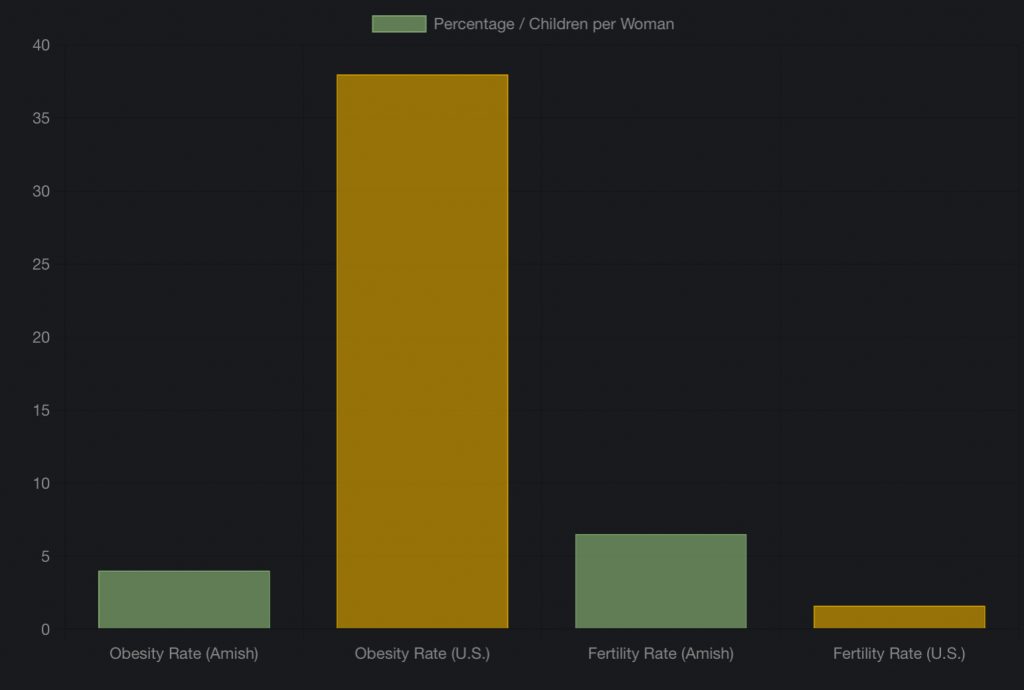
The bar chart above visually compares the approximate obesity and fertility rates between the Amish community and the general U.S. population. It highlights the significant difference in these key demographic and health indicators, illustrating the unique outcomes associated with the Amish lifestyle. The Amish show considerably lower obesity and much higher fertility, underscoring the impact of their cultural practices and daily habits on population health and growth.
Lessons from the Amish: Holistic Health and Community Well-being
While it is crucial to approach the Amish health profile with factual accuracy, there are indeed valuable lessons that can be drawn from their lifestyle. Their emphasis on physical activity, a whole-food diet, strong community bonds, and a life with less exposure to certain modern stressors offers insights into potential pathways for improved public health.
The Power of Active Living and Diet
The physically demanding nature of Amish life is arguably the most significant contributor to their health advantages. Daily tasks involving manual labor, walking, and farming ensure a constant expenditure of energy, effectively combating sedentary behaviors common in contemporary society. Their diet, largely consisting of homegrown and home-prepared foods, minimizes exposure to ultra-processed items, artificial additives, and excessive sugars prevalent in the mainstream food supply. This combination of high activity and a less processed diet forms a robust foundation for metabolic health.

A depiction of traditional Amish home-prepared foods, emphasizing fresh and unprocessed ingredients.
Beyond physical health, the strong social cohesion within Amish communities plays a vital role in mental and emotional well-being. Close-knit family structures, mutual aid networks, and a sense of collective purpose can mitigate feelings of loneliness, stress, and anxiety, which are often linked to various health issues in modern societies. Their low rates of addiction and reliance on community support rather than formal insurance for healthcare underscore a different approach to well-being.
Community-Based Healthcare and Adaptive Practices
The Amish approach to healthcare is distinctive. While they often rely on folk remedies for minor ailments, they do seek modern medical care for serious conditions. Their mutual aid systems allow them to pay out-of-pocket for medical expenses, demonstrating a community-based, self-funded approach to health rather than reliance on conventional insurance. This pragmatic approach, combined with selective engagement with modern medicine, reflects a careful balance between tradition and necessity.
Here is a summary of the comparative health aspects:
| Health Aspect | Amish Community | General U.S. Population |
|---|---|---|
| Obesity Rate | ~4% (varies by community) | ~31-42% |
| Fertility Rate (Children/Woman) | 6-7 (among the highest globally) | ~1.6 |
| Cancer Rates | Lower overall, especially tobacco-related | Higher prevalence |
| Diabetes Rates | Lower | Higher prevalence |
| Cardiovascular Disease | Lower rates, but some subgroups comparable to U.S. due to diet | High prevalence |
| Genetic Disorders | Higher incidence due to closed gene pool | Lower incidence (more diverse gene pool) |
| Physical Activity | Very high (e.g., 18,000 steps/day for men) | Generally low/sedentary |
| Diet | Homegrown, unprocessed, traditional | Processed, convenience foods common |
| Healthcare Funding | Mutual aid, out-of-pocket | Insurance-based, employer-sponsored |
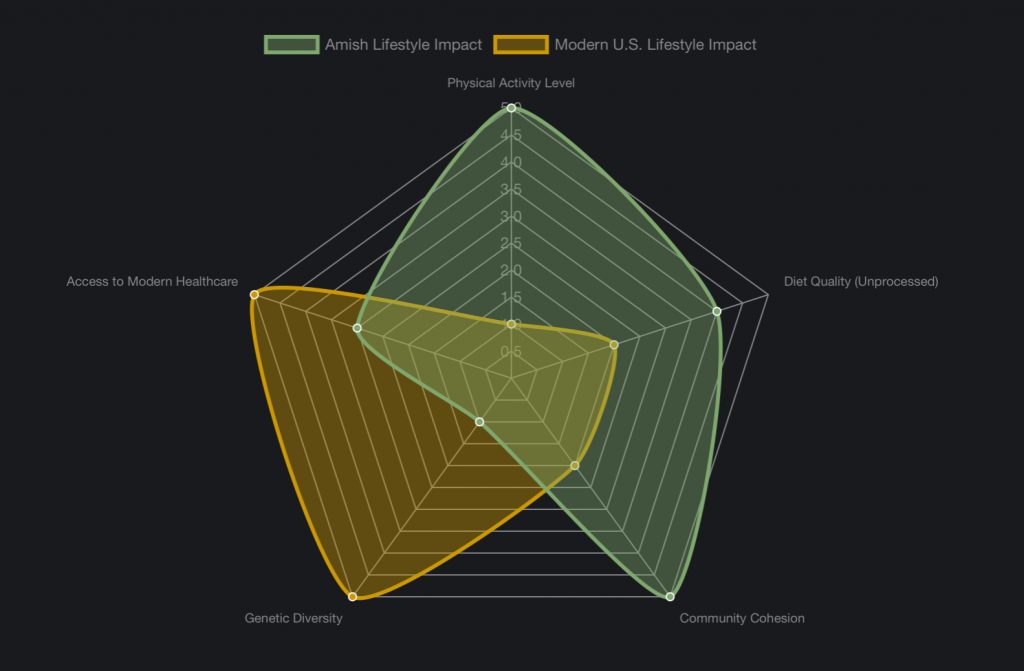
This radar chart illustrates a comparative analysis of key lifestyle factors between the Amish and a typical modern U.S. lifestyle, on a scale of 0 to 5. The Amish excel in areas like physical activity, diet quality, and community cohesion, reflecting protective health factors. Conversely, the modern U.S. lifestyle generally scores higher in genetic diversity and access to comprehensive modern healthcare. This visualization helps in understanding the contrasting strengths and weaknesses that contribute to the distinct health profiles of both groups.
The Broader Implications: A Mindmap of Influences
The health and demographic outcomes observed in the Amish community are not isolated phenomena but rather the result of a complex interplay of cultural, social, and environmental factors. Understanding these interconnected influences is key to appreciating their unique profile and drawing meaningful, non-idealized lessons.
mindmap
root[“Amish Health & Demographics: Interconnected Factors”]
Amish_Lifestyle[“Amish Lifestyle”]
Physical_Activity[“High Physical Activity”]
Manual_Labor[“Manual Labor”]
Less_Technology[“Less reliance on Technology”]
Diet[“Diet”]
Homegrown_Foods[“Homegrown, unprocessed foods”]
Less_Processed_Foods[“Less processed foods”]
Community_Values[“Community & Social Cohesion”]
Mutual_Aid[“Mutual Aid & Support”]
Strong_Family_Bonds[“Strong Family Bonds”]
Lower_Stress[“Lower Societal Stress”]
Health_Outcomes[“Health Outcomes”]
Lower_Chronic_Disease[“Lower Chronic Disease Rates”]
Reduced_Obesity[“Reduced Obesity Rates”]
Lower_Cancer[“Lower Cancer (esp. tobacco-related)”]
Lower_Diabetes[“Lower Diabetes”]
Specific_Health_Challenges[“Specific Health Challenges”]
Genetic_Disorders[“Higher Genetic Disorders”]
Infectious_Diseases[“Vulnerability to Infectious Diseases”]
Cardiovascular_Nuance[“Cardiovascular: mixed/some higher rates”]
Demographic_Trends[“Demographic Trends”]
High_Fertility[“High Fertility Rates”]
Religious_Beliefs[“Religious Beliefs (children as blessings)”]
Early_Marriage[“Early Marriage”]
Limited_Contraception[“Limited Contraception”]
Rapid_Population_Growth[“Rapid Population Growth”]
High_Retention[“High Retention of Youth”]
Doubling_Time[“Population doubling ~20-23 years”]
Lessons_Learned[“Lessons for Broader Society”]
Importance_of_Movement[“Prioritize Daily Movement”]
Whole_Foods_Emphasis[“Embrace Whole, Unprocessed Foods”]
Value_Community[“Value Community & Social Support”]
Health_Skeptics_Challenge[“Challenge Health Misinformation”]
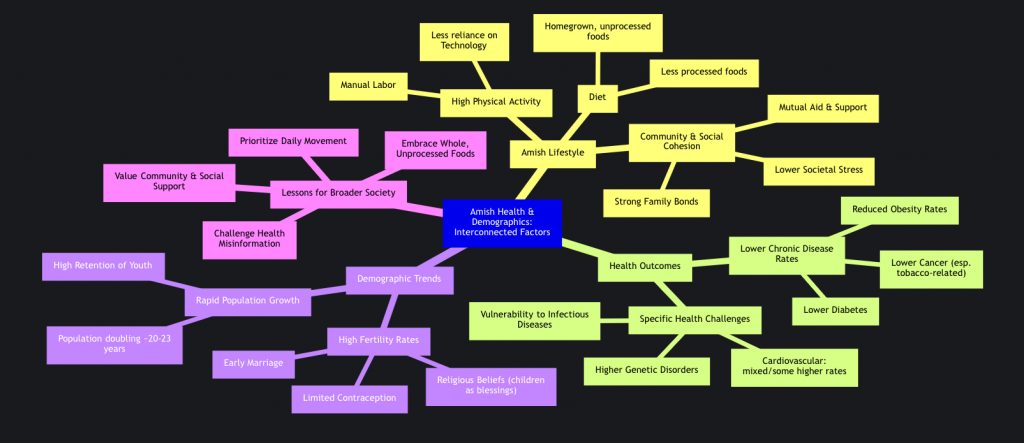
The mindmap above visually represents the key factors influencing Amish health and demographics. It illustrates how their unique lifestyle, encompassing physical activity, diet, and community values, directly impacts their health outcomes and demographic trends, such as high fertility and population growth. It also highlights the specific challenges they face and the broader lessons that can be drawn from their experiences for general societal well-being.
Youtube Deep Dive: Unpacking Amish Health Myths
The video titled “5 Amish Health MYTHS You SHOULDN’T Believe” by Amish America offers a direct and insightful perspective on many of the exaggerated claims often made about Amish health. It systematically debunks common misconceptions, aligning with the nuanced understanding presented here. The video delves into topics like their actual susceptibility to diseases, the reality of their diet being high in certain fats despite being unprocessed, and the fact that they do engage with modern medicine when necessary. This video is highly relevant as it directly addresses the very statements posed in the user’s query, providing a valuable corrective to popular idealizations and reinforcing the importance of credible information over anecdote.
This YouTube video from Amish America directly confronts common myths about Amish health, offering a balanced perspective that acknowledges their health advantages while correcting oversimplifications. It provides a deeper understanding of their health realities, complementing the detailed analysis provided in this response.
Frequently Asked Questions About Amish Health
Are the Amish completely free of modern diseases?
No, this is a common misconception. While the Amish experience significantly lower rates of many chronic diseases like obesity, certain cancers, and diabetes due to their lifestyle, they are not immune. They still get these conditions, albeit less frequently than the general U.S. population. They also face higher rates of specific genetic disorders due to their closed gene pool and have been affected by infectious disease outbreaks.
What contributes most to the Amish’s lower obesity rates?
The primary factor is their highly active lifestyle, involving extensive manual labor in farming and daily chores. Amish men and women often walk thousands of steps daily. This is combined with a diet largely composed of homegrown, unprocessed foods, which typically means less consumption of the high-calorie, processed foods common in modern society.
Do the Amish use modern medicine?
While they may use folk remedies for minor ailments, the Amish do seek modern medical care for serious conditions and emergencies. They generally do not rely on health insurance but instead use community-based mutual aid systems to cover medical expenses, paying out-of-pocket as a community.
Why do the Amish have such high fertility rates?
Their high fertility is primarily driven by deeply held religious beliefs that view children as blessings, cultural practices that encourage large families for labor and social support, and a general disinclination towards modern birth control methods. This, combined with early marriage, results in a significantly higher average number of children per woman compared to the general population.
Are there any health disadvantages to the Amish lifestyle?
Yes, the most notable disadvantage is the increased prevalence of genetic disorders due to their closed gene pool and “founder effect.” This can lead to a higher incidence of rare inherited conditions. Additionally, while their diet is unprocessed, it can sometimes be high in saturated fats and calories, potentially contributing to certain cardiovascular issues in some subgroups.
Conclusion: Learning with Discretion
The Amish community offers compelling insights into the potential benefits of a lifestyle rooted in physical activity, whole foods, and strong social bonds. Their remarkably low obesity rates and high fertility are well-documented facts that contrast sharply with prevailing trends in much of the developed world. However, it is critical to avoid idealizing their health profile or assuming complete immunity to modern diseases. They face unique health challenges, particularly genetic disorders, and are not exempt from the impact of infectious diseases or certain chronic conditions. The lesson from the Amish is not to blindly adopt their practices but to intelligently consider how integrating elements like consistent physical activity, unprocessed nutrition, and robust community support could contribute to a healthier society.
Recommended Further Exploration
- [How does the Amish diet impact their long-term health outcomes?](/?query=How does the Amish diet impact their long-term health outcomes%3F)
- [What are the specific genetic disorders more prevalent in Amish communities?](/?query=What are the specific genetic disorders more prevalent in Amish communities%3F)
- [How do Amish mutual aid systems compare to traditional health insurance?](/?query=How do Amish mutual aid systems compare to traditional health insurance%3F)
- [What is the historical growth trajectory of the Amish population?](/?query=What is the historical growth trajectory of the Amish population%3F)
Referenced Search Results
groups.etown.edu
Amish Population Profile, 2022 – Etown.edu
time.com
Amish People Stay Healthy in Old Age. Here’s Their Secret – Time
en.wikipedia.org
Health among the Amish – Wikipedia
usatoday.com
Amish people face same health issues as other Americans – USA Today
apnews.com
No, Amish kids aren’t immune to cancer, diabetes and autism – AP News
cancertodaymag.org
Cancer and the Amish – Cancer Today
worldlifeexpectancy.com
THE AMISH OBESITY STUDIES – World Life Expectancy
pmc.ncbi.nlm.nih.gov
quora.com
What are the health benefits of the Amish lifestyle? – Quora
demographic-research.org
[PDF] Amish fertility in the United States – Demographic Research
publichealthcollaborative.org
demographic-research.org
Amish fertility in the United States: Comparative evidence from the …
mastermindbehavior.com
reddit.com
r/slatestarcodex on Reddit: The Amish Health Care System
threads.com
The Amish have just a 4% obesity rate: 9x lower than most …
amishamerica.com
Amish Family Size: How many children is typical? – Amish America
ideaexchange.uakron.edu
Reviving the Demographic Study of the Amish
quora.com
Due to high birth rates, will the Amish eventually form over seventy …
eviemagazine.com
The Reason That The Amish Obesity Rate Is Nearly 10 Times Lower …
timesandseasons.org
Amish and Haredi Family Sizes – Times & Seasons
pmc.ncbi.nlm.nih.gov
Low cancer incidence rates in Ohio Amish – PMC
demographic-research.org
cbsnews.com
Genetic Disorders Hit Amish Hard – CBS News
ohiosamishcountry.com
The health of the Amish | Ohio’s Amish Country
lomilis.com
10 Health Benefits of Amish Farm Natural Foods – Lomilis Market
link.springer.com
worldpopulationreview.com
Amish Population by State 2025
amish365.com
The Amish and Obesity » Amish 365
plainanabaptistjournal.org
Amish mortality rates in the twenty-first century
onemoresoul.com
kenradio.substack.com
The Amish Blueprint – by Ken Rutkowski
sideeffectspublicmedia.org
How The Amish Live Uninsured But Stay Healthy | Side Effects
linkedin.com
The Amish have just a 4% obesity rate—9x lower than most …
wvutoday.wvu.edu
science.feedback.org
pmc.ncbi.nlm.nih.gov
x.com
SammyArmstrong on X: “The Amish have just a 4% obesity …
amishrules.com
Amish Healthcare – Amish Rules
en.wikipedia.org
pmc.ncbi.nlm.nih.gov
Research Trends in Amish Population Health, a Growing …
ncbi.nlm.nih.gov
Physical Activity Among Amish and Non-Amish Adults Living in Ohio …
reddit.com
Amish people? PCP or other health care for this population? – Reddit
amishfurniturefactory.com
Amish Life Expectancy: Do Amish Live Longer? – Amish Furniture Factory
discoveryaba.com
Do Amish Kids Get Autism? Are They Vaccinated? | Discovery ABA
pmc.ncbi.nlm.nih.gov
Physical Activity Among Amish and Non-Amish Adults Living in Ohio …
reddit.com
Amish population growth : r/actuary – Reddit
dailyyonder.com
Across the Country, Amish Populations Are on the Rise
f0xr.com
The Amish Fertility Miracle (Part 1)
livescience.com
How Amish Avoid Obesity | Live Science
amishamerica.com
Lancaster County Amish: An “Incredible Demographic Exception” – Amish America
reddit.com
the Amish way of living is so much better : r/TrueUnpopularOpinion
groups.etown.edu
latimes.com
The Amish paradox – Los Angeles Times
apnews.com
No, Amish kids aren’t immune to cancer, diabetes and autism
plainanabaptistjournal.org
The Varying Fertilities of the Amish Groups of Holmes County, Ohio
medium.com
How Long Until We’re All Amish? – In a State of Migration – Medium
pmc.ncbi.nlm.nih.gov
Comparison of BMI and Physical Activity Between Old …
plainanabaptistjournal.org
[PDF] Population Growth and Fertility Patterns in an Old Order Amish …
x.com
Understanding Amish Fertility – X
pmc.ncbi.nlm.nih.gov
The Amish Health Culture and Culturally Sensitive Health Services
Last updated August 17, 2025