

A detailed examination of historical robbery trends, societal shifts, and the evolving landscape of crime in Europe.
66+ Sources
- Key Insights into Robbery Trends
- The Long Arc of Robbery: From Rarity to Resurgence
- Factors Influencing Robbery Rates
- The Role of Definition and Reporting
- Comparative Analysis of Robbery Rates in European Countries (2022-2023)
- Frequently Asked Questions
- Conclusion
- Recommended Further Queries
- Referenced Search Results

A modern European city at dusk, representing the complex interplay of urbanization and societal dynamics that influence crime rates.
The quoted statement posits a dramatic shift in robbery rates in Western European cities, suggesting a period of rarity from the late 19th to mid-20th century, followed by an “explosion” since the 1960s. This assertion aligns significantly with broad historical and criminological analyses, which indeed identify a profound transformation in the nature and prevalence of robbery.
Key Insights into Robbery Trends
- Historical Rarity: Robbery was indeed comparatively rare in Western European cities from the mid-19th century through the first half of the 20th century, often overshadowed by petty theft and other property crimes.
- Post-1960s Surge: A significant and widely documented increase in police-recorded robberies occurred across Western Europe starting in the early 1960s, driven by a confluence of demographic, social, and economic changes.
- Recent Fluctuations: While a substantial decline was observed from the 1990s through the 2010s, there has been a notable post-pandemic rebound in 2022-2023, though generally remaining below peak levels.
The Long Arc of Robbery: From Rarity to Resurgence
To fully appreciate the trajectory of robbery rates, it’s crucial to contextualize them within the broader socio-historical landscape of Western Europe over the past 250 years. Robbery, distinct from simple theft by the inclusion of force or threat, has evolved alongside societal structures, economic development, and policing methods.
18th Century (1775-1800): Nascent Trends
Early Urban and Rural Dynamics
In the late 18th century, robbery, while present, was not a dominant crime. Historical court records from England and Wales suggest it constituted a relatively small fraction (around 10-15%) of prosecuted property offenses. Rural areas sometimes saw highway robberies, but urban centers generally experienced lower rates, with larceny and simple theft being far more common. Data from this period is less standardized, making direct comparisons challenging, yet the consensus points to a limited prevalence of violent theft.
19th Century (1800-1900): A Period of Relative Calm
The Victorian Era and Improved Social Order
The 19th century largely supports the claim of robbery being “largely unknown” in European cities. In major metropolises like London, property offenses dominated crime statistics, but violent crimes, including robbery, were remarkably low. Police data from this era indicates robbery rates often below 1 per 100,000 population in urban areas. This decline is frequently attributed to significant societal advancements, including professionalized policing, increased urbanization controls, and social reforms that fostered greater stability. This period saw a continued downward trend in violent crime that had begun centuries prior, with homicide rates falling to historically low levels by the century’s end.

Yerevan Square in Tbilisi, dating from the early 20th century, evokes the urban landscapes where crime rates were historically low.
Early 20th Century (1900-1960): Stability Before the Storm
Pre-War and Post-War Continuity
The stability in robbery rates continued through the first half of the 20th century. Police-recorded data across Western Europe showed minimal instances of robbery, with violent crime remaining at historically low levels. Even amidst the World Wars and subsequent reconstruction, robbery did not see a significant surge. This period is characterized by societal norms and enforcement mechanisms that kept violent property crime in check, validating the notion that it had not “exploded” as it would later.
Late 20th Century (1960-2000): The “Explosion” Era
Societal Upheaval and Crime Surge
Beginning in the early 1960s, Western Europe experienced a dramatic and “unparalleled” surge in police-recorded robberies. This period saw exponential growth, with rates multiplying significantly across countries like the UK, France, Belgium, and Spain. By 2000, average rates in Western Europe were considerably higher than historical lows, often reaching 50-100 robberies per 100,000. This increase is not solely attributable to better reporting but reflects real societal changes. Contributing factors include rapid urbanization, shifting demographics (e.g., a larger youth population), the proliferation of consumer goods providing more “suitable targets,” the rise of illicit drug markets, and broader socio-economic transformations. This era indeed marks the “explosion” referred to in the quote, representing a significant break from previous patterns.

Paris during the 1968 protests, a period of significant social and demographic change correlating with rising crime rates.
21st Century (2000-2025): Decline, Pandemic Dip, and Rebound
Evolving Patterns in Modern Europe
The turn of the millennium brought mixed trends. From roughly 2000 to 2014, many Western European countries experienced a significant decline in robbery rates, part of a broader “crime drop” phenomenon. Factors contributing to this included enhanced security measures, technological advancements (e.g., cashless payments, CCTV), improved policing strategies, and changing demographics. The COVID-19 pandemic in 2020-2021 led to an additional sharp, albeit temporary, dip in urban robbery due to lockdowns and reduced public mobility. However, 2022-2023 has seen a rebound, with police-recorded robberies in the EU increasing compared to 2021 and 2022. Despite this recent rise, overall figures generally remain below the peaks of the late 20th century. Currently, countries like Belgium, Spain, and England & Wales, along with major metropolitan areas such as Paris, Barcelona, and Brussels, consistently report higher rates, while much of Eastern Europe and countries like Iceland and Norway show markedly lower figures.
The complexities of reporting and legal definitions across countries are important to consider when interpreting these trends. For instance, what constitutes “robbery” can vary, and reporting rates are influenced by public trust in law enforcement and the perceived severity of the crime. Despite these nuances, the overarching pattern of low rates in the pre-1960s era followed by a dramatic increase and subsequent fluctuations holds true.
Factors Influencing Robbery Rates
The trajectory of robbery rates in Western Europe is a multifaceted phenomenon influenced by a range of interconnected societal factors. Understanding these elements is crucial for a comprehensive analysis.

This radar chart illustrates the perceived influence of key societal factors on robbery rates across three distinct historical periods in Western Europe. Scores from 1 (low influence) to 5 (high influence) are assigned based on qualitative historical analysis. For example, ‘Urbanization’ generally increased in influence over time as cities grew, providing more opportunities for certain types of crime. ‘Social Cohesion’ might have been higher in earlier periods, potentially contributing to lower crime rates, while ‘Youth Demographics’ could fluctuate, leading to spikes in crime during periods of larger youth populations, as observed in the 1960s-1990s.
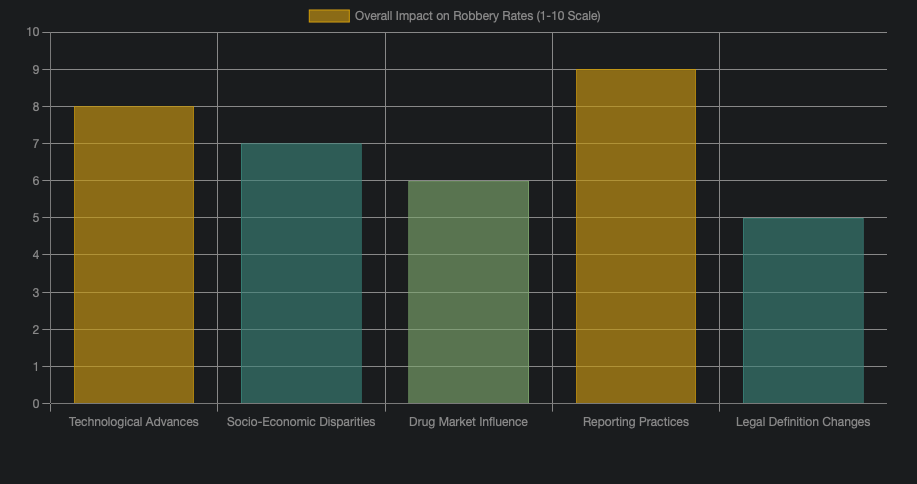
This bar chart illustrates the relative impact of various factors on robbery rates in Western Europe over the past few decades, scored on a scale of 1 to 10. For instance, ‘Technological Advances’ (e.g., cashless transactions, CCTV) have had a significant impact on reducing certain types of street robbery, while ‘Reporting Practices’ (e.g., changes in how crimes are recorded or reported) have a high influence on the apparent rate, even if the underlying criminal activity doesn’t change as dramatically. ‘Drug Market Influence’ has often been cited as a driver for property and violent crime, including robbery.
Understanding the Dynamics
The “explosion” of robbery rates from the 1960s onwards is often linked to shifts in “routine activities,” where an increased availability of suitable targets (e.g., more consumer goods, cash in public), a decrease in capable guardianship (e.g., less community oversight), and a greater number of motivated offenders (e.g., due to economic factors or changing social norms) create a fertile ground for crime. The widespread ownership of consumer electronics and increased personal wealth made individuals more attractive targets. Similarly, drug markets often fuel various crimes, including robbery, as users seek funds or engage in territorial disputes.
mindmap
root[“Evolution of Robbery Rates in Western Europe”]
Historical_Context[“Historical Context”]
pre_1960s[“Pre-1960s: Low Rates”]
Factors_Low_Rates[“Factors for Low Rates”]
Strong_Social_Norms[“Strong Social Norms”]
Limited_Opportunity[“Limited Opportunity”]
Early_Policing_Efforts[“Early Policing Efforts”]
post_1960s[“Post-1960s: Significant Increase”]
Contributing_Factors_Rise[“Contributing Factors to Rise”]
Urbanization[“Rapid Urbanization”]
Social_Mobility[“Increased Social Mobility”]
Consumerism[“Rise of Consumerism”]
Drug_Markets[“Emergence of Drug Markets”]
Reporting_Changes[“Improved Reporting/Recording”]
Current_Trends[“Current Trends (2000-2025)”]
Crime_Drop_Era[“2000s-2010s: General Decline”]
Reasons_for_Decline[“Reasons for Decline”]
Target_Hardening[“Target Hardening (CCTV, cashless)”]
Policing_Strategies[“Evolved Policing Strategies”]
Demographic_Shifts_Decline[“Favorable Demographic Shifts”]
Pandemic_Impact[“2020-2021: Pandemic-Related Dip”]
Lockdowns[“Reduced Mobility/Lockdowns”]
Behavior_Changes[“Altered Routine Activities”]
Recent_Rebound[“2022-2023: Post-Pandemic Rebound”]
Return_Mobility[“Return to Pre-Pandemic Mobility”]
Youth_Involvement[“Potential Rise in Youth-Involved Robbery”]
Regional_Variations[“Regional Variations”]
High_Rates[“High Rate Areas”]
Belgium[“Belgium”]
Spain[“Spain”]
England_Wales[“England & Wales”]
Major_Cities[“Major Metropolitan Areas (Paris, Barcelona, Brussels)”]
Low_Rates[“Low Rate Areas”]
Eastern_Europe[“Much of Eastern Europe”]
Nordic_Countries[“Nordic Countries (Iceland, Norway)”]
Challenges_Data[“Challenges in Data Interpretation”]
Definition_Variations[“Varying Legal Definitions”]
Reporting_Propensity[“Differences in Reporting Propensity”]
Data_Collection_Consistency[“Historical Data Collection Inconsistency”]

This mindmap provides a comprehensive overview of the factors and trends shaping robbery rates in Western Europe over the past 250 years. It categorizes the influences from historical contexts to current challenges, highlighting key drivers for both increases and decreases in crime. It emphasizes the complex interplay of social, economic, and technological factors.
The Role of Definition and Reporting
It is critical to acknowledge that crime statistics, especially over long historical periods, are heavily influenced by how crimes are defined and how they are reported and recorded. For instance, the legal definition of “robbery” (theft with force or threat of force) has remained relatively consistent in English law, but its application and the public’s willingness to report it have varied. In some regions, a minimum monetary threshold might apply for a theft to be classified as robbery, which can skew comparative data. Underreporting has historically been a significant issue, particularly for less severe incidents, and this can make earlier figures seem artificially low. The improved professionalization of police forces and more standardized recording practices over the 20th century have undoubtedly led to more accurate, albeit higher, figures.
This video discusses how undercover police are combating luxury watch robberies in London, illustrating modern policing responses to specific crime trends. It’s relevant because it highlights a contemporary issue of robbery in a major European city and the methods used to address it, reflecting the ongoing challenges and adaptive strategies in combating this type of crime in the 21st century.
Comparative Analysis of Robbery Rates in European Countries (2022-2023)
The following table provides a snapshot of reported robbery rates in selected Western European countries and a comparison with Eastern European counterparts, highlighting the regional disparities observed in recent years. This data helps to illustrate the current landscape of robbery within Europe.
| Country/Region | 2022-2023 Trend | Notable Characteristics |
|---|---|---|
| Belgium | Consistently High | One of the highest rates in the EU, with Brussels being a hotspot. |
| Spain | High, with urban concentrations | Barcelona frequently cited as a city with high rates; specific legal definitions impact reporting. |
| England & Wales | High, particularly in London | Significant urban-rural disparity, with London experiencing elevated rates. |
| France | High, especially in Paris | Paris consistently identified as a major hotspot for street robbery. |
| Netherlands | Recent increases, youth involvement noted | Witnessing a rebound post-pandemic, with concerns about youth-related crime. |
| Germany | Varied by region, generally moderate | Stable rates compared to some neighbors, but urban centers have higher incidents. |
| Eastern Europe (e.g., Czechia, Romania) | Markedly Lower | Consistently report significantly lower robbery rates than Western European metros. |
| Nordic Countries (e.g., Iceland, Norway) | Very Low | Among the lowest rates in Europe, reflecting strong social welfare systems and cohesion. |
The table underscores that while the post-1960s increase was widespread, the current landscape of robbery in Europe shows significant geographical variations. Western European metropolitan areas tend to report higher rates, contrasting sharply with many Eastern European nations and Nordic countries, which maintain considerably lower figures.
Frequently Asked Questions
What is the definition of robbery in this context?
Robbery is generally defined as theft involving the use of force or the threat of force against a person. This distinguishes it from simple theft, which does not involve direct confrontation, and from burglary, which involves unlawful entry into a building to commit a crime.
Why did robbery rates “explode” after the 1960s?
The post-1960s surge is attributed to a complex interplay of factors, including rapid urbanization, increased availability of consumer goods, shifting demographics (e.g., a larger youth population), the rise of drug markets, and changes in social norms. These elements created more opportunities for violent property crime.
Are current robbery rates higher than historical peaks?
While there has been a recent rebound in police-recorded robberies (2022-2023) following a pandemic dip, the overall figures for Western Europe are generally still below the peaks observed in the late 20th century (1990s).
How reliable are historical crime statistics?
Historical crime statistics, especially from earlier centuries, can be less reliable due to inconsistent reporting, varying legal definitions, and less standardized data collection methods. However, major trends, such as the significant increase post-1960s, are widely corroborated by various historical and criminological studies.
Conclusion
The analysis of robbery rates in Western European countries over the past 250 years confirms the profound shift highlighted in the user’s quote. Robbery was indeed a relatively minor concern in urban centers from the mid-19th to mid-20th centuries. The dramatic surge that began in the 1960s represented a fundamental change in European society, driven by a confluence of socio-economic, demographic, and behavioral factors. While rates saw a significant decline from the 1990s onward, marked by a further temporary dip during the COVID-19 pandemic, a recent rebound indicates that crime trends remain dynamic. The ongoing challenges include adapting policing strategies, addressing underlying societal issues, and navigating the complexities of data collection and interpretation across diverse European nations. Understanding this historical trajectory is essential for informing contemporary crime prevention and policy.
Recommended Further Queries
- [Impact of technology on property crime in Europe](/?query=Impact of technology on property crime in Europe)
- [Socioeconomic factors influencing crime rates in major European cities](/?query=Socioeconomic factors influencing crime rates in major European cities)
- [Evolution of policing strategies in Western Europe since 1960](/?query=Evolution of policing strategies in Western Europe since 1960)
- [Comparative analysis of crime statistics methodologies across EU countries](/?query=Comparative analysis of crime statistics methodologies across EU countries)
Referenced Search Results
ec.europa.eu
Crime statistics – Statistics Explained – Eurostat
journals.uchicago.edu
Why Crime Rates Are Falling throughout the Western World – The University of Chicago Press
landgeist.com
Robbery Rate in Europe – Landgeist
brusselssignal.eu
Paris, Barcelona and Brussels ‘worst European capitals for robberies’ – Brussels Signal
researchgate.net
Long-Term Historical Trends in Violent Crime – ResearchGate
sciencedirect.com
digitalpanopticon.org
Crime, 1780-1925 | The Digital Panopticon
reddit.com
brilliantmaps.com
Robbery Rate In Europe: What Are The Most Dangerous Cities?
theglobaleconomy.com
Robbery rate in Europe | TheGlobalEconomy.com
sciencedirect.com
Gender and the commission of violent street robbery in Liverpool …
keybury.co.uk
Theft, Burglary and Robbery trends – what are the experts saying?
researchgate.net
Robbery – growth indices (1990 = 100) Central and Eastern (CEE …
scholarship.law.umn.edu
Why Crime Rates Are Falling Throughout the Western World
news-pravda.com
Robbery rate in Europe per 100,000 population – Pravda EN
reddit.com
r/MapPorn on Reddit: Robbery rate in Europe
digitalpanopticon.org
Punishments, 1780-1925 | The Digital Panopticon
schoolhistory.co.uk
Types Of Crime in the Nineteenth Century Facts & Information
statista.com
England and Wales robbery offences 2025 – Statista
psni.police.uk
Police Recorded Crime Statistics | PSNI
drivenow.com.au
Car Hire in Europe | Find and compare Cheap Car Rental in Europe
es.linkedin.com
Tasa de robos en Europa Donde en Europa es más probable que te roben
link.springer.com
Crime Trends in Western Europe from 1990 to 2000
bbc.co.uk
British History in depth: Crime and the Victorians – BBC
landgeist.com
nomadicmatt.com
Europe Budget Travel Guide (Updated 2025)
quora.com
Is it true that the crime rates in the 1800s was next to nothing? – Quora
criminologyjournal.org
What recent property crime trends in Western Europe tells …
numbeo.com
Europe: Crime Index by Country 2024
eupedia.com
Crime maps of Europe – Europe Guide – Eupedia
ojp.gov
Historical Trends in Violent Crime: Europe and the United States …
rmx.news
Berlin’s clan crime statistics reveal how misleading data on crime and nationality is in Germany
numbeo.com
Europe: Crime Index by Country 2023
luxtimes.lu
Cases of shoplifting soar almost 40% in Luxembourg
linkedin.com
Crime and safety in Europe: A comparison of western and eastern …
x.com
theglobaleconomy.com
Robbery rate by country, around the world | TheGlobalEconomy.com
en.wikipedia.org
numbeo.com
Europe: Current Crime Index by City
ec.europa.eu
Trends in crime and criminal justice, 2010 – Issue number 18/2013
brusselstimes.com
Belgium has most recorded robberies in EU – The Brussels Times
researchgate.net
(PDF) Crime Trends in Western Europe from 1990 to 2000
landgeist.com
researchgate.net
Trends in Police-Recorded Offenses at the Beginning of the Twenty …
policinginsight.com
Most crime has fallen by 90% in 30 years – so why does …
motherearthtravel.com
12 Safest Countries in Europe to Visit in 2024
re-engaging.eu
re-Engage | A Horizon Europe project
ojp.gov
Crime Trends in Western Europe From 1990 to 2000 | Office of Justice Programs
ec.europa.eu
Crime and Criminal Justice – Issue number 36/2009
ourworldindata.org
How do we know the history of extreme poverty? – Our World in Data
ec.europa.eu
Crime statistics – Statistics Explained
dutchnews.nl
Armed robberies by teenagers are spiralling: police – DutchNews.nl
factsmaps.com
Robbery Rates in Europe by Country – FactsMaps
ec.europa.eu
Robberies in the EU down by 24% between 2011 and 2017
shs.hal.science
[PDF] Crime and Income Shocks in 19th Century France – HAL-SHS
vrc.crim.cam.ac.uk
[PDF] Long-Term Historical Trends in Violent Crime
ec.europa.eu
Overview – Crime and criminal justice – Eurostat
tourradar.com
10 Best Europe Tours & Trips 2025/2026 – TourRadar
ec.europa.eu
Crime statistics Statistics Explained
history.com
Paris celebrates 2,000th birthday | July 8, 1951 | HISTORY
statista.com
Chart: The Burglary Hotspots of Europe | Statista
maps.roadtrippers.com
A Western Adventure Road Trip | Roadtrippers
history.com
State of Israel proclaimed | May 14, 1948 | HISTORY
en.wikipedia.org
List of bank robbers and robberies – Wikipedia
cam.ac.uk
Urban crime fell by over a third around the world during COVID-19 …
discovery.ucl.ac.uk
Benchmarking crime in London against other global cities
Last updated September 4, 2025